Del Collado Maite, Andrade Gabriella Mamede, Meirelles Flávio Vieira, da Silveira Juliano Coelho, Perecin Felipe
Faculty of Animal Sciences and Food Engineering, Department of Veterinary Medicine, University of São Paulo, Pirassununga, SP, Brazil.
Anim Reprod. 2018 Aug 17;15(3):261-270. doi: 10.21451/1984-3143-AR2018-0082.
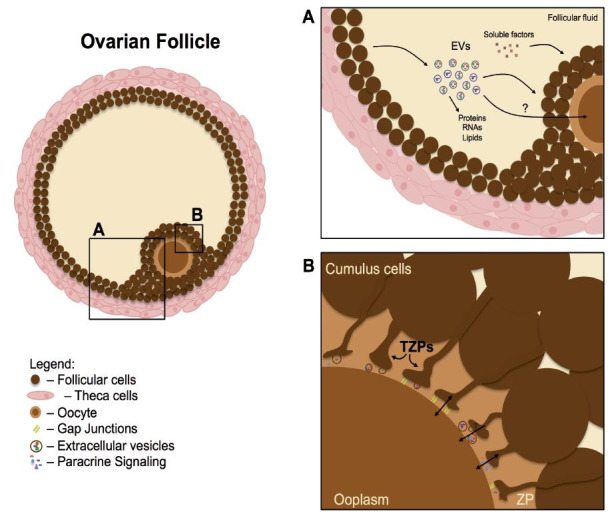
The magnitude of oocyte's role for embryo development is categorical. This unique cell contains the machineries and cellular components necessary to remodel male and female chromatin, to sustain early development and to, ultimately, generate a complete and complex individual. However, to gain these competences before fertilization, the oocyte undergoes several morphological, cellular and molecular changes during its lifetime enclosed in the ovarian follicle. This review will briefly revisit how the oocyte orchestrate the follicular cells, and how molecules transit to the oocyte from the innermost (cumulus) and outermost (antrum and granulosa cells) layers surrounding the follicle-enclosed oocyte. Finally, we will discuss the interferences of culture conditions in the communication of the oocyte with its surrounding cells and the potential strategies to modulate these communication systems to increase oocyte competence.
卵母细胞对胚胎发育的作用程度是绝对的。这个独特的细胞包含重塑雄性和雌性染色质、维持早期发育并最终生成一个完整而复杂个体所需的机制和细胞成分。然而,为了在受精前获得这些能力,卵母细胞在其位于卵巢卵泡内的生命周期中会经历几种形态、细胞和分子变化。本综述将简要回顾卵母细胞如何协调卵泡细胞,以及分子如何从围绕卵泡内卵母细胞的最内层(卵丘)和最外层(卵泡腔和颗粒细胞)层转运到卵母细胞。最后,我们将讨论培养条件对卵母细胞与其周围细胞通讯的干扰,以及调节这些通讯系统以提高卵母细胞能力的潜在策略。