Johnstone Carolina, Pérez Montse, Malca Estrella, Quintanilla José María, Gerard Trika, Lozano-Peral Diego, Alemany Francisco, Lamkin John, García Alberto, Laiz-Carrión Raúl
Centro Oceanográfico de Málaga, Instituto Español de Oceanografía, Consejo Superior de Investigaciones Científicas, Fuengirola, Málaga, Spain.
Centro Oceanográfico de Vigo, Instituto Español de Oceanografía, Consejo Superior de Investigaciones Científicas, Vigo, Pontevedra, Spain.
PeerJ. 2021 Jun 14;9:e11568. doi: 10.7717/peerj.11568. eCollection 2021.
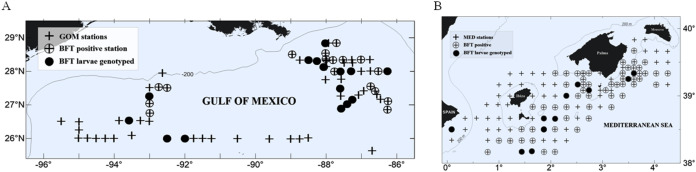
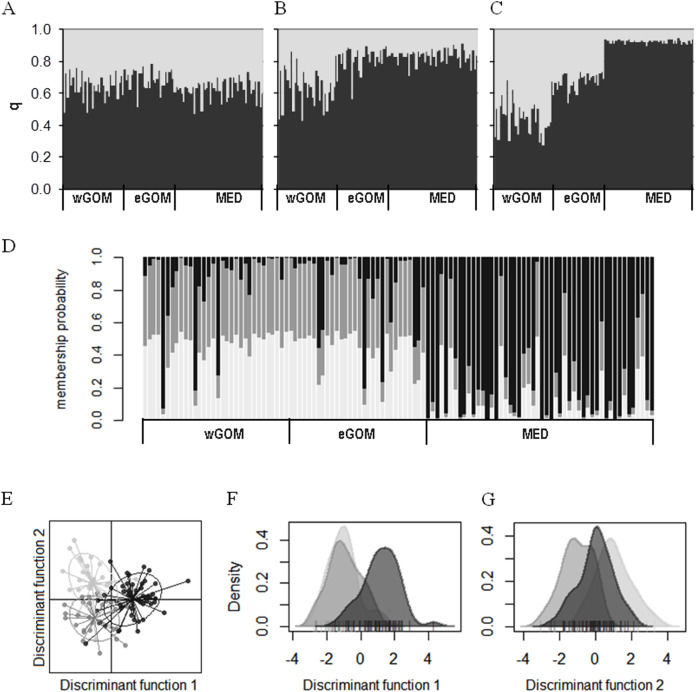
The highly migratory Atlantic bluefin tuna (ABFT) is currently managed as two distinct stocks, in accordance with natal homing behavior and population structuring despite the absence of barriers to gene flow. Larval fish are valuable biological material for tuna molecular ecology. However, they have hardly been used to decipher the ABFT population structure, although providing the genetic signal from successful breeders. For the first time, cooperative field collection of tuna larvae during 2014 in the main spawning area for each stock, the Gulf of Mexico (GOM) and the Mediterranean Sea (MED), enabled us to assess the ABFT genetic structure in a precise temporal and spatial frame exclusively through larvae. Partitioning of genetic diversity at nuclear microsatellite loci and in the mitochondrial control region in larvae spawned contemporarily resulted in low significant fixation indices supporting connectivity between spawners in the main reproduction area for each population. No structuring was detected within the GOM after segregating nuclear diversity in larvae spawned in two hydrographically distinct regions, the eastern GOM (eGOM) and the western GOM (wGOM), with the larvae from eGOM being more similar to those collected in the MED than the larvae from wGOM. We performed clustering of genetically characterized ABFT larvae through Bayesian analysis and by Discriminant Analysis of Principal Components (DAPC) supporting the existence of favorable areas for mixing of ABFT spawners from Western and Eastern stocks, leading to gene flow and apparent connectivity between weakly structured populations. Our findings suggest that the eastern GOM is more prone for the mixing of breeders from the two ABFT populations. Conservation of this valuable resource exploited for centuries calls for intensification of tuna ichthyoplankton research and standardization of genetic tools for monitoring population dynamics.
高度洄游的大西洋蓝鳍金枪鱼(ABFT)目前根据其出生地归巢行为和种群结构被管理为两个不同的种群,尽管不存在基因流动障碍。幼鱼是金枪鱼分子生态学中有价值的生物材料。然而,尽管幼鱼能提供成功繁殖者的遗传信号,但它们几乎未被用于解读ABFT的种群结构。2014年,我们首次在每个种群的主要产卵区,即墨西哥湾(GOM)和地中海(MED),合作进行了金枪鱼幼鱼的实地采集,这使我们能够仅通过幼鱼在精确的时间和空间框架内评估ABFT的遗传结构。对同期产卵的幼鱼在核微卫星位点和线粒体控制区的遗传多样性进行划分,结果显示固定指数较低且具有显著性,这支持了每个种群主要繁殖区产卵者之间的连通性。在将产于两个水文特征不同区域,即东墨西哥湾(eGOM)和西墨西哥湾(wGOM)的幼鱼的核多样性进行分离后,未在GOM内部检测到种群结构,eGOM的幼鱼与在MED采集的幼鱼比wGOM的幼鱼更相似。我们通过贝叶斯分析和主成分判别分析(DAPC)对具有遗传特征的ABFT幼鱼进行聚类,支持存在有利于西部和东部种群的ABFT产卵者混合的区域,从而导致基因流动以及结构松散的种群之间明显的连通性。我们的研究结果表明,东墨西哥湾更容易出现两个ABFT种群的繁殖者混合的情况。对这种被开发利用了几个世纪的宝贵资源进行保护,需要加强金枪鱼浮游鱼类研究,并对监测种群动态的遗传工具进行标准化。