Jusob Farad Rafique, George Carlisle, Mapp Glenford
School of Science and Technology, Middlesex University, London, UK.
Z Gesundh Wiss. 2022;30(1):37-47. doi: 10.1007/s10389-021-01608-9. Epub 2021 Jun 18.
New challenges are being faced by global healthcare systems such as an increase in the elderly population, budget cuts as well as the ongoing Covid-19 pandemic. As pressures mount on healthcare systems to provide treatment to patients, mHealth is seen as one of the possible solutions to addressing these challenges. Given the sensitivity of health data, the rapid development of the mHealth sector raises privacy concerns. The aims of this research were to investigate privacy threats/concerns in the context of mHealth and the management of chronic diseases and to propose a novel privacy framework to address these concerns.
The study adopted a modified version of the engineering design process. After defining the problem, information was gathered through literature reviews, and analyses of existing regulatory (privacy) frameworks and past research on privacy threats/concerns. Requirements for a new framework were then specified leading to its development and comparison with existing frameworks.
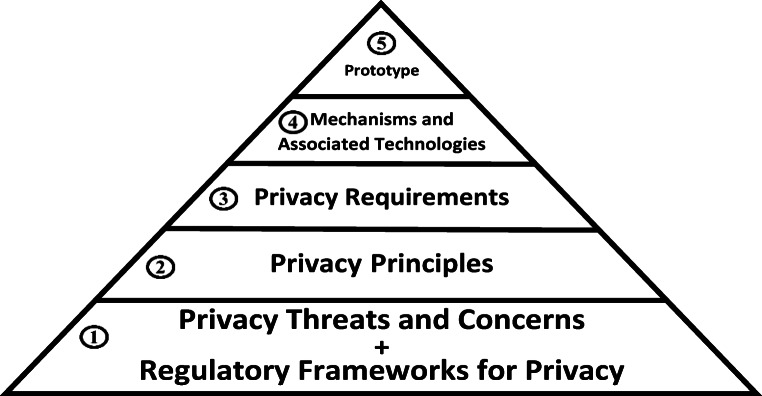
A novel future-proof privacy framework was developed and illustrated. Using existing regulatory frameworks for privacy and privacy threats/concerns from research studies, privacy principles and their resulting requirements were identified. Furthermore, mechanisms and associated technologies needed to implement the privacy principles/requirements into a functional prototype were also identified. A comparison of the proposed framework with existing frameworks, showed that it addressed privacy threats/concerns in a more comprehensive manner.
This research makes a valuable contribution to protecting privacy in mHealth. The novel framework developed is an improvement on existing frameworks. It is also future-proof since its foundations are built on regulatory frameworks and privacy threats/concerns existing at the time of its deployment/revision.
全球医疗保健系统正面临新的挑战,如老年人口增加、预算削减以及持续的新冠疫情。随着医疗保健系统为患者提供治疗的压力不断增大,移动医疗被视为应对这些挑战的可能解决方案之一。鉴于健康数据的敏感性,移动医疗行业的快速发展引发了隐私担忧。本研究的目的是调查移动医疗背景下以及慢性病管理中的隐私威胁/担忧,并提出一个新颖的隐私框架来解决这些担忧。
该研究采用了工程设计流程的修改版。在定义问题后,通过文献综述、对现有监管(隐私)框架的分析以及过去关于隐私威胁/担忧的研究来收集信息。然后确定新框架的要求,进而开发该框架并与现有框架进行比较。
开发并展示了一个新颖的面向未来的隐私框架。利用现有的隐私监管框架以及研究中的隐私威胁/担忧,确定了隐私原则及其相应要求。此外,还确定了将隐私原则/要求落实到功能原型中所需的机制和相关技术。将所提出的框架与现有框架进行比较,结果表明它能更全面地解决隐私威胁/担忧。
本研究对保护移动医疗中的隐私做出了有价值的贡献。所开发的新颖框架是对现有框架的改进。由于其基础建立在部署/修订时存在的监管框架和隐私威胁/担忧之上,它也具有前瞻性。