Department of Anesthesiology, Jingzhou Central Hospital, Jinzhou, Hubei, China.
Bioengineered. 2021 Dec;12(1):3177-3187. doi: 10.1080/21655979.2021.1946358.
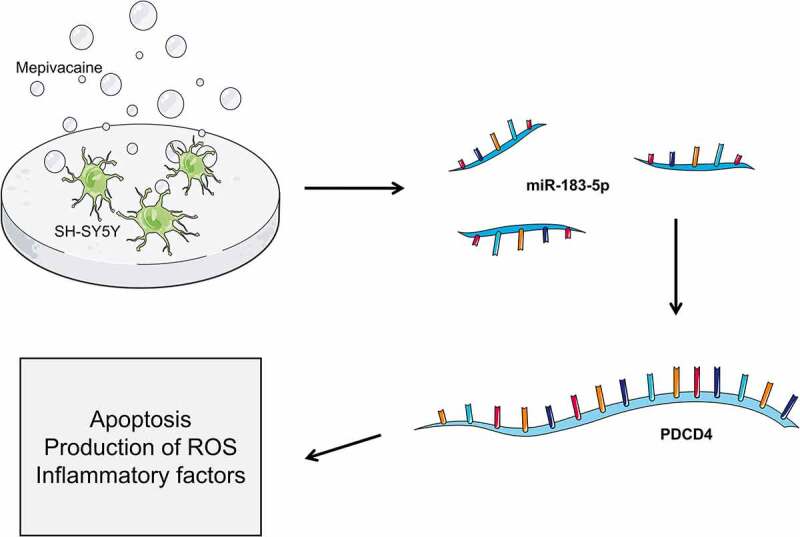
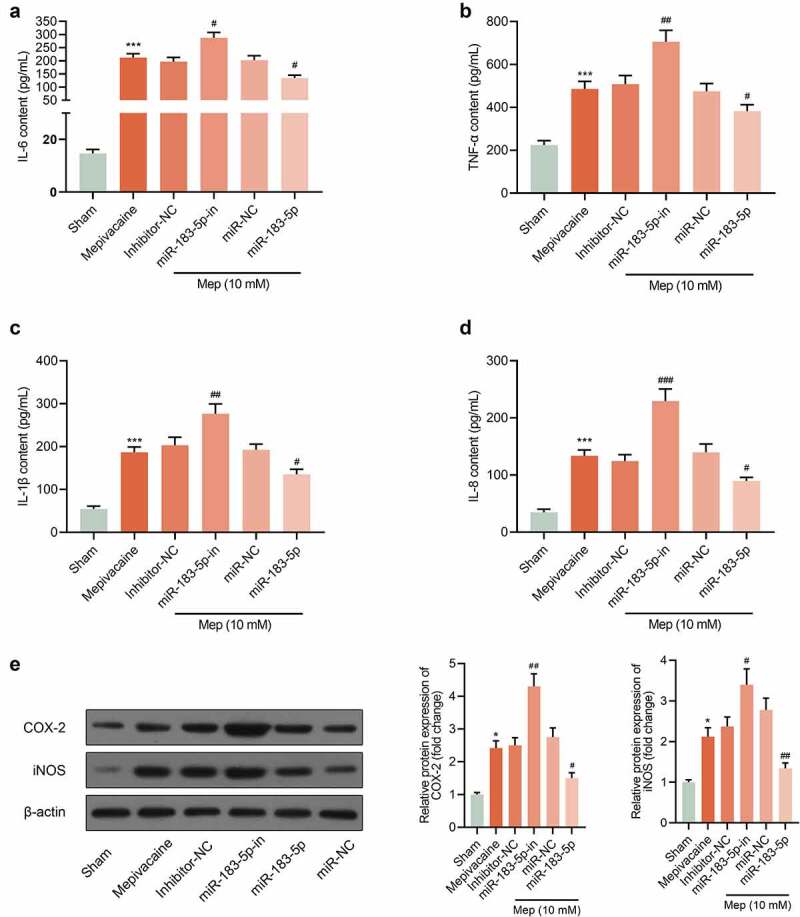
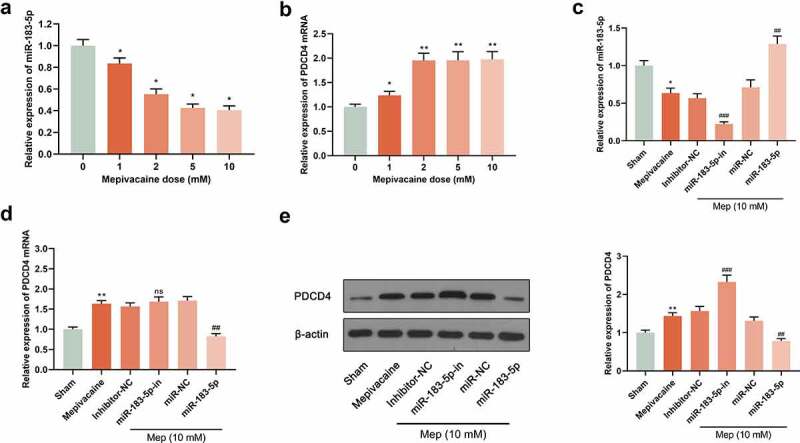
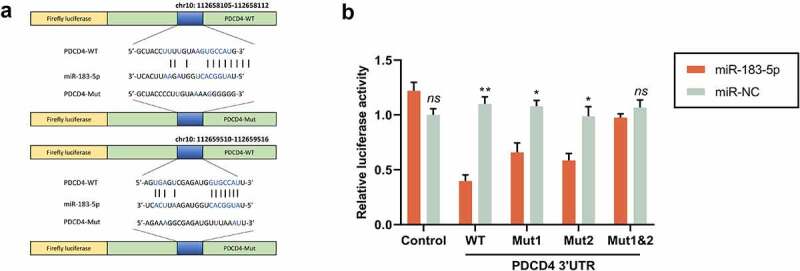
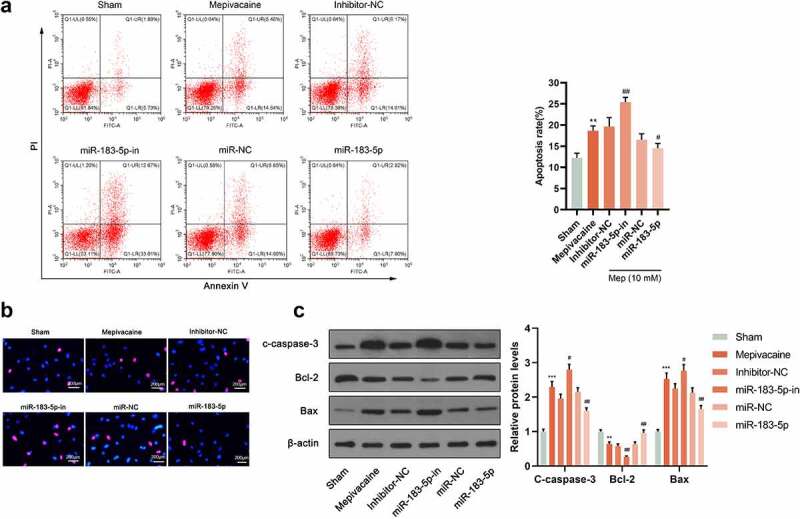
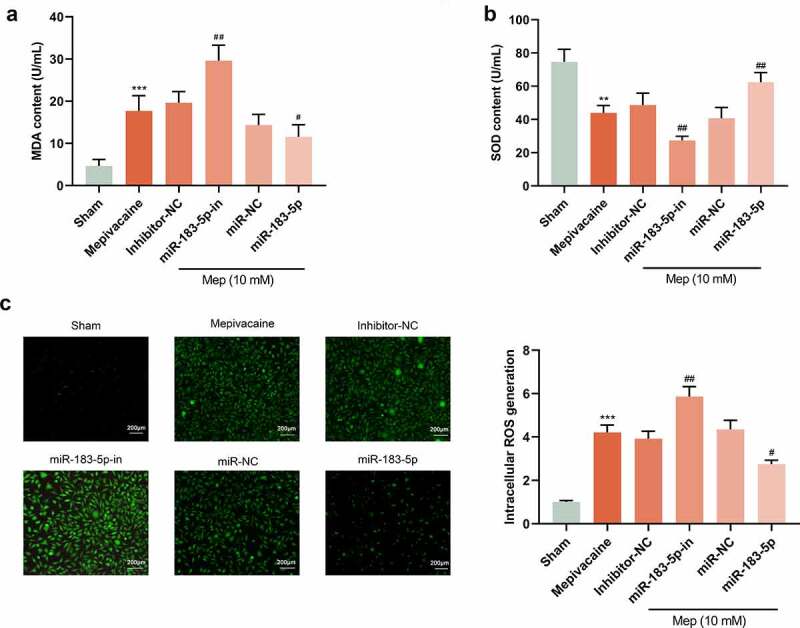
With the gradual recognition of the side effects of local anesthetics, the nerve injury caused by local anesthetics has received growing attention. This research intended to delve into miR-183-5p changes in mepivacaine-mediated SH-SY5Y cell injury, as well as its modulatory mechanism on cell apoptosis. RT-qPCR was adopted for assaying miR-183-5p and PDCD4 mRNA expression. Our team respectively transfected miR-183-5p mimic and inhibitor to enhance or inhibit miR-183-5p function. We employed Western blot for detecting PDCD4 protein levels, as well as flow cytometry and Hoechst 33342/PI double staining for determining cell apoptosis rate. Additionally, our crew applied an ELISA kit for measuring TNF-α, IL-1β, IL-6, and IL-8 contents. The level of reactive oxygen species (ROS) production was examined by the Image-iT LIVE Green ROS detection Kit. As well as dual-luciferase reporter experiment for verifying the targeting link of miR-183-5p with PDCD4. In mepivacaine-induced cell apoptosis in SH-SY5Y cells, miR-183-5p expression was down-regulated. TNF-α, IL-1β, IL-6, and IL-8 contents were elevated. The rate of apoptosis increased visibly, cleaved caspase-3 and Bax levels waxed, whereas Bcl-2 level waned. MiR-183-5p could alleviate the damaging impact of mepivacaine. Dual-luciferase reporter experiments demonstrated that miR-183-5p directly targeted PDCD4. Collectively, we concluded that a high concentration of mepivacaine can cause SH-SY5Y cell damage, miR-183-5p functions crucially in mepivacaine-mediated cell damage. This study provides a theoretical basis for elucidating the mechanism of mepivacaine-induced nerve cell damage, and overexpressed miR-183-5p likely become a novel strategy to combat mepivacaine-induced nerve damage.Abbreviations:miRNA: Micro RNA; PDCD4: Programmed Cell Death 4; MDA: Malondialdehyde; SOD: Superoxide Dismutase; ROS: Reactive Oxygen Species; WT: Wild Type; Mut: Mutant; UTR: Untranslated Region; IL-6: Interleukin-6; IL-1β: Interleukin-1β; TNF-α: Tumor Necrosis Factor-α; IL-8: Interleukin-8; COX-2: Cyclooxygenase-2; iNOS: inducible NOS; MEP: Mepivacaine.
随着人们逐渐认识到局部麻醉剂的副作用,局部麻醉剂引起的神经损伤越来越受到关注。本研究旨在探讨甲哌卡因介导的 SH-SY5Y 细胞损伤中 miR-183-5p 的变化及其对细胞凋亡的调节机制。采用 RT-qPCR 检测 miR-183-5p 和 PDCD4mRNA 的表达。我们分别转染 miR-183-5p 模拟物和抑制剂来增强或抑制 miR-183-5p 的功能。采用 Western blot 检测 PDCD4 蛋白水平,采用流式细胞术和 Hoechst33342/PI 双重染色法检测细胞凋亡率。此外,我们还使用 ELISA 试剂盒测定 TNF-α、IL-1β、IL-6 和 IL-8 的含量。采用 Image-iT LIVE Green ROS 检测试剂盒检测活性氧(ROS)的产生水平。通过双荧光素酶报告实验验证 miR-183-5p 与 PDCD4 的靶向关系。在甲哌卡因诱导的 SH-SY5Y 细胞凋亡中,miR-183-5p 的表达下调。TNF-α、IL-1β、IL-6 和 IL-8 的含量升高。细胞凋亡率明显增加,裂解的 caspase-3 和 Bax 水平增加,而 Bcl-2 水平降低。miR-183-5p 可以减轻甲哌卡因的损伤作用。双荧光素酶报告实验表明,miR-183-5p 可以直接靶向 PDCD4。综上所述,高浓度的甲哌卡因可导致 SH-SY5Y 细胞损伤,miR-183-5p 在甲哌卡因介导的细胞损伤中起关键作用。本研究为阐明甲哌卡因诱导神经细胞损伤的机制提供了理论依据,过表达 miR-183-5p 可能成为防治甲哌卡因诱导神经损伤的新策略。缩写:miRNA:微小 RNA;PDCD4:程序性细胞死亡因子 4;MDA:丙二醛;SOD:超氧化物歧化酶;ROS:活性氧;WT:野生型;Mut:突变型;UTR:非翻译区;IL-6:白细胞介素 6;IL-1β:白细胞介素 1β;TNF-α:肿瘤坏死因子-α;IL-8:白细胞介素 8;COX-2:环氧化酶 2;iNOS:诱导型一氧化氮合酶;MEP:甲哌卡因。