City of Hope Comprehensive Cancer Center, Duarte, CA.
Instituto Nacional de Ciencias Médicas y Nutrición Salvador Zubirán, Mexico City, Mexico.
JCO Glob Oncol. 2021 Jun;7:992-1002. doi: 10.1200/GO.20.00587.
Genomic cancer risk assessment (GCRA) is standard-of-care practice that uses genomic tools to identify individuals with increased cancer risk, enabling screening for early detection and cancer prevention interventions. GCRA is not available in most of Mexico, where breast cancer (BC) is the leading cause of cancer death and ovarian cancer has a high mortality rate.
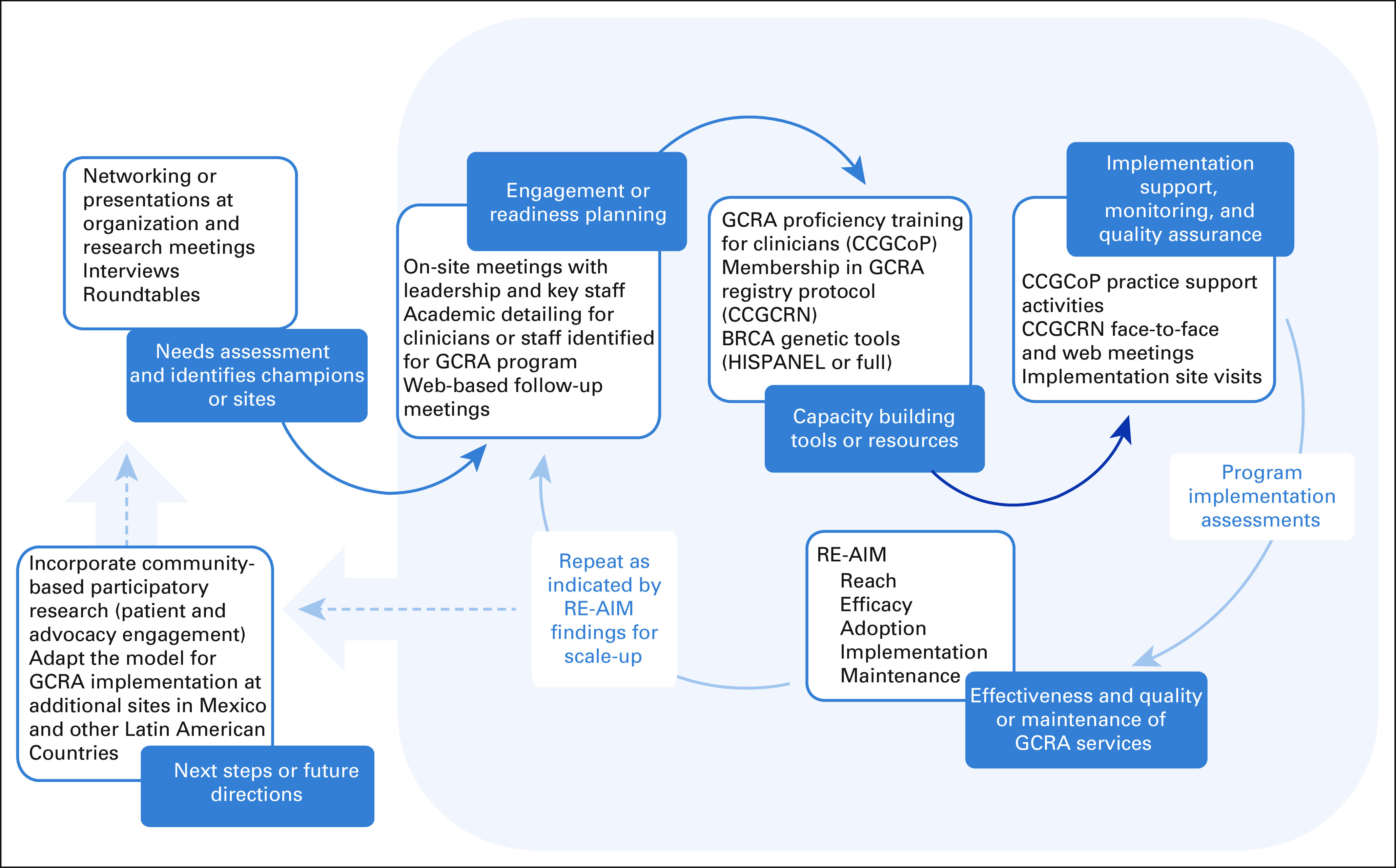
Guided by an implementation science framework, we piloted the Genomic Risk Assessment for Cancer Implementation and Sustainment (GRACIAS) intervention, combining GCRA training, practice support, and low-cost / () gene testing at four centers in Mexico. The RE-AIM model was adapted to evaluate GRACIAS intervention outcomes, including reach, the proportion of new patients meeting adapted National Comprehensive Cancer Network criteria who participated in GCRA. Barriers to GCRA were identified through roundtable sessions and semistructured interviews.
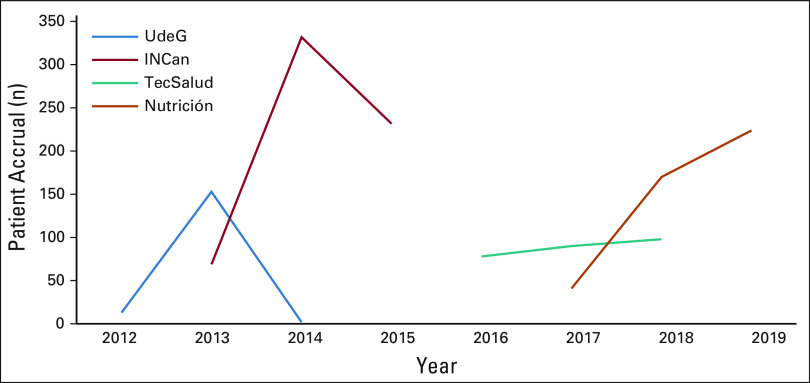
Eleven clinicians were trained across four sites. Mean pre-post knowledge score increased from 60% to 67.2% (range 53%-86%). GCRA self-efficacy scores increased by 31% (95% CI, 6.47 to 55.54; = .02). Participant feedback recommended Spanish content to improve learning. GRACIAS promoted reach at all sites: 77% in Universidad de Guadalajara, 86% in Instituto Nacional de Cancerología, 90% in Tecnológico de Monterrey, and 77% in Instituto Nacional de Ciencias Médicas y Nutrición Salvador Zubirán. Overall, a pathogenic variant was identified in 15.6% (195 of 1,253) of patients. All trainees continue to provide GCRA and address barriers to care.
We describe the first project to use implementation science methods to develop and deliver an innovative multicomponent implementation intervention, combining low-cost testing, comprehensive GCRA training, and practice support in Mexico. Scale-up of the GRACIAS intervention will promote risk-appropriate care, cancer prevention, and reduction in related mortality.
基因组癌症风险评估(GCRA)是一种标准的护理实践,它使用基因组工具来识别癌症风险增加的个体,从而能够进行早期检测和癌症预防干预。在墨西哥,GCRA 无法普及,因为乳腺癌(BC)是癌症死亡的主要原因,而卵巢癌的死亡率很高。
我们在实施科学框架的指导下,在墨西哥的四个中心试点了基因组癌症风险评估的实施和维持(GRACIAS)干预措施,该措施结合了 GCRA 培训、实践支持和低成本/()基因检测。适应性综合癌症网络(NCCN)标准的新患者参与 GCRA 的比例。通过圆桌会议和半结构化访谈确定了 GCRA 的障碍。
在四个地点培训了 11 名临床医生。平均知识得分从 60%增加到 67.2%(范围为 53%-86%)。GCRA 自我效能得分增加了 31%(95%CI,6.47 至 55.54; =.02)。参与者反馈建议增加西班牙语内容以提高学习效果。GRACIAS 在所有站点都提高了覆盖率:瓜达拉哈拉大学为 77%,国家癌症研究所为 86%,蒙特雷技术学院为 90%,国家医学和营养研究所萨尔瓦多·祖比兰为 77%。总体而言,在 1253 名患者中,有 15.6%(195 名)发现了致病性变异。所有受训者继续提供 GCRA 并解决护理障碍。
我们描述了第一个使用实施科学方法在墨西哥开发和提供创新的多组分实施干预措施的项目,该措施结合了低成本测试、全面的 GCRA 培训和实践支持。GRACIAS 干预措施的扩大将促进适当的风险护理、癌症预防和相关死亡率的降低。