Dutil Julie, Golubeva Volha A, Pacheco-Torres Alba L, Diaz-Zabala Hector J, Matta Jaime L, Monteiro Alvaro N
Ponce Research Institute, Ponce Health Sciences University, Ponce, PR, USA.
Cancer Epidemiology Program, H. Lee Moffitt Cancer Center and Research Institute, Tampa, FL, USA.
Breast Cancer Res Treat. 2015 Dec;154(3):441-53. doi: 10.1007/s10549-015-3629-3. Epub 2015 Nov 12.
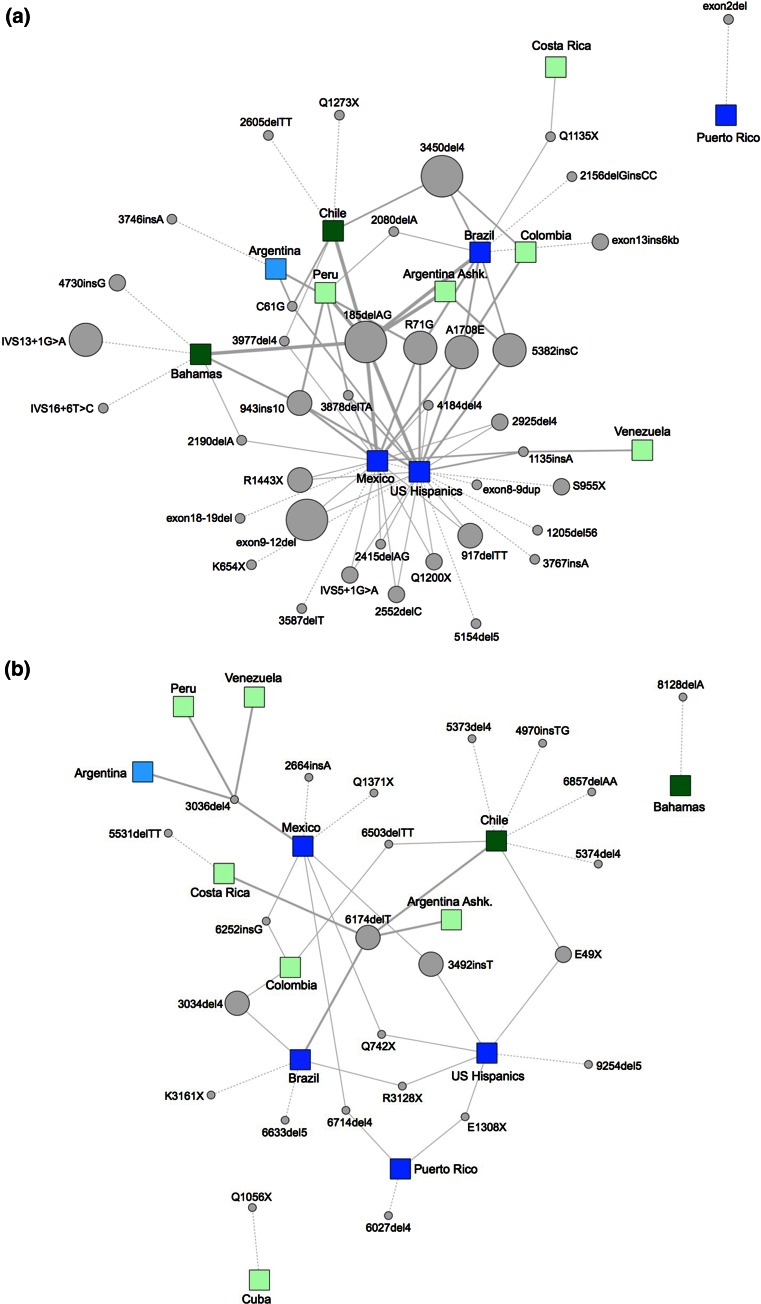
Hereditary cancer predisposition gene testing allows the identification of individuals at high risk of cancer that may benefit from increased surveillance, chemoprevention, and prophylactic surgery. In order to implement clinical genetic strategies adapted to each population's needs and intrinsic genetic characteristic, this review aims to present the current status of knowledge about the spectrum of BRCA pathogenic variants in Latin American populations. We have conducted a comprehensive review of 33 studies published between 1994 and 2015 reporting the prevalence and/or spectrum of BRCA1 (OMIM 113705) and BRCA2 (OMIM 600185) variants. The combined sample size for these studies consisted of 4835 individuals from 13 countries in Latin America and the Caribbean, as well as in Hispanics in the United States. A total of 167 unique pathogenic variants have been reported in the existing literature. In unselected breast cancer cases, the prevalence ranged from 1.2 to 27.1%. Some countries presented a few recurrent pathogenic variants, while others were characterized by diverse, non-recurrent variants. The proportion of BRCA pathogenic variants shared between Hispanics in the United States and Latin American populations was estimated at 10.4%. Within Latin America and the Caribbean, 8.2% of the BRCA variants reported were present in more than one country. Countries with high prevalence of BRCA pathogenic variants may benefit from more aggressive testing strategies, while testing of recurrent variant panels might present a cost-effective solution for improving genetic testing in some, but not all, countries.
遗传性癌症易感性基因检测能够识别出患癌风险较高的个体,这些个体可能会从加强监测、化学预防和预防性手术中获益。为了实施适应各人群需求和内在遗传特征的临床遗传策略,本综述旨在介绍拉丁美洲人群中BRCA致病变异谱的现有知识状况。我们对1994年至2015年间发表的33项研究进行了全面综述,这些研究报告了BRCA1(OMIM 113705)和BRCA2(OMIM 600185)变异的患病率和/或变异谱。这些研究的合并样本量包括来自拉丁美洲和加勒比地区13个国家的4835名个体,以及美国的西班牙裔个体。现有文献中共报告了167种独特的致病变异。在未经选择的乳腺癌病例中,患病率在1.2%至27.1%之间。一些国家出现了一些反复出现的致病变异,而其他国家的特点是变异多样、不反复出现。据估计,美国西班牙裔和拉丁美洲人群中共享的BRCA致病变异比例为10.4%。在拉丁美洲和加勒比地区,报告的BRCA变异中有8.2%在不止一个国家出现。BRCA致病变异患病率高的国家可能会从更积极的检测策略中获益,而检测反复出现的变异组可能是一种具有成本效益的解决方案,可在一些(但不是所有)国家改善基因检测。