The National Institute for Health Research and Applied Research Collaboration West (NIHR ARC West), University Hospitals Bristol and Weston NHS Foundation Trust, 9th Floor, Whitefriars, Lewins Mead, Bristol, BS1 2NT, UK.
Population Health Sciences, Bristol Medical School, University of Bristol, Canynge Hall, 58 Whiteladies Rd, Bristol, BS8 2PL, UK.
BMC Health Serv Res. 2021 Jun 29;21(1):613. doi: 10.1186/s12913-021-06634-7.
Hospital admissions for Ambulatory Care Sensitive Conditions (ACSCs) are potentially avoidable. Dementia is one of the leading chronic conditions in terms of variability in ACSC admissions by general practice, as well as accounting for around a third of UK emergency admissions.
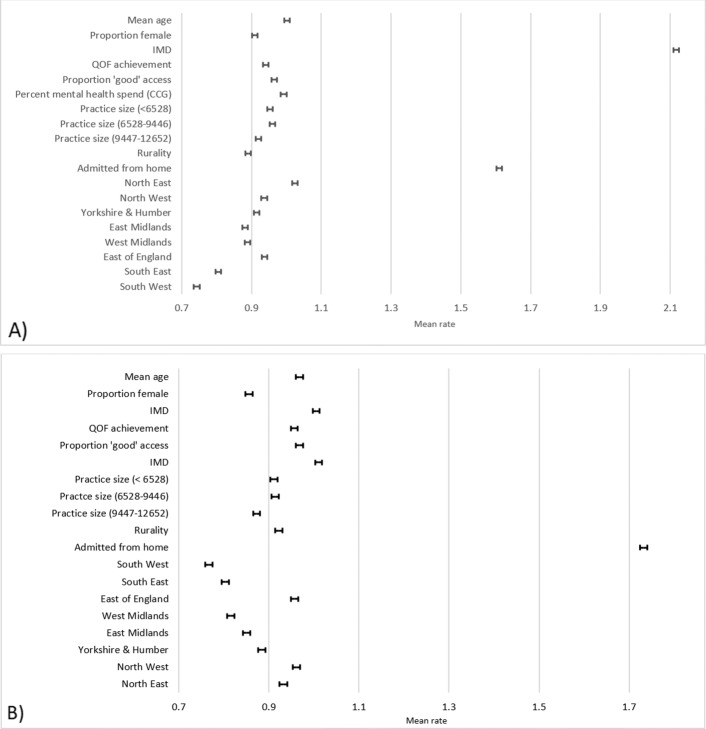
Using Bayesian multilevel linear regression models, we examined the ecological association of organizational characteristics of general practices (ACSC n=7076, non-ACSC n=7046 units) and Clinical Commissioning Groups (CCG n=212 units) in relation to ACSC and non-ACSC admissions for people with dementia in England.
The rate of hospital admissions are variable between GP practices, with deprivation and being admitted from home as risk factors for admission for ACSC and non-ACSC admissions. The budget allocated by the CCG to mental health shows diverging effects for ACSC versus non-ACSC admissions, so it is likely there is some geographic variation.
A variety of factors that could explain avoidable admissions for PWD at the practice level were examined; most were equally predictive for avoidable and non-avoidable admissions. However, a high amount of variation found at the practice level, in conjunction with the diverging effects of the CCG mental health budget, implies that guidance may be applied inconsistently, or local services may have differences in referral criteria. This indicates there is potential scope for improvement.
门诊医疗敏感条件 (ACSCs) 的住院治疗是可以避免的。痴呆症是普通医疗实践中 ACSC 住院治疗差异最大的主要慢性疾病之一,约占英国急诊入院人数的三分之一。
我们使用贝叶斯多层次线性回归模型,研究了英格兰普通医疗实践(ACSC=7076 例,非 ACSC=7046 例)和临床委托组(CCG=212 例)的组织特征与痴呆患者 ACSC 和非 ACSC 入院之间的生态关联。
各全科医生实践之间的住院率存在差异,贫困和从家中入院是 ACSC 和非 ACSC 入院的风险因素。CCG 分配给精神健康的预算对 ACSC 与非 ACSC 入院有不同的影响,因此可能存在一些地域差异。
研究了可能解释 PWD 在实践层面可避免入院的各种因素;大多数因素对可避免和不可避免的入院同样具有预测性。然而,在实践层面发现了大量的变异,加上 CCG 精神健康预算的不同影响,这表明指导可能不一致实施,或者当地服务可能在转诊标准上存在差异。这表明有潜力进行改进。