Division of Psychiatry, University College London, 6th Floor, Maple House, 149 Tottenham Court Road, London, W1T 7NF, UK.
Camden and Islington NHS Foundation Trust, 4 St Pancras Way, London, NW1 0PE, UK.
BMC Med. 2019 Jul 15;17(1):130. doi: 10.1186/s12916-019-1369-7.
Hospitalisation is often harmful for people with dementia and results in high societal costs, so avoidance of unnecessary admissions is a global priority. However, no intervention has yet reduced admissions of community-dwelling people with dementia. We therefore aimed to examine hospitalisation rates of people with dementia and whether these differ from people without dementia and to identify socio-demographic and clinical predictors of hospitalisation.
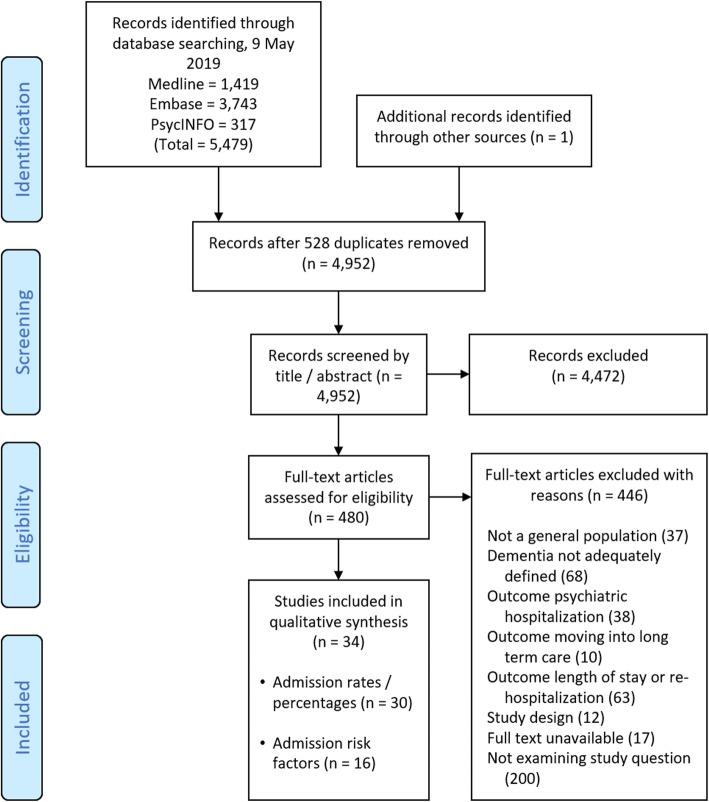
We searched MEDLINE, Embase, and PsycINFO from inception to 9 May 2019. We included observational studies which (1) examined community-dwelling people with dementia of any age or dementia subtype, (2) diagnosed dementia using validated diagnostic criteria, and (3) examined all-cause general (i.e. non-psychiatric) hospital admissions. Two authors screened abstracts for inclusion and independently extracted data and assessed included studies for risk of bias. Three authors graded evidence strength using Cochrane's GRADE approach, including assessing for evidence of publication bias using Begg's test. We used random effects meta-analysis to pool estimates for hospitalisation risk in people with and without dementia.
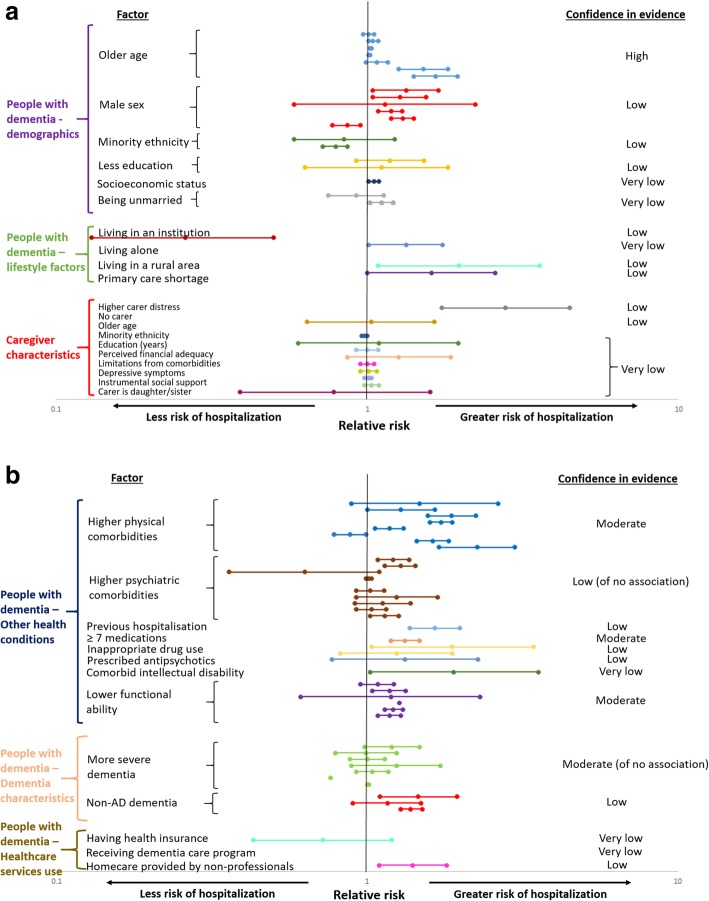
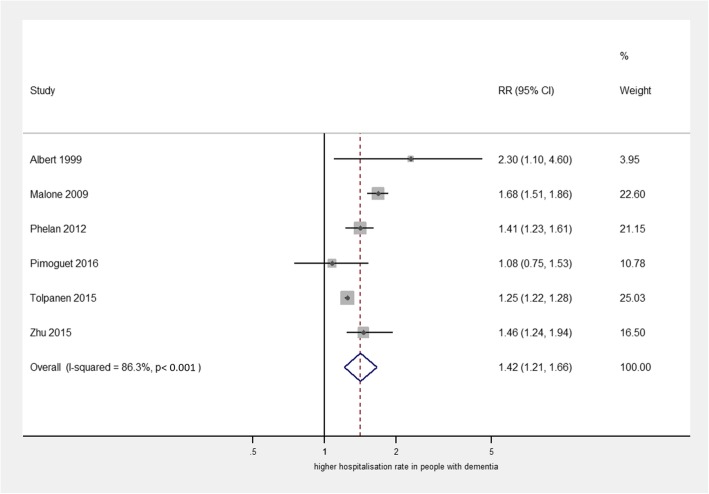
We included 34 studies of 277,432 people with dementia: 17 from the USA, 15 from Europe, and 2 from Asia. The pooled relative risk of hospitalisation for people with dementia compared to those without was 1.42 (95% confidence interval 1.21, 1.66) in studies adjusted for age, sex, and physical comorbidity. Hospitalisation rates in people with dementia were between 0.37 and 1.26/person-year in high-quality studies. There was strong evidence that admission is associated with older age, and moderately strong evidence that multimorbidity, polypharmacy, and lower functional ability are associated with admission. There was strong evidence that dementia severity alone is not associated.
People with dementia are more frequently admitted to hospital than those without dementia, independent of physical comorbidities. Future interventions to reduce unnecessary hospitalisations should target potentially modifiable factors, such as polypharmacy and functional ability, in high-risk populations.
住院治疗对痴呆症患者往往有害,并导致高昂的社会成本,因此避免不必要的住院治疗是全球的重点。然而,目前还没有任何干预措施能够减少社区居住的痴呆症患者的住院率。因此,我们旨在研究痴呆症患者的住院率,以及这些患者与非痴呆症患者的住院率是否存在差异,并确定导致住院的社会人口学和临床预测因素。
我们从建库起至 2019 年 5 月 9 日检索了 MEDLINE、Embase 和 PsycINFO。我们纳入了以下研究:(1)研究任何年龄或痴呆亚型的社区居住的痴呆症患者;(2)使用经过验证的诊断标准诊断痴呆症;(3)研究所有原因的普通(即非精神科)住院入院情况。两名作者筛选摘要以确定纳入标准,并独立提取数据并评估纳入研究的偏倚风险。三名作者使用 Cochrane 的 GRADE 方法评估证据强度,包括使用 Begg 检验评估发表偏倚的证据。我们使用随机效应荟萃分析来汇总痴呆症患者和非痴呆症患者的住院风险估计值。
我们纳入了 34 项研究,共涉及 277432 名痴呆症患者:17 项来自美国,15 项来自欧洲,2 项来自亚洲。在调整了年龄、性别和身体合并症后,与非痴呆症患者相比,痴呆症患者的住院相对风险为 1.42(95%置信区间 1.21,1.66)。在高质量研究中,痴呆症患者的住院率在 0.37 至 1.26/人年之间。有强有力的证据表明,入院与年龄较大有关,且有中度强有力的证据表明,多种合并症、多种药物治疗和较低的功能能力与入院有关。有强有力的证据表明,痴呆症严重程度本身与入院无关。
痴呆症患者的住院率高于非痴呆症患者,且与身体合并症无关。未来减少不必要住院治疗的干预措施应针对高危人群中潜在可改变的因素,如多种药物治疗和功能能力。