• 文献检索
  • 文档翻译
  • 深度研究
  • 学术资讯
  • Suppr Zotero 插件Zotero 插件
  • 邀请有礼
  • 套餐&价格
  • 历史记录
应用&插件
Suppr Zotero 插件Zotero 插件浏览器插件Mac 客户端Windows 客户端微信小程序
定价
高级版会员购买积分包购买API积分包
服务
文献检索文档翻译深度研究API 文档MCP 服务
关于我们
关于 Suppr公司介绍联系我们用户协议隐私条款
关注我们

Suppr 超能文献

核心技术专利:CN118964589B侵权必究
粤ICP备2023148730 号-1Suppr @ 2026

文献检索

告别复杂PubMed语法,用中文像聊天一样搜索,搜遍4000万医学文献。AI智能推荐,让科研检索更轻松。

立即免费搜索

文件翻译

保留排版,准确专业,支持PDF/Word/PPT等文件格式,支持 12+语言互译。

免费翻译文档

深度研究

AI帮你快速写综述,25分钟生成高质量综述,智能提取关键信息,辅助科研写作。

立即免费体验

经导管主动脉瓣置换术(TAVR)与癌症:超过3000万患者的机器学习增强倾向评分死亡率及成本分析

TAVR and cancer: machine learning-augmented propensity score mortality and cost analysis in over 30 million patients.

作者信息

Monlezun Dominique J, Hostetter Logan, Balan Prakash, Palaskas Nicolas, Lopez-Mattei Juan, Cilingiroglu Mehmet, Iakobishvili Zaza, Ewer Michael, Marmagkiolis Konstantinos, Iliescu Cezar

机构信息

Department of Cardiology, The University of Texas M.D. Anderson Cancer Center, 1400 Pressler Street, Unit 1451, Houston, TX, 77030, USA.

Global System Analytics & Structures, New Orleans, USA.

出版信息

Cardiooncology. 2021 Jun 28;7(1):25. doi: 10.1186/s40959-021-00111-0.

DOI:10.1186/s40959-021-00111-0
PMID:34183072
原文链接:https://pmc.ncbi.nlm.nih.gov/articles/PMC8237429/
Abstract

INTRODUCTION

Cardiovascular disease (CVD) and cancer are the top mortality causes globally, yet little is known about how the diagnosis of cancer affects treatment options in patients with hemodynamically compromising aortic stenosis (AS). Patients with cancer often are excluded from aortic valve replacement (AVR) trials including trials with transcatheter AVR (TAVR) and surgical AVR (SAVR). This study looks at how cancer may influence treatment options and assesses the outcome of patients with cancer who undergo SAVR or TAVR intervention. Additionally, we sought to quantitate and compare both clinical and cost outcomes for patients with and without cancer.

METHODS

This population-based case-control study uses the most recent year available National Inpatient Sample (NIS (2016) from the United States Department of Health and Human Services' Agency for Healthcare Research and Quality (AHRQ). Machine learning augmented propensity score adjusted multivariable regression was conducted based on the likelihood of undergoing TAVR versus medical management (MM) and TAVR versus SAVR with model optimization supported by backward propagation neural network machine learning.

RESULTS

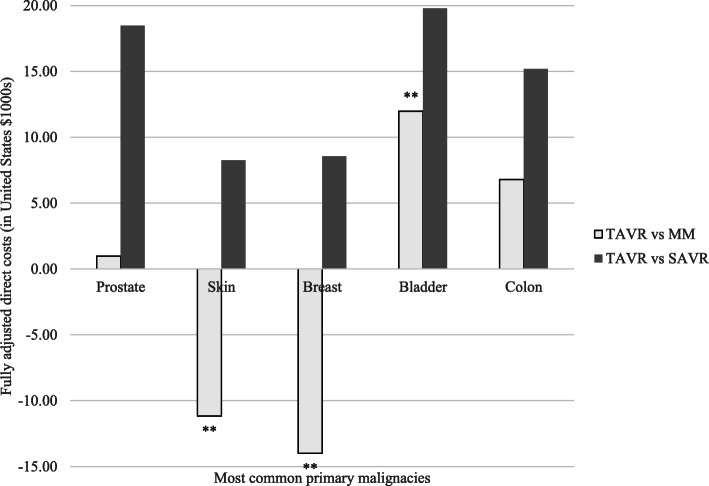
Of the 30,195,722 total hospital admissions, 39,254 (0.13%) TAVRs were performed, with significantly fewer performed in patients with versus without cancer even in those of comparable age and mortality risk (23.82% versus 76.18%, p < 0.001) despite having similar hospital and procedural mortality. Multivariable regression in patients with cancer demonstrated that mortality was similar for TAVR, MM, and SAVR, though LOS and cost was significantly lower for TAVR versus MM and comparable for TAVR versus SAVR. Patients with prostate cancer constituted the largest primary cancer among TAVR patients including those with metastatic disease. There were no significant race or geographic disparities for TAVR mortality.

DISCUSSION

Comparison of aortic valve intervention in patients with and without cancer suggests that interventions are underutilized in the cancer population. This study suggests that patients with cancer including those with metastasis have similar inpatient outcomes to patients without cancer. Further, patients who have symptomatic AS and those with higher risk aortic valve disease should be offered the benefit of intervention. Modern techniques have reduced intervention-related adverse events, provided improved quality of life, and appear to be cost effective; these advantages should not necessarily be denied to patients with co-existing cancer.

摘要

引言

心血管疾病(CVD)和癌症是全球主要的死亡原因,但对于癌症诊断如何影响血流动力学不稳定的主动脉瓣狭窄(AS)患者的治疗选择,人们知之甚少。癌症患者通常被排除在主动脉瓣置换(AVR)试验之外,包括经导管主动脉瓣置换术(TAVR)和外科主动脉瓣置换术(SAVR)试验。本研究旨在探讨癌症如何影响治疗选择,并评估接受SAVR或TAVR干预的癌症患者的预后。此外,我们试图对有癌症和无癌症患者的临床和成本结果进行量化和比较。

方法

这项基于人群的病例对照研究使用了美国卫生与公众服务部医疗保健研究与质量局(AHRQ)提供的最新年份(2016年)全国住院样本(NIS)。基于接受TAVR与药物治疗(MM)以及TAVR与SAVR的可能性,进行了机器学习增强倾向评分调整的多变量回归,并通过反向传播神经网络机器学习进行模型优化。

结果

在30,195,722例住院患者中,共进行了39,254例(0.13%)TAVR手术,即使在年龄和死亡风险相当的患者中,有癌症患者接受TAVR手术的比例也显著低于无癌症患者(23.82%对76.18%,p < 0.001),尽管两者的住院和手术死亡率相似。对癌症患者进行的多变量回归分析表明,TAVR、MM和SAVR的死亡率相似,但TAVR组的住院时间和成本显著低于MM组,与SAVR组相当。前列腺癌患者是接受TAVR手术患者中最主要的原发癌症类型,包括那些有转移疾病的患者。TAVR死亡率在种族或地域方面没有显著差异。

讨论

对有癌症和无癌症患者的主动脉瓣干预进行比较表明,癌症患者中干预措施的使用不足。本研究表明,包括有转移的癌症患者在内,癌症患者的住院结局与无癌症患者相似。此外,有症状的AS患者和主动脉瓣疾病风险较高的患者应能从干预中获益。现代技术减少了与干预相关的不良事件,提高了生活质量,且似乎具有成本效益;这些优势不一定应被患有并存癌症的患者所剥夺。
https://cdn.ncbi.nlm.nih.gov/pmc/blobs/a2b3/8237429/8f674a8e21f5/40959_2021_111_Fig1_HTML.jpg

相似文献

1
TAVR and cancer: machine learning-augmented propensity score mortality and cost analysis in over 30 million patients.经导管主动脉瓣置换术(TAVR)与癌症:超过3000万患者的机器学习增强倾向评分死亡率及成本分析
Cardiooncology. 2021 Jun 28;7(1):25. doi: 10.1186/s40959-021-00111-0.
2
In-hospital outcomes of transcatheter versus surgical aortic valve replacement in end stage renal disease.终末期肾病患者行经导管主动脉瓣置换术与外科主动脉瓣置换术的院内转归比较。
Catheter Cardiovasc Interv. 2018 Oct 1;92(4):757-765. doi: 10.1002/ccd.27433. Epub 2017 Nov 24.
3
Cost and contribution margin of transcatheter versus surgical aortic valve replacement.经导管主动脉瓣置换术与外科主动脉瓣置换术的成本与边际贡献。
J Thorac Cardiovasc Surg. 2017 Dec;154(6):1872-1880.e1. doi: 10.1016/j.jtcvs.2017.06.020. Epub 2017 Jun 21.
4
Length of Stay and Discharge Disposition After Transcatheter Versus Surgical Aortic Valve Replacement in the United States.美国经导管主动脉瓣置换术与外科主动脉瓣置换术后的住院时间和出院去向。
Circ Cardiovasc Interv. 2018 Sep;11(9):e006929. doi: 10.1161/CIRCINTERVENTIONS.118.006929.
5
Conventional surgery, sutureless valves, and transapical aortic valve replacement: what is the best option for patients with aortic valve stenosis? A multicenter, propensity-matched analysis.传统手术、无缝合瓣膜和经心尖主动脉瓣置换术:对于主动脉瓣狭窄患者,哪种方法最佳?一项多中心、倾向评分匹配分析。
J Thorac Cardiovasc Surg. 2013 Nov;146(5):1065-70; discussion 1070-1. doi: 10.1016/j.jtcvs.2013.06.047. Epub 2013 Sep 8.
6
The impact of mitral stenosis on outcomes of aortic valve stenosis patient undergoing surgical aortic valve replacement or transcatheter aortic valve replacement.二尖瓣狭窄对接受外科主动脉瓣置换术或经导管主动脉瓣置换术的主动脉瓣狭窄患者预后的影响。
J Interv Cardiol. 2018 Oct;31(5):655-660. doi: 10.1111/joic.12519. Epub 2018 May 17.
7
Association of Hospital Surgical Aortic Valve Replacement Quality With 30-Day and 1-Year Mortality After Transcatheter Aortic Valve Replacement.医院外科主动脉瓣置换质量与经导管主动脉瓣置换后 30 天和 1 年死亡率的关系。
JAMA Cardiol. 2019 Jan 1;4(1):16-22. doi: 10.1001/jamacardio.2018.4051.
8
Cost-Effectiveness of Transcatheter Versus Surgical Aortic Valve Replacement in Patients With Severe Aortic Stenosis at Intermediate Risk.经导管主动脉瓣置换术与外科主动脉瓣置换术治疗中危重度主动脉瓣狭窄患者的成本效果分析。
Circulation. 2019 Feb 12;139(7):877-888. doi: 10.1161/CIRCULATIONAHA.118.035236.
9
Hospital outcomes of transcatheter versus surgical aortic valve replacement in female in the United States.美国女性经导管主动脉瓣置换术与外科主动脉瓣置换术的医院治疗结果
Catheter Cardiovasc Interv. 2018 Mar 1;91(4):813-819. doi: 10.1002/ccd.27362. Epub 2017 Oct 9.
10
Contemporary Trends and Outcomes of Percutaneous and Surgical Aortic Valve Replacement in Patients With Cancer.癌症患者行经皮和外科主动脉瓣置换术的当代趋势和结局。
J Am Heart Assoc. 2020 Jan 21;9(2):e014248. doi: 10.1161/JAHA.119.014248.

引用本文的文献

1
Transcatheter Aortic Valve Replacement (TAVR) Versus Surgical Aortic Valve Replacement (SAVR): A Review on the Length of Stay, Cost, Comorbidities, and Procedural Complications.经导管主动脉瓣置换术(TAVR)与外科主动脉瓣置换术(SAVR):关于住院时间、费用、合并症及手术并发症的综述
Cureus. 2024 Feb 19;16(2):e54435. doi: 10.7759/cureus.54435. eCollection 2024 Feb.
2
Artificial intelligence-augmented analysis of contemporary procedural, mortality, and cost trends in carcinoid heart disease in a large national cohort with a focus on the "forgotten pulmonic valve".在一个大型全国队列中,利用人工智能增强对类癌性心脏病当代手术、死亡率和成本趋势的分析,重点关注“被遗忘的肺动脉瓣”。
Front Cardiovasc Med. 2023 Feb 8;9:1071138. doi: 10.3389/fcvm.2022.1071138. eCollection 2022.
3

本文引用的文献

1
Anastomotic Leak is Increased With Infection After Colectomy: Machine Learning-Augmented Propensity Score Modified Analysis of 46 735 Patients.吻合口漏在结肠切除术后感染时增加:机器学习增强的倾向评分修正分析 46735 例患者。
Am Surg. 2022 Jan;88(1):74-82. doi: 10.1177/0003134820973720. Epub 2020 Dec 24.
2
Transcatheter aortic valve replacement in patients with severe aortic stenosis and active cancer: a systematic review and meta-analysis.严重主动脉瓣狭窄合并活动性癌症患者的经导管主动脉瓣置换术:一项系统评价和荟萃分析。
Open Heart. 2020 Mar 11;7(1):e001131. doi: 10.1136/openhrt-2019-001131. eCollection 2020.
3
Mortality Due to Aortic Stenosis in the United States, 2008-2017.
Artificial Intelligence-Augmented Propensity Score, Cost Effectiveness and Computational Ethical Analysis of Cardiac Arrest and Active Cancer with Novel Mortality Predictive Score.人工智能增强的心脏骤停和活动性癌症的倾向评分、成本效益和计算伦理分析,以及新型死亡率预测评分。
Medicina (Kaunas). 2022 Aug 3;58(8):1039. doi: 10.3390/medicina58081039.
4
Fractional Flow Reserve Cardio-Oncology Effects on Inpatient Mortality, Length of Stay, and Cost Based on Malignancy Type: Machine Learning Supported Nationally Representative Case-Control Study of 30 Million Hospitalizations.基于恶性肿瘤类型的机器学习支持的全国代表性 3000 万例住院病例对照研究:分数流量储备心血管肿瘤学对住院患者死亡率、住院时间和成本的影响。
Medicina (Kaunas). 2022 Jun 28;58(7):859. doi: 10.3390/medicina58070859.
5
Machine Learning in Causal Inference: Application in Pharmacovigilance.机器学习在因果推断中的应用:在药物警戒中的应用。
Drug Saf. 2022 May;45(5):459-476. doi: 10.1007/s40264-022-01155-6. Epub 2022 May 17.
6
2021. The year in review. Structural heart interventions.2021 年回顾。结构性心脏病介入治疗。
Int J Cardiol. 2022 Jul 15;359:99-104. doi: 10.1016/j.ijcard.2022.04.023. Epub 2022 Apr 12.
2008-2017 年美国主动脉瓣狭窄导致的死亡率。
JAMA. 2019 Jun 11;321(22):2236-2238. doi: 10.1001/jama.2019.6292.
4
Transcatheter Aortic-Valve Replacement with a Balloon-Expandable Valve in Low-Risk Patients.经皮球囊扩张式主动脉瓣置换术治疗低危患者。
N Engl J Med. 2019 May 2;380(18):1695-1705. doi: 10.1056/NEJMoa1814052. Epub 2019 Mar 16.
5
Transcatheter Aortic-Valve Replacement with a Self-Expanding Valve in Low-Risk Patients.经导管主动脉瓣置换术治疗低危患者的自膨式瓣膜。
N Engl J Med. 2019 May 2;380(18):1706-1715. doi: 10.1056/NEJMoa1816885. Epub 2019 Mar 16.
6
Transcatheter Aortic Valve Replacement in Oncology Patients With Severe Aortic Stenosis.经导管主动脉瓣置换术治疗严重主动脉瓣狭窄的肿瘤患者。
JACC Cardiovasc Interv. 2019 Jan 14;12(1):78-86. doi: 10.1016/j.jcin.2018.10.026.
7
A Cancer Paradox: Machine-Learning Backed Propensity-Score Analysis of Coronary Angiography Findings in Cardio-Oncology.癌症悖论:基于机器学习的心脏肿瘤学中冠状动脉造影结果倾向评分分析
J Invasive Cardiol. 2019 Jan;31(1):21-26. doi: 10.25270/jic/18.00215.
8
An update on the management and outcomes of cancer patients with severe aortic stenosis.癌症合并严重主动脉瓣狭窄患者的管理和结局更新。
Catheter Cardiovasc Interv. 2019 Sep 1;94(3):438-445. doi: 10.1002/ccd.28052. Epub 2018 Dec 14.
9
Machine Learning-Augmented Propensity Score-Adjusted Multilevel Mixed Effects Panel Analysis of Hands-On Cooking and Nutrition Education versus Traditional Curriculum for Medical Students as Preventive Cardiology: Multisite Cohort Study of 3,248 Trainees over 5 Years.基于机器学习的倾向评分调整多层次混合效应面板分析:医学生实践烹饪与营养教育与传统课程在预防心脏病学中的效果——5 年 3248 名学员的多站点队列研究。
Biomed Res Int. 2018 Apr 15;2018:5051289. doi: 10.1155/2018/5051289. eCollection 2018.
10
The impact of mitral stenosis on outcomes of aortic valve stenosis patient undergoing surgical aortic valve replacement or transcatheter aortic valve replacement.二尖瓣狭窄对接受外科主动脉瓣置换术或经导管主动脉瓣置换术的主动脉瓣狭窄患者预后的影响。
J Interv Cardiol. 2018 Oct;31(5):655-660. doi: 10.1111/joic.12519. Epub 2018 May 17.