Plata-Martinez R, Ide S, Shinohara M, Garcia E S, Mizuno N, Dominguez L A, Taira T, Yamashita Y, Toh A, Yamada T, Real J, Husker A, Cruz-Atienza V M, Ito Y
Division of Earth and Planetary sciences, Kyoto University, Kyoto, Japan.
Department of Earth and Planetary Science, School of Science, The University of Tokyo, Tokyo, Japan.
Nat Commun. 2021 Jun 28;12(1):3976. doi: 10.1038/s41467-021-24210-9.
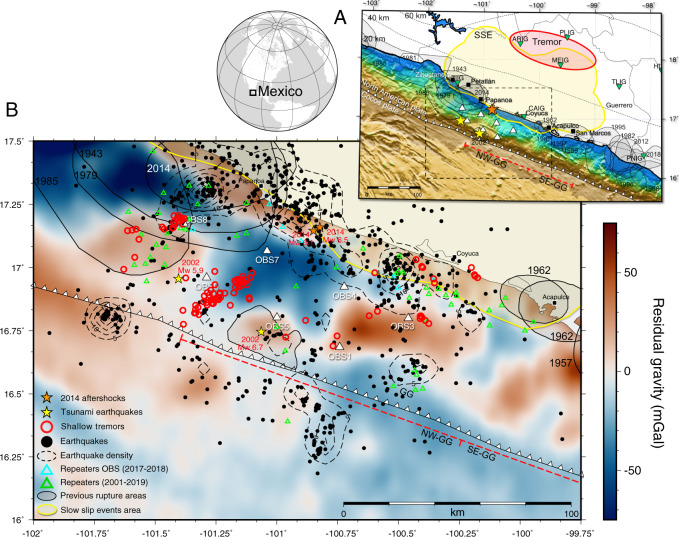
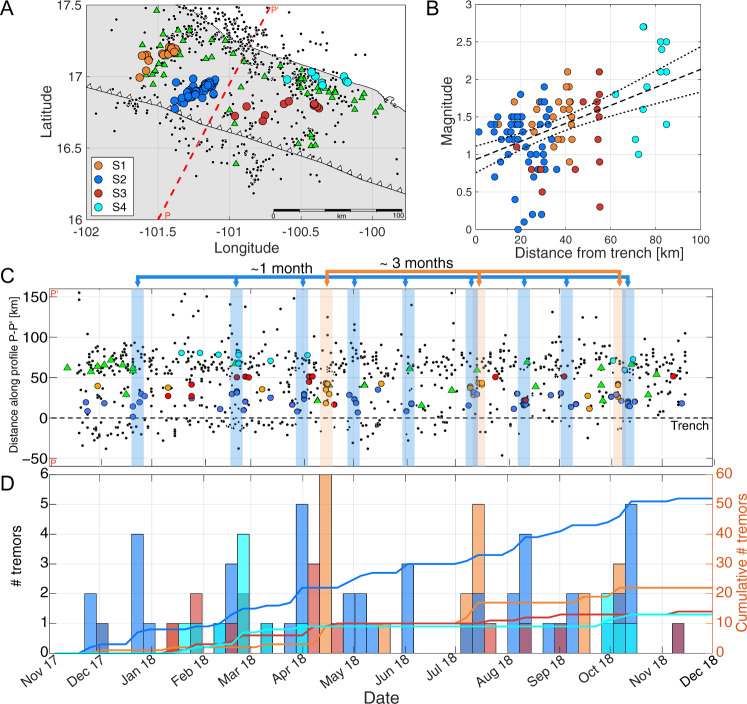
The Guerrero seismic gap is presumed to be a major source of seismic and tsunami hazard along the Mexican subduction zone. Until recently, there were limited observations at the shallow portion of the plate interface offshore Guerrero, so we deployed instruments there to better characterize the extent of the seismogenic zone. Here we report the discovery of episodic shallow tremors and potential slow slip events in Guerrero offshore. Their distribution, together with that of repeating earthquakes, seismicity, residual gravity and bathymetry, suggest that a portion of the shallow plate interface in the gap undergoes stable slip. This mechanical condition may not only explain the long return period of large earthquakes inside the gap, but also reveals why the rupture from past M < 8 earthquakes on adjacent megathrust segments did not propagate into the gap to result in much larger events. However, dynamic rupture effects could drive one of these nearby earthquakes to break through the entire Guerrero seismic gap.
格雷罗地震空区被认为是墨西哥俯冲带地震和海啸灾害的主要来源。直到最近,格雷罗近海板块界面浅部的观测数据还很有限,因此我们在那里部署了仪器,以更好地描述地震活动带的范围。在此,我们报告在格雷罗近海发现了间歇性浅源震颤和潜在的慢滑事件。它们的分布,连同重复地震、地震活动性、剩余重力和水深测量的分布,表明该空区内浅部板块界面的一部分经历了稳定滑动。这种力学状态不仅可以解释空区内大地震的长复发周期,还揭示了为什么相邻巨型逆冲断层段过去M<8级地震的破裂没有传播到该空区内从而引发更大规模事件的原因。然而,动态破裂效应可能会促使附近的一次地震突破整个格雷罗地震空区。