Department of Anesthesiology, Yantai Affiliated Hospital of Binzhou Medical University, Yantai, 264100, Shandong, People's Republic of China.
Department of Anesthesiology, School of Medicine, Shandong University, 44 Wenhua West Road, Jinan, 250012, Shandong, People's Republic of China.
Sci Rep. 2021 Jun 28;11(1):13421. doi: 10.1038/s41598-021-92762-3.
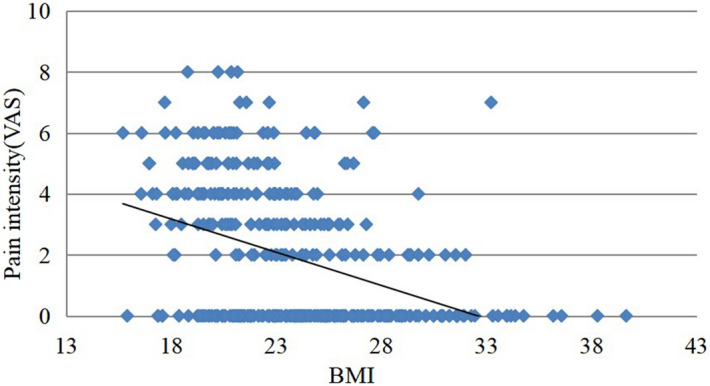
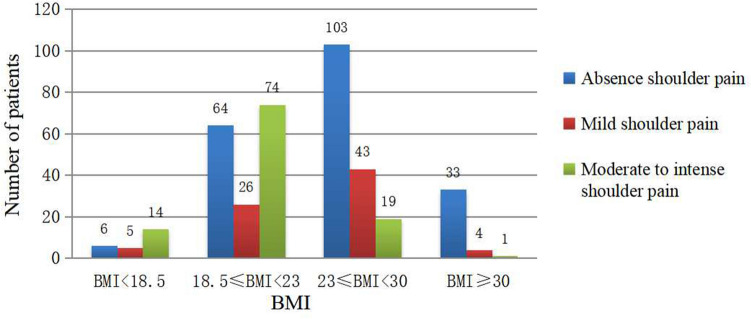
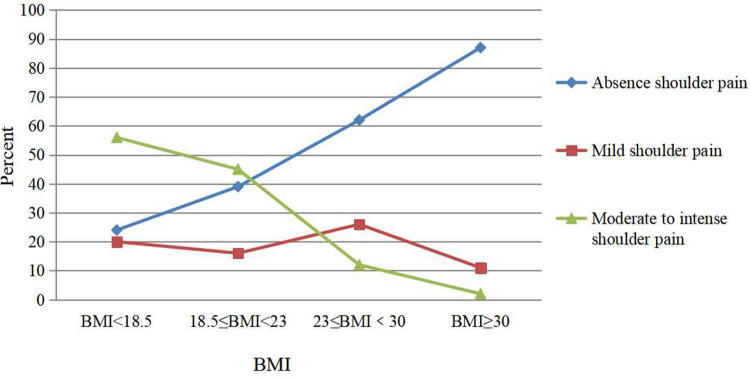
Postlaparoscopic shoulder pain (PLSP) is a common clinical problem that needs to be addressed by medical professionals who are currently perform laparoscopic surgeries. The purpose of this study was to determine the perioperative clinical factors and demographic characteristics associated with PLSP. A prospective observational study was performed with 442 inpatients undergoing laparoscopic surgery for infertility. The pain visual analogue scale was used as the measuring instrument. To identify the predictors of PLSP, we performed multivariate conditional logistic regression. PLSP was correlated with body mass index (BMI, odds ratio = 0.815). The incidence of shoulder pain and more severe shoulder pain in patients with a lower BMI was significantly higher than it was in patients with a higher BMI, and BMI was significantly negatively correlated with PLSP. Most of the patients (95%) began to experience shoulder pain on the first postoperative day, and it rarely occurred on the day of surgery. Patients with lower BMI presented a higher risk of reporting shoulder pain on the first postoperative day. We should identify high-risk patients in advance and make specific treatment plans according to the characteristics of their symptoms.
腹腔镜术后肩部疼痛(PLSP)是一种常见的临床问题,需要由目前正在进行腹腔镜手术的医学专业人员来解决。本研究旨在确定与 PLSP 相关的围手术期临床因素和人口统计学特征。对 442 名因不孕症接受腹腔镜手术的住院患者进行了前瞻性观察研究。疼痛视觉模拟评分被用作测量工具。为了确定 PLSP 的预测因素,我们进行了多变量条件逻辑回归分析。PLSP 与体重指数(BMI)呈负相关(比值比=0.815)。与 BMI 较高的患者相比,BMI 较低的患者出现肩部疼痛和更严重肩部疼痛的概率显著更高,且 BMI 与 PLSP 呈显著负相关。大多数患者(95%)在术后第一天开始出现肩部疼痛,而很少在手术当天出现。BMI 较低的患者在术后第一天报告肩部疼痛的风险更高。我们应该提前识别高危患者,并根据其症状特点制定具体的治疗计划。