United Heart & Vascular Clinic, Allina Health System, St Paul, Minnesota, USA.
Boston Scientific, St. Paul, Minnesota, USA.
Pacing Clin Electrophysiol. 2021 Aug;44(8):1320-1330. doi: 10.1111/pace.14303. Epub 2021 Jul 21.
The INGEVITY lead (Boston Scientific, St Paul, MN, USA) has excellent clinical performance. However, its single filar design results in decreased lead tensile strength and a possible challenging extraction. This study's goal is to evaluate techniques for extracting the INGEVITY lead.
Two- and three-dimensional models were created to simulate lead extraction from a right atrial appendage lead implant with a left subclavian approach and lead/fibrosis attachment sites. Standard and unique lead extraction preparation strategies were evaluated. Traction forces were measured from a superior approach alone or in combination with a femoral approach.
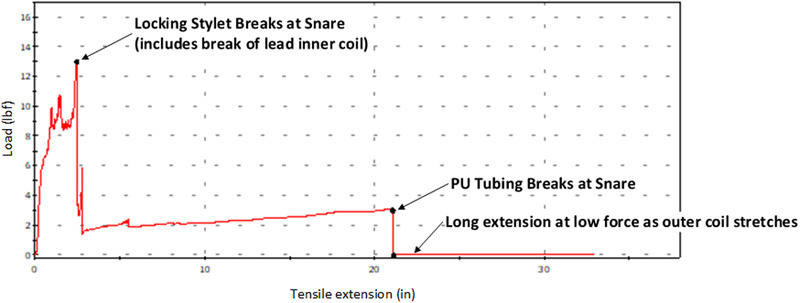
For lead extraction via the superior approach, leaving the terminal on the lead was the only factor influencing maximum tolerated load (p-value = .0007). Scar attachment provided greater lead tensile strength by transferring traction loading forces to the polyurethane outer insulation but dependent on insulation integrity. The strongest extraction rail was seen with a simulated femoral snaring of a locking stylet within the INGEVITY lead. Deployed screw retraction was most successful by rotating a Philips LLD#2 stylet (Philips Healthcare, Amsterdam, Netherlands) within the lead.
Results from in vitro simulations of INGEVITY lead extraction from an atrial location found the lead has low maximum tensile strength resulting in a poor extraction rail with common extraction tools and methods. However, the strength of the INGEVITY Lead extraction rail can be significantly increased by leaving the lead terminal intact and femoral snaring of the locking stylet within the lead. Such techniques may improve extraction of the INGEVITY lead.
INGEVITY 导联(波士顿科学公司,明尼苏达州圣保罗)具有出色的临床性能。然而,其单丝设计导致导联拉伸强度降低,并且可能难以取出。本研究旨在评估取出 INGEVITY 导联的技术。
创建二维和三维模型,以模拟从右心耳导联植入物通过左锁骨下途径和导联/纤维化附着部位取出导联。评估了标准和独特的导联取出准备策略。仅从上方或与股部途径联合测量牵引力。
对于通过上方途径进行的导联取出,仅留下导联末端是影响最大耐受负荷的唯一因素(p 值=0.0007)。瘢痕附着通过将牵引加载力转移到聚氨酯外绝缘层来提供更大的导联拉伸强度,但取决于绝缘层的完整性。在模拟的股部圈套锁定导丝内的 INGEVITY 导联时,看到最强的取出轨道。通过在导联内旋转飞利浦 LLD#2 导丝(荷兰皇家飞利浦电子公司),成功地进行了部署的螺钉缩回。
从心房位置体外模拟 INGEVITY 导联取出的结果发现,该导联的最大拉伸强度较低,导致使用常见的导联取出工具和方法时,取出轨道较差。然而,通过保留导联末端完整并在导联内圈套锁定导丝,可以显著增加 INGEVITY 导联的取出轨道强度。这些技术可能会改善 INGEVITY 导联的取出。