de Winde Charlotte M, Makris Spyridon, Millward Lindsey J, Cantoral-Rebordinos Jesús A, Benjamin Agnesska C, Martínez Víctor G, Acton Sophie E
Stromal Immunology Group, MRC Laboratory for Molecular Cell Biology, University College London, Gower Street, London WC1E 6BT, UK.
J Cell Sci. 2021 Jul 15;134(14). doi: 10.1242/jcs.258610. Epub 2021 Jul 22.
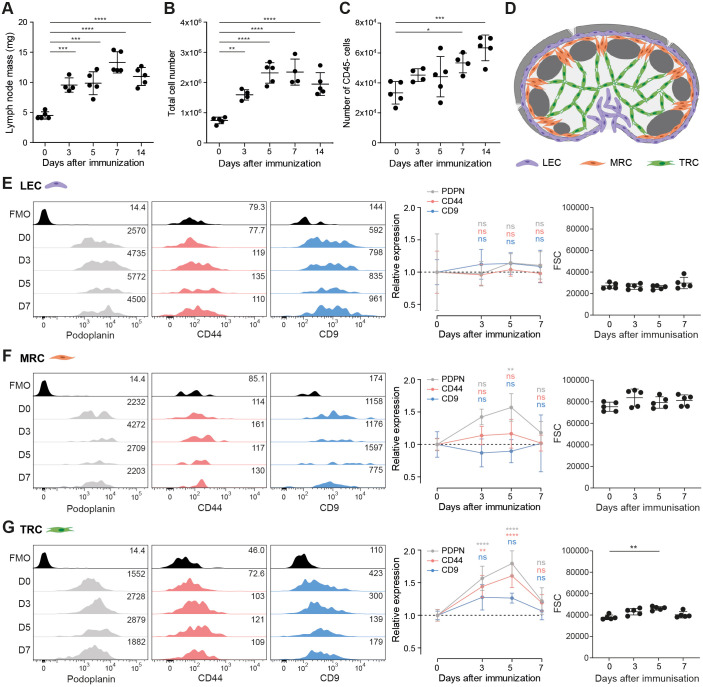
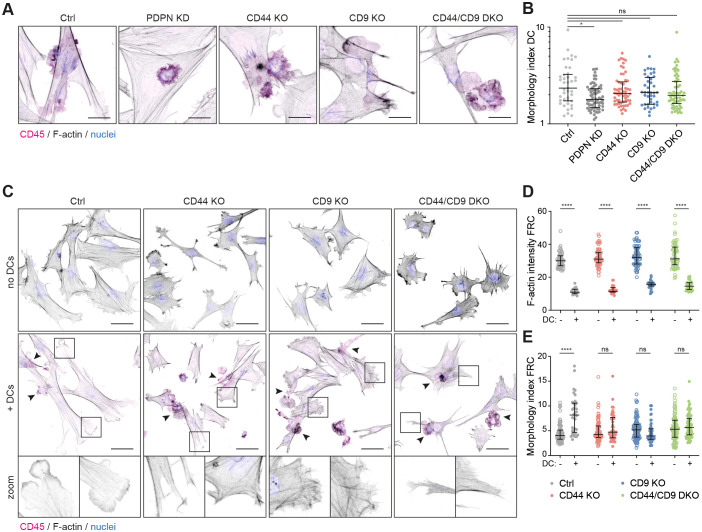
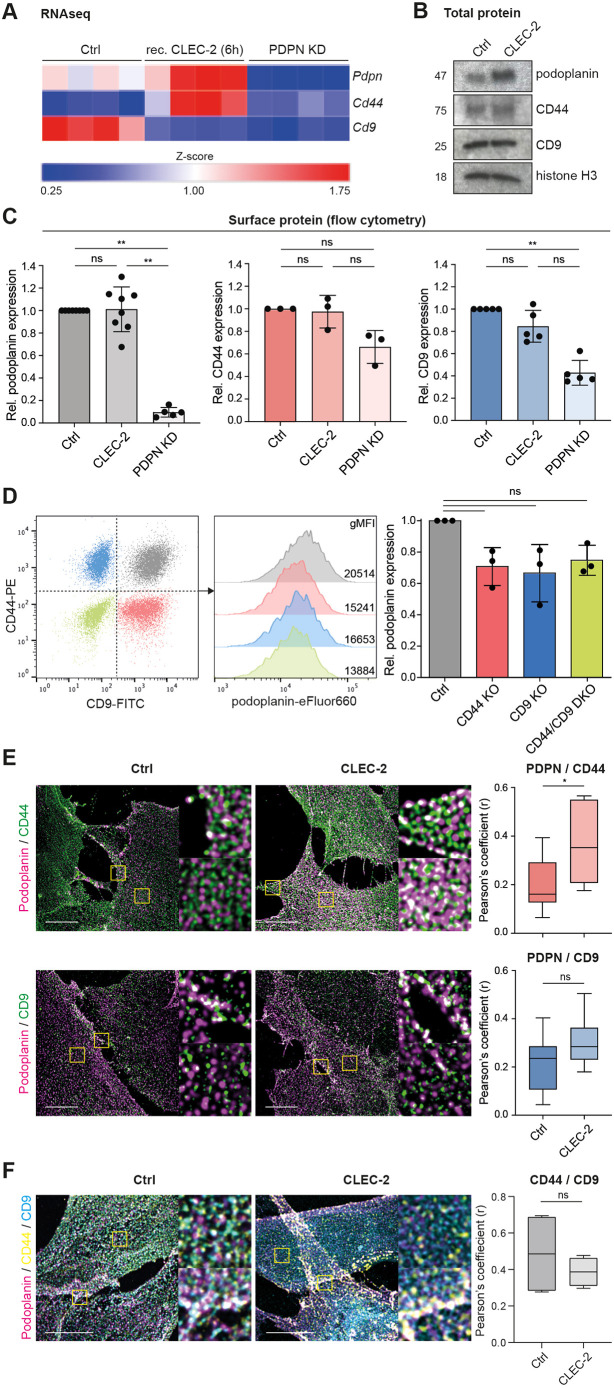
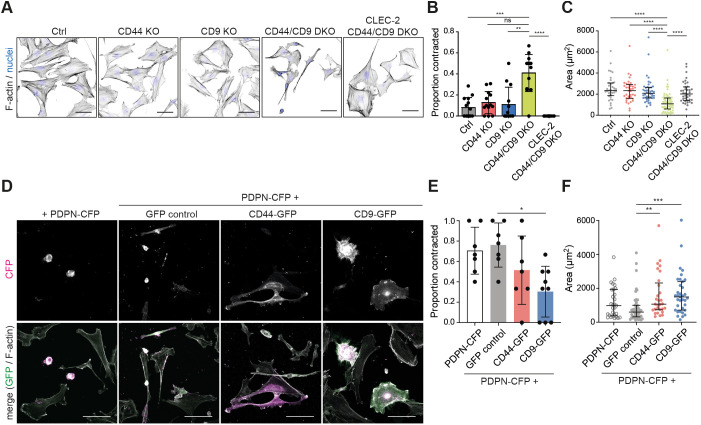
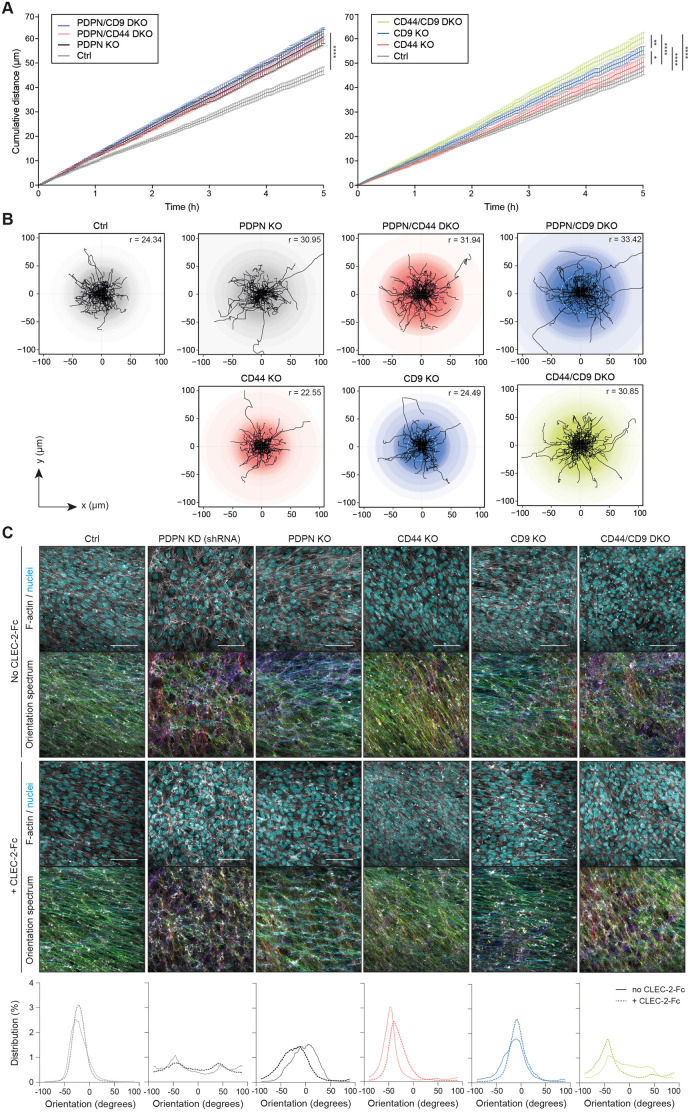
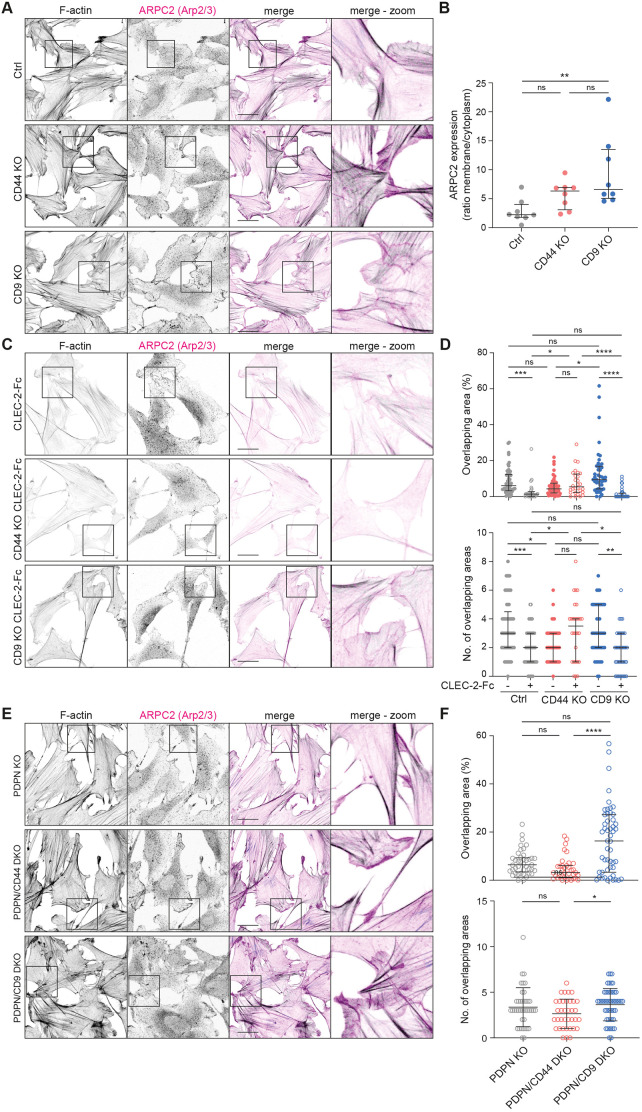
In adaptive immunity, CLEC-2+ dendritic cells (DCs) contact fibroblastic reticular cells (FRCs) inhibiting podoplanin-dependent actomyosin contractility, permitting FRC spreading and lymph node expansion. The molecular mechanisms controlling lymph node remodelling are incompletely understood. We asked how podoplanin is regulated on FRCs in the early phase of lymph node expansion, and which other proteins are required for the FRC response to DCs. We find that podoplanin and its partner proteins CD44 and CD9 are differentially expressed by specific lymph node stromal populations in vivo, and their expression in FRCs is coregulated by CLEC-2 (encoded by CLEC1B). Both CD44 and CD9 suppress podoplanin-dependent contractility. We find that beyond contractility, podoplanin is required for FRC polarity and alignment. Independently of podoplanin, CD44 and CD9 affect FRC-FRC interactions. Furthermore, our data show that remodelling of the FRC cytoskeleton in response to DCs is a two-step process requiring podoplanin partner proteins CD44 and CD9. Firstly, CLEC-2 and podoplanin binding inhibits FRC contractility, and, secondly, FRCs form protrusions and spread, which requires both CD44 and CD9. Together, we show a multi-faceted FRC response to DCs, which requires CD44 and CD9 in addition to podoplanin.
在适应性免疫中,CLEC-2⁺树突状细胞(DCs)与成纤维网状细胞(FRCs)接触,抑制血小板反应蛋白依赖性肌动球蛋白收缩性,使FRCs得以伸展并促进淋巴结扩张。目前对控制淋巴结重塑的分子机制了解尚不完全。我们研究了在淋巴结扩张早期FRCs上血小板反应蛋白是如何被调控的,以及FRCs对DCs作出反应还需要哪些其他蛋白质。我们发现,血小板反应蛋白及其伴侣蛋白CD44和CD9在体内由特定的淋巴结基质群体差异表达,并且它们在FRCs中的表达由CLEC-2(由CLEC1B编码)共同调控。CD44和CD9均抑制血小板反应蛋白依赖性收缩性。我们发现,除了收缩性外,血小板反应蛋白对FRCs的极性和排列也很重要。不依赖于血小板反应蛋白,CD44和CD9影响FRCs之间的相互作用。此外,我们的数据表明,FRCs细胞骨架对DCs作出反应的重塑是一个两步过程,需要血小板反应蛋白伴侣蛋白CD44和CD9。首先,CLEC-2与血小板反应蛋白结合会抑制FRCs的收缩性,其次,FRCs形成突起并伸展,这需要CD44和CD9。我们共同展示了FRCs对DCs的多方面反应,除了血小板反应蛋白外,还需要CD44和CD9。