Zhao Ruining, Shan Jiahao, Nie Lihong, Yang Xiaobo, Yuan Zhongyu, Xu Haoran, Liu Ziyang, Zhou Xiaojie, Ma Wenzhuo, Shi Hongbin
Department of Urology, General Hospital of Ningxia Medical University, Yinchuan, China.
Ningxia Medical University, Yinchuan, China.
J Clin Lab Anal. 2021 Aug;35(8):e23883. doi: 10.1002/jcla.23883. Epub 2021 Jun 29.
The purpose of this study was to explore the predictive value of the ratio of the product of neutrophils and hemoglobin to lymphocytes (NHL) in patients with non-muscular invasive bladder cancer (NMIBC).
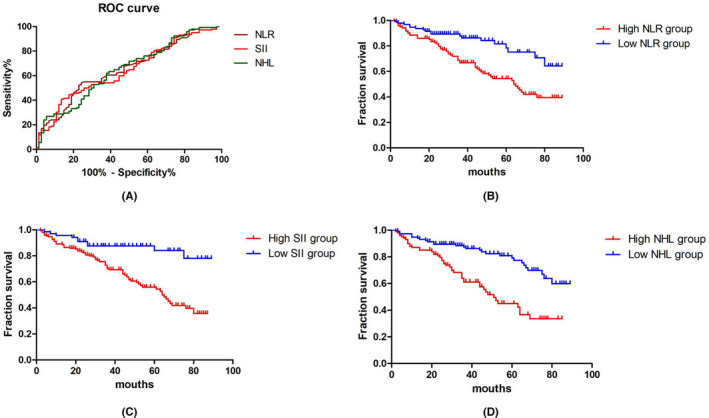
We retrospectively collected clinical and pathological data of patients with NMIBC who underwent transurethral resection of bladder tumor (TURBT) at our hospital between 2013 and 2018. The ratio of neutrophils to lymphocytes (NLR), the Systemic Immune Inflammation Index (SII), and NHL were obtained based on routine blood settlement within a week before surgery. The receiver operating characteristic curve was used to determine the optimal cutoff value of each index, and different groups were grouped accordingly. Kaplan-Meier survival curve and Cox regression model were used to study the factors affecting the prognosis of NMIBC patients.
There was significant difference in recurrence-free survival (RFS) rate between the high NLR group and the low NLR group, the high SII group and the low SII group, and the high NHL group and the low NHL group. Cox univariate regression analysis showed that tumor number, tumor size, tumor pathological grade, tumor pathological stage, NLR, SII, and NHL were related to postoperative RFS in patients with NMIBC. The tumor number, tumor pathological grade, SII, and NHL were independent predictors of RFS in multivariate analysis.
The preoperative clinical inflammatory indexes NLR, SII, and NHL have certain predictive value for postoperative RFS in NMIBC patients.
本研究旨在探讨中性粒细胞与血红蛋白乘积与淋巴细胞比值(NHL)在非肌层浸润性膀胱癌(NMIBC)患者中的预测价值。
我们回顾性收集了2013年至2018年在我院接受经尿道膀胱肿瘤切除术(TURBT)的NMIBC患者的临床和病理数据。根据术前一周内的血常规结果得出中性粒细胞与淋巴细胞比值(NLR)、全身免疫炎症指数(SII)和NHL。采用受试者工作特征曲线确定各指标的最佳截断值,并据此进行分组。采用Kaplan-Meier生存曲线和Cox回归模型研究影响NMIBC患者预后的因素。
高NLR组与低NLR组、高SII组与低SII组、高NHL组与低NHL组之间的无复发生存(RFS)率存在显著差异。Cox单因素回归分析显示,肿瘤数量、肿瘤大小、肿瘤病理分级、肿瘤病理分期、NLR、SII和NHL与NMIBC患者术后RFS相关。多因素分析中,肿瘤数量、肿瘤病理分级、SII和NHL是RFS的独立预测因素。
术前临床炎症指标NLR、SII和NHL对NMIBC患者术后RFS具有一定的预测价值。