Department of Otorhinolaryngology, Head and Neck Surgery, The Second Affiliated Hospital, Harbin Medical University, No. 246 Xuefu Road, Harbin, 150086, China.
Department of Head and Neck Surgery, Harbin Medical University Cancer Hospital, No.150 Haping Road, Harbin, 150081, China.
BMC Cancer. 2021 Jun 29;21(1):753. doi: 10.1186/s12885-021-08513-0.
Terminal differentiation-induced ncRNA (TINCR) plays an essential role in epidermal differentiation and is involved in the development of various cancers.
qPCR was used to detect the expression level of TINCR in tissues and cell lines of laryngeal squamous cell carcinoma (LSCC). The potential targets of TINCR were predicted by the bioinformation website. The expression of miR-210 and BTG2 genes were detected by qPCR, and the protein levels of BTG2 and Ki-67 were evaluated by western blot. CCK-8 assay, scratch test, and transwell chamber were used to evaluate the proliferation, invasion, and metastasis ability of LSCC cells. The relationships among TINCR, miR-210, and BTG2 were investigated by bioinformatics software and luciferase reporter assay. The in vivo function of TINCR was accessed on survival rate and tumor growth in nude mice.
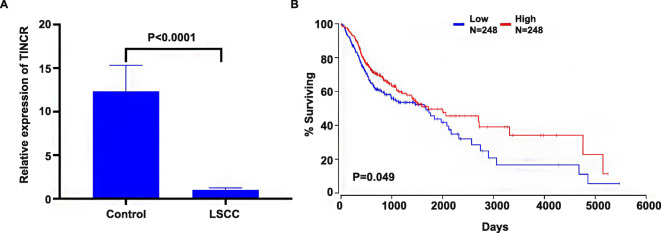
We used qRT-PCR to detect the expression of TINCR in laryngeal squamous cell carcinoma (LSCC) tissues and cells and found significantly lower levels in cancer tissues compared with adjacent tissues. Additionally, patients with high TINCR expression had a better prognosis. TINCR overexpression was observed to inhibit the proliferation and invasion of LSCC cells. TINCR was shown to exert its antiproliferation and invasion effects by adsorbing miR-210, which significantly promoted the proliferation and invasion of laryngeal squamous cells. Overexpression of miR-210 was determined to reverse the tumour-suppressive effects of TINCR. BTG2 (anti-proliferation factor 2) was identified as the target gene of miR-210, and BTG2 overexpression inhibited the proliferation and invasion of LSCC cells. BTG2 knockdown relieved the inhibitory effects of TINCR on the proliferation and invasion of LSCC. Finally, TINCR upregulation slowed xenograft tumour growth in nude mice and significantly increased survival compared with control mice.
The results of this study suggest that TINCR inhibits the proliferation and invasion of LSCC by regulating the miR-210/BTG2 pathway, participates in cell cycle regulation, and may become a target for the treatment of LSCC.
终末分化诱导 ncRNA(TINCR)在表皮分化中发挥重要作用,并参与多种癌症的发展。
使用 qPCR 检测喉鳞状细胞癌(LSCC)组织和细胞系中 TINCR 的表达水平。通过生物信息网站预测 TINCR 的潜在靶标。通过 qPCR 检测 miR-210 和 BTG2 基因的表达水平,并通过 Western blot 评估 BTG2 和 Ki-67 的蛋白水平。使用 CCK-8 测定、划痕试验和 Transwell 室评估 LSCC 细胞的增殖、侵袭和转移能力。通过生物信息学软件和荧光素酶报告基因检测研究 TINCR、miR-210 和 BTG2 之间的关系。在裸鼠中评估 TINCR 的体内功能通过生存率和肿瘤生长。
我们使用 qRT-PCR 检测了喉鳞状细胞癌(LSCC)组织和细胞中 TINCR 的表达,发现与相邻组织相比,癌症组织中的表达水平明显降低。此外,TINCR 高表达的患者预后更好。TINCR 过表达观察到抑制 LSCC 细胞的增殖和侵袭。TINCR 通过吸附 miR-210 发挥其抗增殖和侵袭作用,显著促进喉鳞状细胞的增殖和侵袭。miR-210 的过表达逆转了 TINCR 的肿瘤抑制作用。BTG2(抗增殖因子 2)被鉴定为 miR-210 的靶基因,BTG2 过表达抑制 LSCC 细胞的增殖和侵袭。BTG2 敲低缓解了 TINCR 对 LSCC 细胞增殖和侵袭的抑制作用。最后,TINCR 的上调减缓了裸鼠异种移植肿瘤的生长,并与对照小鼠相比显著提高了生存率。
本研究结果表明,TINCR 通过调节 miR-210/BTG2 通路抑制 LSCC 的增殖和侵袭,参与细胞周期调节,可能成为 LSCC 治疗的靶点。