Hews-Girard Julia, Goodyear Marilyn Dawn
Southern Alberta Rare Blood and Bleeding Disorders Comprehensive Care Program, Calgary, AB, T2N 2T9, Canada.
Cumming School of Medicine, University of Calgary, Calgary, AB, T2N 1N9, Canada.
Allergy Asthma Clin Immunol. 2021 Jun 29;17(1):61. doi: 10.1186/s13223-021-00563-0.
Hereditary angioedema (HAE) is a rare but serious disorder associated with a multifaceted burden of illness including a high prevalence of psychiatric symptoms and impaired health-related quality of life (HRQoL). Despite recent efforts to clarify the psychosocial implications of HAE, important gaps still remain. The aim of this study was to characterize the psychosocial burden associated with HAE types 1 and 2.
Type 1 or 2 HAE patients (n = 17), aged 19 years or older, completed the Depression, Anxiety, Stress Scale (DASS-21) and the DSM-5 cross cutting measures to identify psychiatric symptomatology, Angioedema Quality of Life Questionnaire (AE-QoL) and the Short-Form 36-Item Health Survey version 2 (SF-36v2) to assess disease-related and generic HRQoL respectively, and the Work Productivity and Activity Impairment Questionnaire (WPAI) to measure impact on work productivity and daily activities. Data analyses were conducted using SPSS statistical software (Version 25.0; IBM, Armonk, NY). Descriptive statistics were used to summarize continuous demographics and clinical characteristics and outcomes of interest while frequency distributions were used for categorical variables. T tests were used to compare SF-36v2 domain scores to Canadian norms and sex differences in scale scores.
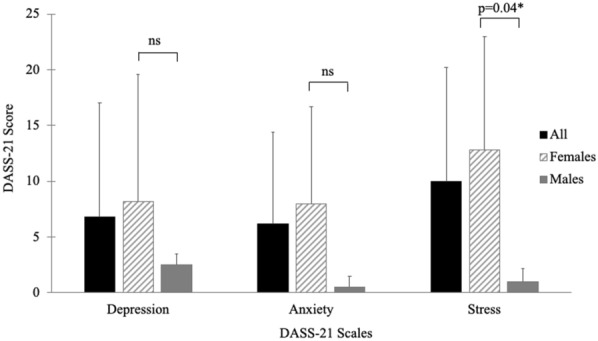
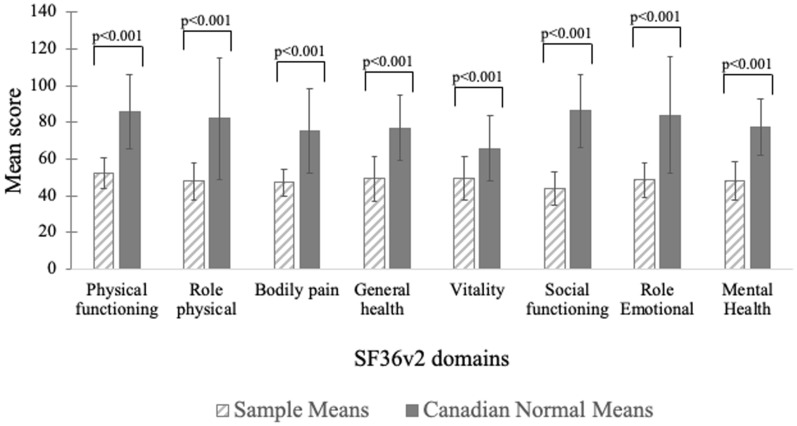
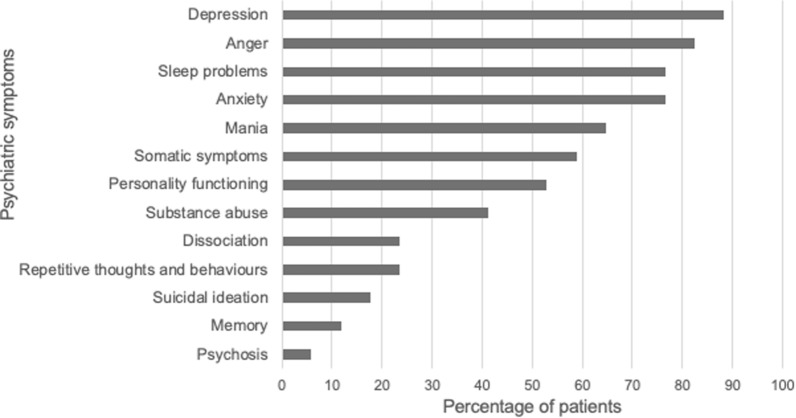
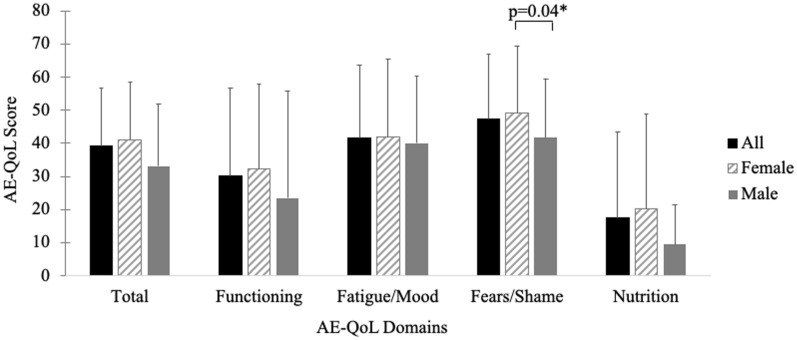
Depression [DASS-21 score = 6.8 ± 10.2; n = 12 (71%)] anxiety [DASS-21 score = 6.2 ± 8.2; n = 13 (76%)] and stress [DASS-21 score = 10 ± 10.2; n = 13 (76%)] were prevalent. Other psychiatric symptoms warranting inquiry included mania (n = 14, 82.4%), anger (n = 14, 82.4%), sleep disturbances (n = 13, 76.5%), somatic symptoms (n = 11, 64.7%) and impaired personality functioning (n = 9, 52.9%). Mean AE-QoL score was 39 ± 18.2. Mean SF-36v2 domain scores were significantly lower than Canadian normative data for the entire sample (p < 0.05). Impairment in work productivity was minimal; mean activity impairment was 20.6% ± 21.1% [n = 11 (64.7%)]. Female participants reported significantly greater HAE-related stress [DASS; t(15) = - 2.2, p = 0.04], greater HAE-related fears [AEQoL; t(5.6) = - 2.7, p = 0.04), and lower SF-36v2 domain scores than male patients.
Study findings offer specific, valuable insight into the psychosocial burden of HAE with the potential to improve clinical management of HAE. Best practices for effective management of HAE should include providing holistic care to address the psychosocial and mental health of HAE patients.
遗传性血管性水肿(HAE)是一种罕见但严重的疾病,伴随着多方面的疾病负担,包括精神症状的高患病率和健康相关生活质量(HRQoL)受损。尽管最近努力阐明HAE的社会心理影响,但仍存在重要差距。本研究的目的是描述与1型和2型HAE相关的社会心理负担。
19岁及以上的1型或2型HAE患者(n = 17)完成了抑郁、焦虑、压力量表(DASS - 21)和DSM - 5交叉检查措施以识别精神症状,血管性水肿生活质量问卷(AE - QoL)和简短36项健康调查第2版(SF - 36v2)分别评估与疾病相关的和一般的HRQoL,以及工作生产力和活动障碍问卷(WPAI)以测量对工作生产力和日常活动的影响。使用SPSS统计软件(版本25.0;IBM,阿蒙克,纽约)进行数据分析。描述性统计用于总结连续的人口统计学和临床特征以及感兴趣的结果,而频率分布用于分类变量。T检验用于将SF - 36v2领域得分与加拿大标准以及量表得分中的性别差异进行比较。
抑郁(DASS - 21得分= 6.8±10.2;n = 12(71%))、焦虑(DASS - 21得分= 6.2±8.2;n = 13(76%))和压力(DASS - 21得分= 10±10.2;n = 13(76%))很常见。其他需要询问的精神症状包括躁狂(n = 14,82.4%)、愤怒(n = 14,82.4%)、睡眠障碍(n = 13,76.5%)、躯体症状(n = 11,64.7%)和人格功能受损(n = 9,52.9%)。AE - QoL平均得分为39±18.2。整个样本的SF - 36v2领域平均得分显著低于加拿大标准数据(p < 0.05)。工作生产力的损害最小;平均活动损害为20.6%±21.1%[n = 11(64.7%)]。女性参与者报告的与HAE相关的压力显著更大[DASS;t(15)= - 2.2,p = 0.04],与HAE相关的恐惧更大[AEQoL;t(5.6)= - 2.7,p = 0.04],并且SF - 36v2领域得分低于男性患者。
研究结果为HAE的社会心理负担提供了具体、有价值的见解,有可能改善HAE的临床管理。有效管理HAE的最佳实践应包括提供全面护理以解决HAE患者的社会心理和心理健康问题。