Institute of Health Informatics, University College London, London, UK
Department of Chemical Engineering, University College London, London, UK.
BMJ Open. 2021 Jun 29;11(7):e047832. doi: 10.1136/bmjopen-2020-047832.
To systematically learn lessons from the experiences of countries implementing find, test, trace, isolate, support (FTTIS) in the first wave of the COVID-19 pandemic.
DESIGN, DATA SOURCES AND ELIGIBILITY CRITERIA: We searched MEDLINE (PubMed), Cochrane Library, SCOPUS and JSTOR, initially between 31 May 2019 and 21 January 2021. Research articles and reviews on the use of contact tracing, testing, self-isolation and quarantine for COVID-19 management were included in the review.
We extracted information including study objective, design, methods, main findings and implications. These were tabulated and a narrative synthesis was undertaken given the diverse research designs, methods and implications.
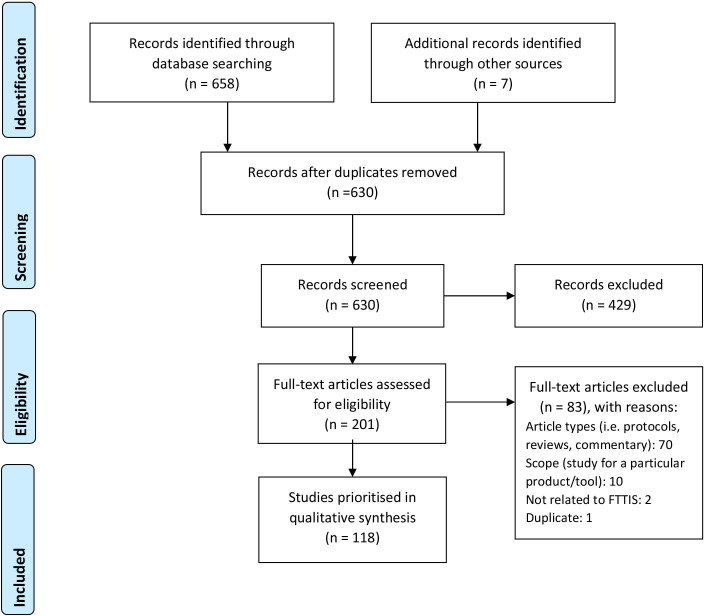
We identified and included 118 eligible studies. We identified the core elements of an effective find, test, trace, isolate, support (FTTIS) system needed to interrupt the spread of a novel infectious disease, where treatment or vaccination was not yet available, as pertained in the initial stages of the COVID-19 pandemic. We report methods used to shorten case finding time, improve accuracy and efficiency of tests, coordinate stakeholders and actors involved in an FTTIS system, support individuals isolating and make appropriate use of digital tools.
We identified in our systematic review the key components of an FTTIS system. These include border controls, restricted entry, inbound traveller quarantine and comprehensive case finding; repeated testing to minimise false diagnoses and pooled testing in resource-limited circumstances; extended quarantine period and the use of digital tools for contact tracing and self-isolation. Support for mental or physical health and livelihoods is needed for individuals undergoing self-isolation/quarantine. An integrated system with rolling-wave planning can best use effective FTTIS tools to respond to the fast-changing COVID-19 pandemic. Results of the review may inform countries considering implementing these measures.
系统地从各国在 COVID-19 大流行第一波期间实施发现、检测、追踪、隔离和支持(FTTIS)的经验中吸取教训。
设计、数据来源和入选标准:我们在 2019 年 5 月 31 日至 2021 年 1 月 21 日之间最初在 MEDLINE(PubMed)、Cochrane 图书馆、SCOPUS 和 JSTOR 上进行了搜索。研究文章和评论纳入了 COVID-19 管理中接触者追踪、检测、自我隔离和检疫的使用。
我们提取了包括研究目标、设计、方法、主要发现和意义在内的信息。鉴于研究设计、方法和意义的多样性,我们将这些信息制成表格并进行了叙述性综合。
我们确定并纳入了 118 项符合条件的研究。我们确定了在 COVID-19 大流行初期,在治疗或疫苗尚未可用的情况下,中断新型传染病传播所需的有效发现、检测、追踪、隔离和支持(FTTIS)系统的核心要素。我们报告了缩短病例发现时间、提高检测准确性和效率、协调 FTTIS 系统中涉及的利益相关者和行为者、支持隔离个体并适当使用数字工具的方法。
我们在系统评价中确定了 FTTIS 系统的关键组成部分。这些包括边境控制、入境限制、入境旅行者检疫和全面病例发现;重复检测以尽量减少误诊和资源有限情况下的 pooled 检测;延长隔离期和使用数字工具进行接触者追踪和自我隔离。需要为正在接受自我隔离/检疫的个人提供身心健康和生计支持。具有滚动式规划的综合系统可以最好地利用有效的 FTTIS 工具应对快速变化的 COVID-19 大流行。该评价的结果可以为考虑实施这些措施的国家提供信息。