Young Academy (Junge Akademie) of the German National Academy of Sciences, Berlin, Germany.
Institute for Analysis and Algebra, Technical University of Braunschweig, Braunschweig, Germany.
PLoS One. 2020 Dec 21;15(12):e0243692. doi: 10.1371/journal.pone.0243692. eCollection 2020.
Rapid testing is paramount during a pandemic to prevent continued viral spread and excess morbidity and mortality. This study investigates whether testing strategies based on sample pooling can increase the speed and throughput of screening for SARS-CoV-2, especially in resource-limited settings.
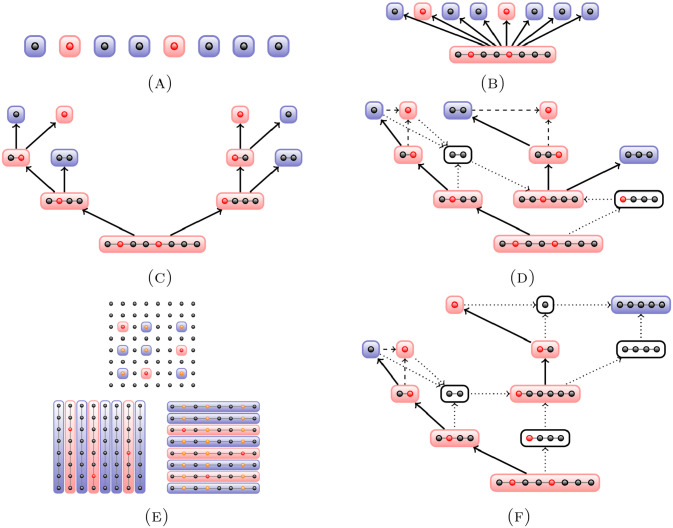
In a mathematical modelling approach conducted in May 2020, six different testing strategies were simulated based on key input parameters such as infection rate, test characteristics, population size, and testing capacity. The situations in five countries were simulated, reflecting a broad variety of population sizes and testing capacities. The primary study outcome measurements were time and number of tests required, number of cases identified, and number of false positives.
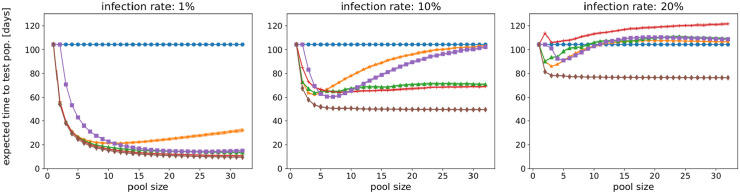
The performance of all tested methods depends on the input parameters, i.e. the specific circumstances of a screening campaign. To screen one tenth of each country's population at an infection rate of 1%, realistic optimised testing strategies enable such a campaign to be completed in ca. 29 days in the US, 71 in the UK, 25 in Singapore, 17 in Italy, and 10 in Germany. This is ca. eight times faster compared to individual testing. When infection rates are lower, or when employing an optimal, yet more complex pooling method, the gains are more pronounced. Pool-based approaches also reduce the number of false positive diagnoses by a factor of up to 100.
The results of this study provide a rationale for adoption of pool-based testing strategies to increase speed and throughput of testing for SARS-CoV-2, hence saving time and resources compared with individual testing.
在大流行期间,快速检测对于防止病毒持续传播以及减少发病率和死亡率至关重要。本研究旨在探讨基于样本混合的检测策略是否可以提高 SARS-CoV-2 筛查的速度和效率,尤其是在资源有限的情况下。
本研究于 2020 年 5 月采用数学建模方法,根据感染率、检测特性、人口规模和检测能力等关键输入参数,模拟了六种不同的检测策略。模拟了五个国家的情况,反映了广泛的人口规模和检测能力差异。主要研究结果测量指标为所需的时间和检测次数、发现的病例数以及假阳性数。
所有测试方法的性能都取决于输入参数,即筛查活动的具体情况。在感染率为 1%的情况下,对每个国家十分之一的人口进行筛查,在现实情况下优化的检测策略可以使美国在大约 29 天内完成筛查,英国需要 71 天,新加坡 25 天,意大利 17 天,德国 10 天。这比个体检测快了约 8 倍。当感染率较低时,或者采用最优但更复杂的混合方法时,效果更加显著。基于混合的方法还可以将假阳性诊断的数量减少到原来的 1/100。
本研究结果为采用基于混合的检测策略提供了依据,以提高 SARS-CoV-2 的检测速度和效率,与个体检测相比,可以节省时间和资源。