Hughes Kelly D, Haynes David, Joseph Anne M
Minnesota Department of Health, Sage Program, 85 7th Place E, St. Paul, MN 55101 USA.
University of Minnesota, Institute for Health Informatics, Suite 8-100, 516 Delaware Street SE, Minneapolis, MN 55455 USA.
Prev Med Rep. 2021 May 29;23:101415. doi: 10.1016/j.pmedr.2021.101415. eCollection 2021 Sep.
The National Breast and Cervical Cancer Early Detection Program (NBCCEDP) is a cancer screening program whose mission is to reduce cancer morbidities for uninsured and underinsured women. A primary activity is to connect women to breast cancer screening. The eligible population and utilization of NBCCEDP screening services have never been quantified at a sub-state level, which hampers effective program evaluation. Here, the Minnesota NBCCEDP, "Sage", serves as a case study to demonstrate novel spatial analysis methods that depict variation of screening rates at the local level.
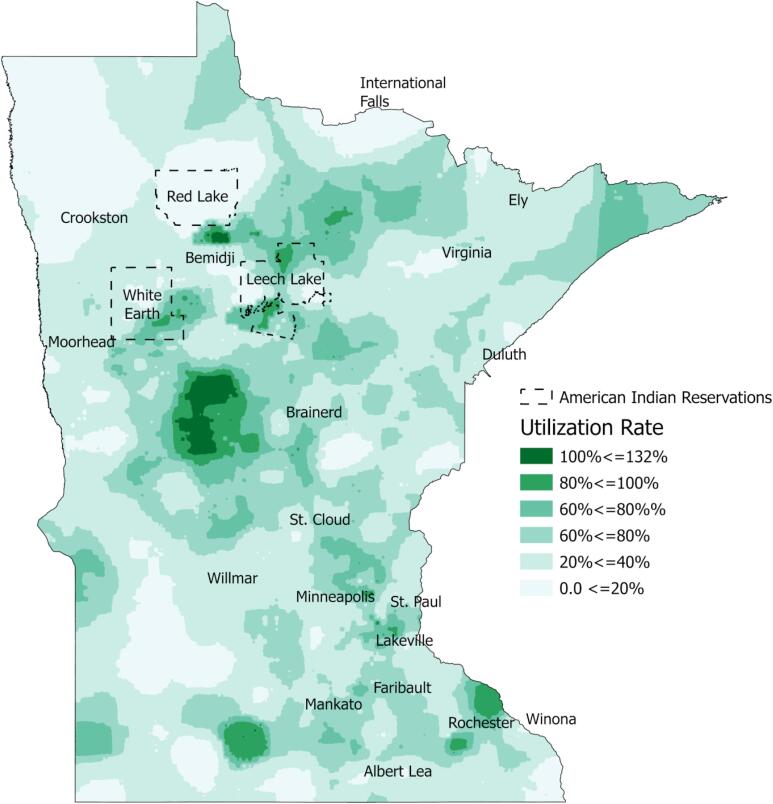
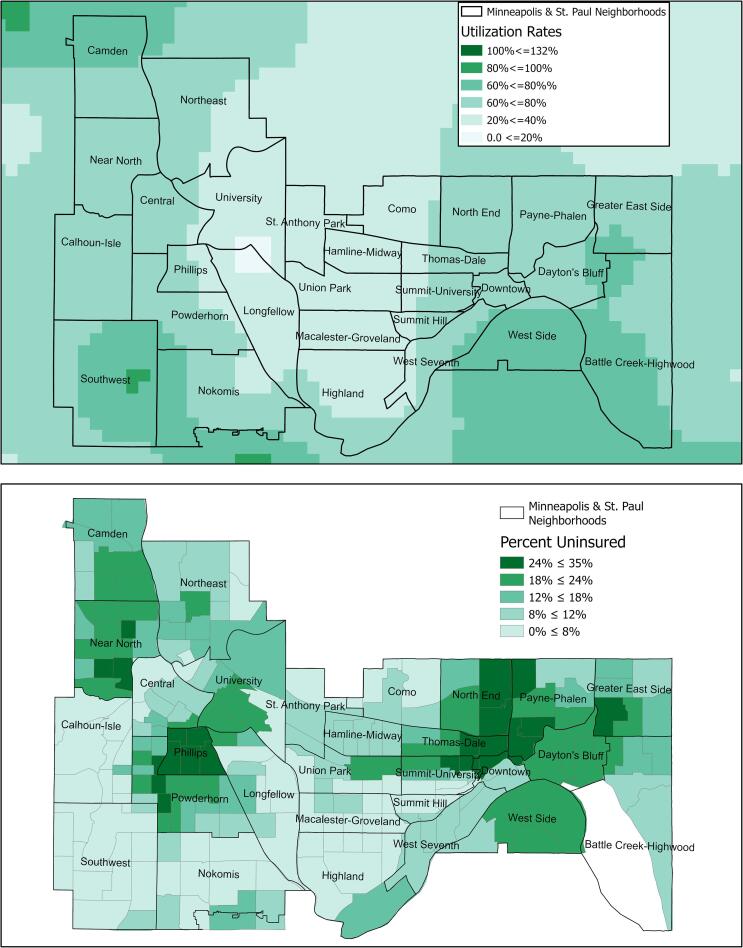
Women who received breast cancer screening through Sage between 2011 and 2015 were geocoded (N = 74,712 screenings); analysis occurred between 2017 and 2019. We determine an eligible population using a synthetic population dataset that provides geographic residence and demographic information. We introduce a novel spatial analysis technique, spatially adaptive filters (SAFs), to create a utilization map of Sage breast screening services by Minnesota women.
Between 2011 and 2015, an average of 36,979 women per year were eligible for NBCCEDP breast cancer screening services, representing 3% of the Minnesota female population 40 and older. For Minnesota NBCCEDP eligible women, the state average breast cancer screening utilization rate was 37.2%, but varied considerably by local regions within the state (range 0% to 131%, SD = 18.7%).
This geospatial model estimated screening service utilization at the local level and enables Minnesota's Sage program to target specific areas they have yet to reach. Similar programs could employ this model to direct program activities.
国家乳腺癌和宫颈癌早期检测项目(NBCCEDP)是一项癌症筛查项目,其使命是降低未参保和参保不足女性的癌症发病率。一项主要活动是帮助女性接受乳腺癌筛查。NBCCEDP筛查服务的 eligible population 和利用率从未在州以下层面进行量化,这妨碍了有效的项目评估。在此,明尼苏达州的NBCCEDP“智者”项目作为一个案例研究,展示了描绘地方层面筛查率变化的新型空间分析方法。
2011年至2015年期间通过“智者”项目接受乳腺癌筛查的女性进行了地理编码(N = 74,712次筛查);分析在2017年至2019年期间进行。我们使用提供地理居住和人口统计信息的合成人口数据集确定 eligible population。我们引入了一种新型空间分析技术,空间自适应滤波器(SAFs),以创建明尼苏达州女性对“智者”项目乳腺癌筛查服务的利用率地图。
2011年至2015年期间,平均每年有36,979名女性符合NBCCEDP乳腺癌筛查服务条件,占明尼苏达州40岁及以上女性人口的3%。对于符合明尼苏达州NBCCEDP条件的女性,该州乳腺癌筛查平均利用率为37.2%,但该州内不同地区差异很大(范围为0%至131%,标准差 = 18.7%)。
这种地理空间模型估计了地方层面的筛查服务利用率,并使明尼苏达州的“智者”项目能够针对尚未覆盖的特定区域。类似项目可以采用此模型来指导项目活动。