Sanders Carolyn Breauna, Knisely Krista, Edrissi Camron, Rathfoot Chase, Poupore Nicolas, Wormack Leah, Nathaniel Thomas
Department of Biomedical Sciences, University of South Carolina School of Medicine Greenville, Greenville, SC, USA.
Brain Circ. 2021 May 29;7(2):92-103. doi: 10.4103/bc.bc_57_20. eCollection 2021 Apr-Jun.
Specific clinical and demographic risk factors may be associated with improving or worsening neurologic outcomes within a population of acute ischemic stroke (AIS) patients with a history of obstructive sleep apnea (OSA). The objective of this study was to determine the changes in neurologic outcome during a 14-day recovery as it relates to initial stroke severity in AIS patients with OSA.
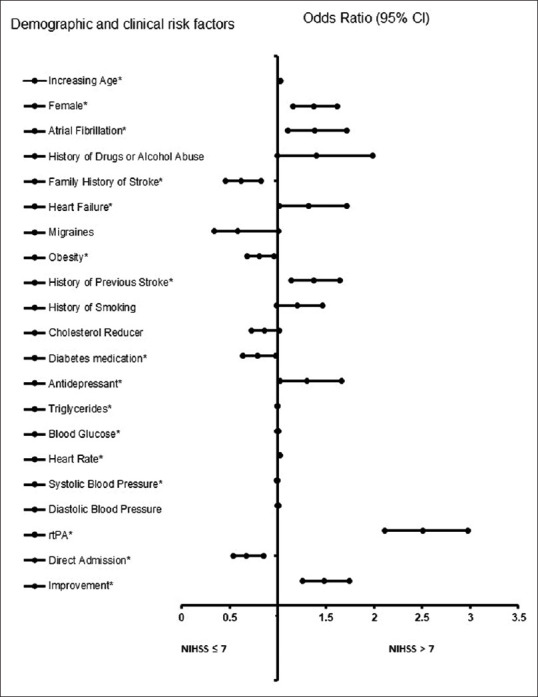
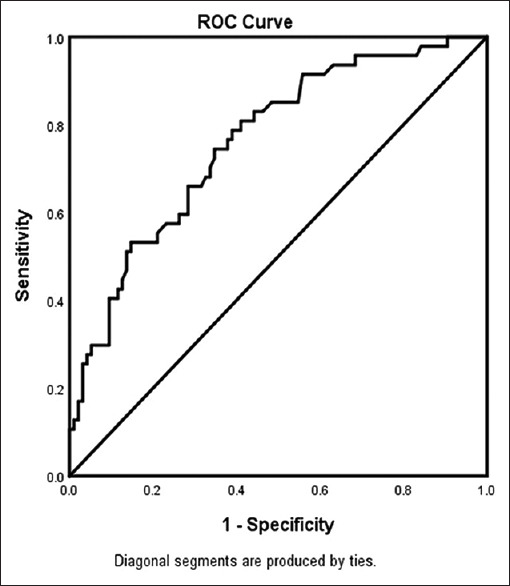
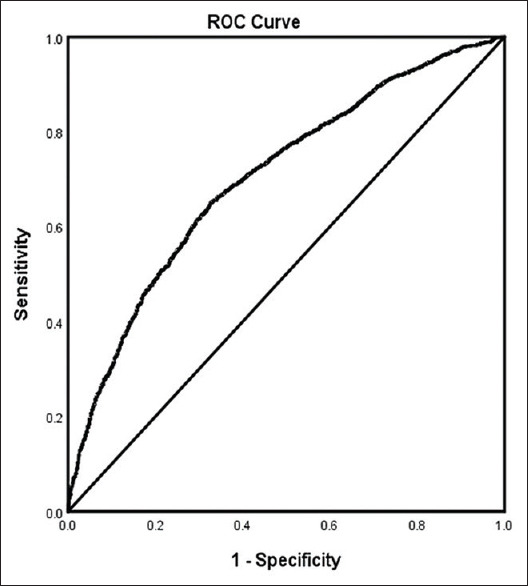
This retrospective study analyzed baseline clinical risk factors and demographic data collected in a regional stroke center from January 2010 to June 2016. Our primary endpoint measure was the National Institutes of Health Stroke Scale (NIHSS) score and our secondary endpoint measures included the clinical factors associated with improving (NIHSS score ≤7) or worsening (NIHSS score >7) neurological outcome. The relative contribution of each variable to stroke severity and related outcome was determined using a logistic regression. The regression models were checked for the overall correct classification percentage using a Hosmer-Lemeshow test, and the sensitivity of our models was determined by the area under the receiver operating characteristic curve.
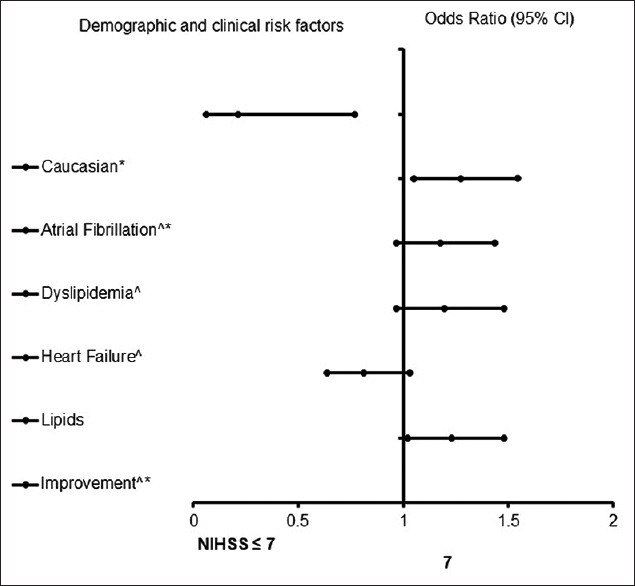
A total of 5469 AIS patients were identified. Of this, 96.89% did not present with OSA while 3.11% of AIS patients presented with OSA. Adjusted multivariate analysis demonstrated that in the AIS population with OSA, atrial fibrillation (AF) (odds ratio [OR] = 3.36, 95% confidence interval [CI], 1.289-8.762, = 0.013) and changes in ambulatory status (OR = 2.813, 95% CI, 1.123-7.041, = 0.027) showed an association with NIHSS score >7 while being Caucasian (OR = 0.214, 95% CI, 0.06-0.767, = 0.018) was associated with NIHSS score ≤7.
In AIS patients with OSA, AF and changes in ambulatory status were associated with worsening neurological outcome while Caucasian patients were associated with improving neurological outcome. Our findings may have significant implications for patient stratification when determining treatment protocols with respect to neurologic outcomes in AIS patients with OSA.
在有阻塞性睡眠呼吸暂停(OSA)病史的急性缺血性卒中(AIS)患者群体中,特定的临床和人口统计学风险因素可能与神经功能结局的改善或恶化相关。本研究的目的是确定在14天恢复期内,与有OSA的AIS患者初始卒中严重程度相关的神经功能结局变化。
这项回顾性研究分析了2010年1月至2016年6月在一个地区性卒中中心收集的基线临床风险因素和人口统计学数据。我们的主要终点指标是美国国立卫生研究院卒中量表(NIHSS)评分,次要终点指标包括与神经功能结局改善(NIHSS评分≤7)或恶化(NIHSS评分>7)相关的临床因素。使用逻辑回归确定每个变量对卒中严重程度和相关结局的相对贡献。使用Hosmer-Lemeshow检验检查回归模型的总体正确分类百分比,并通过受试者操作特征曲线下面积确定我们模型的敏感性。
共识别出5469例AIS患者。其中,96.89%的患者无OSA,3.11%的AIS患者有OSA。校正后的多变量分析表明,在有OSA的AIS患者群体中,房颤(AF)(比值比[OR]=3.36,95%置信区间[CI],1.289 - 8.762,P = 0.013)和活动状态变化(OR = 2.813,95% CI,1.123 - 7.041,P = 0.027)与NIHSS评分>7相关,而白种人(OR = 0.214,95% CI,0.06 - 0.767,P = 0.018)与NIHSS评分≤7相关。
在有OSA的AIS患者中,房颤和活动状态变化与神经功能结局恶化相关,而白种人患者与神经功能结局改善相关。我们的研究结果对于确定有OSA的AIS患者神经功能结局的治疗方案时的患者分层可能具有重要意义。