Kang Eui-Soo, Yook Jang Soo, Ha Min-Seong
Department of Sports Science Convergence-Graduate School, Dongguk University-Seoul, 30, Pildong-ro 1-gil, Jung-gu, Seoul 04620, Korea.
Center for Functional Connectomics, Brain Research Institute, Korea Institute of Science and Technology (KIST), Hwarang-ro 14-gil 5, Seongbuk-gu, Seoul 02792, Korea.
J Clin Med. 2022 May 20;11(10):2888. doi: 10.3390/jcm11102888.
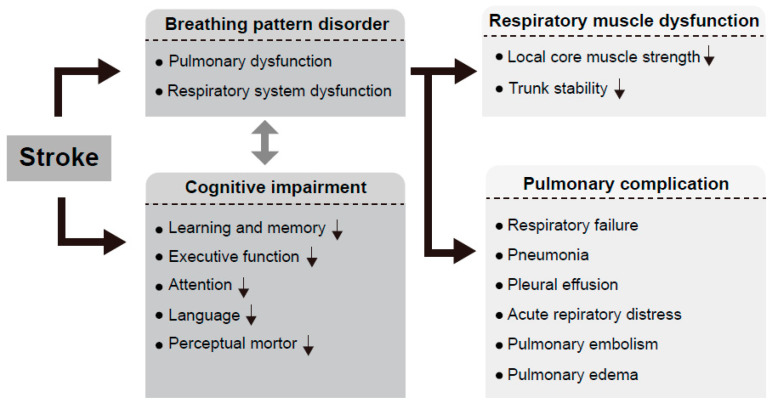
Patients with stroke may experience a certain degree of cognitive decline during the period of recovery, and a considerable number of such patients have been reported to show permanent cognitive damage. Therefore, the period of recovery and rehabilitation following stroke is critical for rapid cognitive functional improvements. As dysfunctional breathing has been reported as one of the factors affecting the quality of life post stroke, a number of studies have focused on the need for improving the breathing function in these patients. Numerous breathing exercises have been reported to enhance the respiratory, pulmonary, cognitive, and psychological functions. However, scientific evidence on the underlying mechanisms by which these exercises improve cognitive function is scattered at best. Therefore, it has been difficult to establish a protocol of breathing exercises for patients with stroke. In this review, we summarize the psychological, vascular, sleep-related, and biochemical factors influencing cognition in patients and highlight the need for breathing exercises based on existing studies. Breathing exercises are expected to contribute to improvements in cognitive function in stroke based on a diverse array of supporting evidence. With relevant follow-up studies, a protocol of breathing exercises can be developed for improving the cognitive function in patients with stroke.
中风患者在恢复期间可能会经历一定程度的认知衰退,而且据报道相当多此类患者存在永久性认知损伤。因此,中风后的恢复和康复期对于快速改善认知功能至关重要。由于功能失调性呼吸已被报道为影响中风后生活质量的因素之一,许多研究聚焦于改善这些患者呼吸功能的必要性。据报道,众多呼吸练习可增强呼吸、肺部、认知和心理功能。然而,关于这些练习改善认知功能的潜在机制的科学证据充其量也只是零散的。因此,很难为中风患者制定呼吸练习方案。在本综述中,我们总结了影响患者认知的心理、血管、睡眠相关和生化因素,并基于现有研究强调了呼吸练习的必要性。基于一系列多样的支持证据,呼吸练习有望有助于改善中风患者的认知功能。通过相关的随访研究,可以制定出改善中风患者认知功能的呼吸练习方案。