Dudoignon Benjamin, Tainturier Laure-Eugénie, Dodet Pauline, Bera Géraldine, Groos Elisabeth, Chaumereuil Charlotte, Maranci Jean-Baptiste, Kas Aurélie, Arnulf Isabelle
Sorbonne University, Paris Brain Institute (ICM), Inserm UMR-S975, CNRS UMR7225, Paris 75013, France.
Sleep Disorders Unit, National Reference Centre for Kleine-Levin Syndrome, Pitié Salpêtrière University Hospital, APHP, Paris 75013, France.
Brain Commun. 2021 Jun 17;3(2):fcab130. doi: 10.1093/braincomms/fcab130. eCollection 2021.
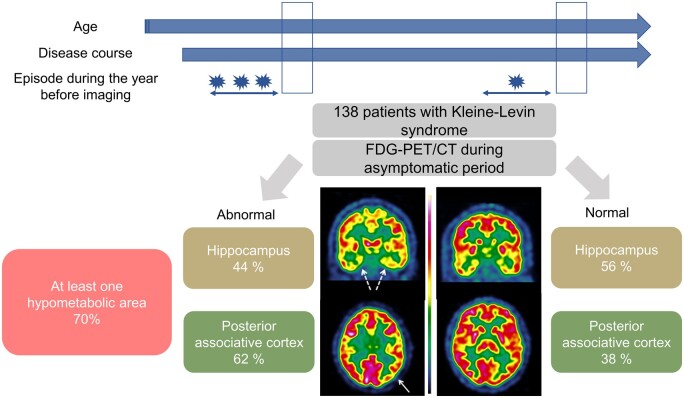
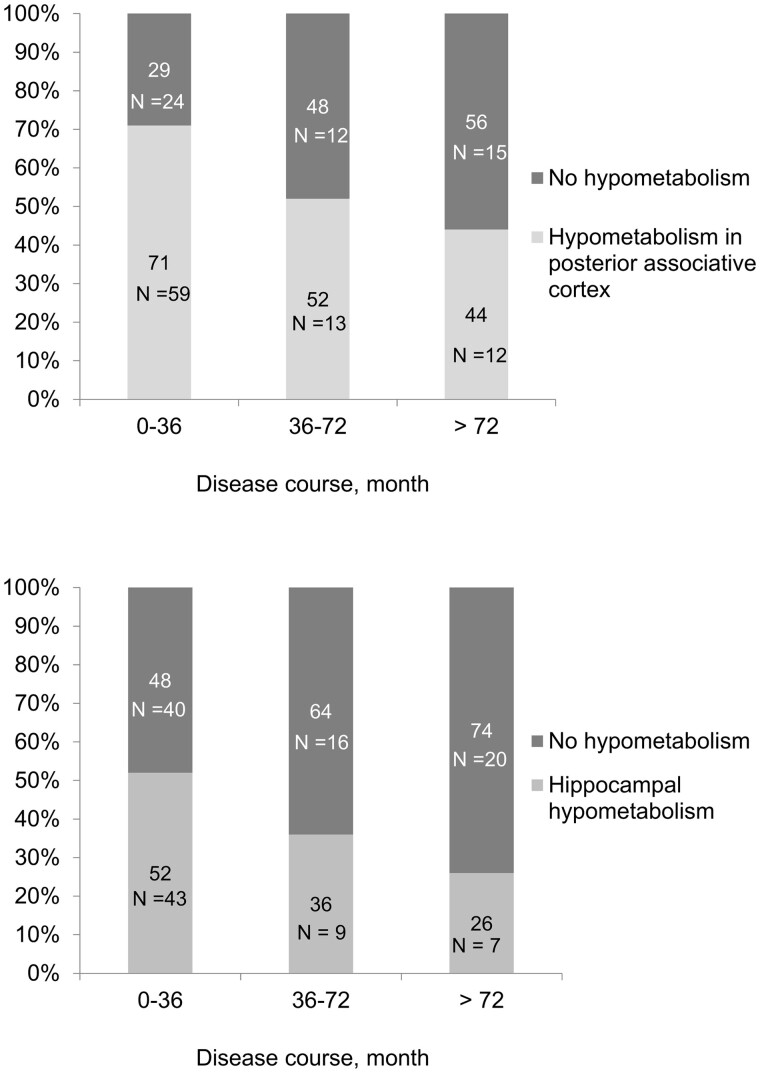
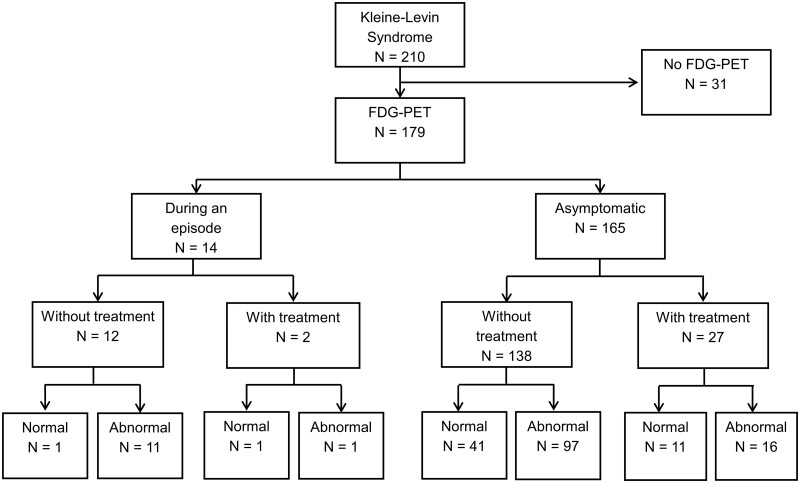
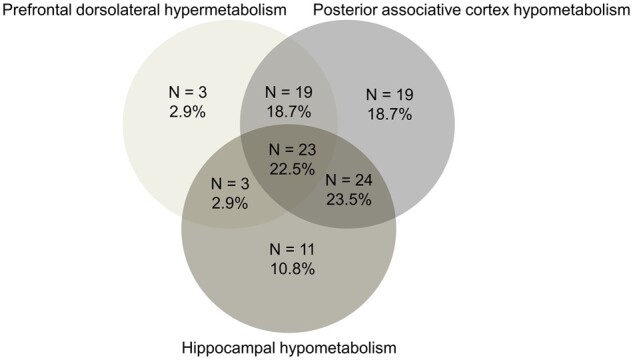
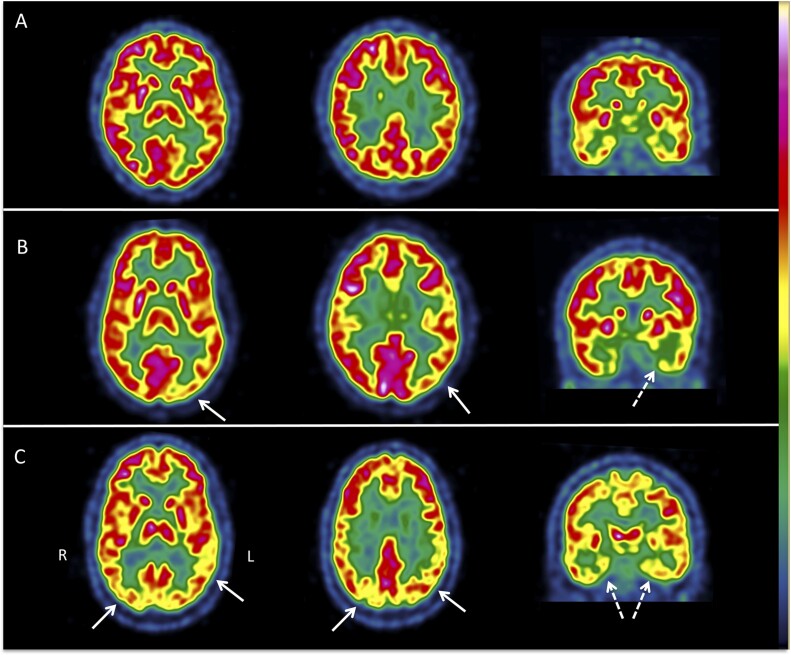
Kleine-Levin syndrome is a rare disorder characterized by relapsing-remitting episodes of severe hypersomnia, cognitive impairment, apathy, derealization and behavioural disturbances. Between episodes, most patients experience normal sleep, mood and behaviour, but they may have some residual abnormalities in brain functional imaging; however, the frequency, localization and significance of abnormal imaging are unknown, as brain functional imaging have been scarce and heterogenous [including scintigraphy 18F-fluorodeoxyglucose positron emission tomography/computerized tomography (FDG-PET/CT) and functional MRI during resting state and cognitive effort] and based on case reports or on group analysis in small groups. Using visual individual analysis of 18F-fluorodeoxyglucose positron emission tomography/computerized tomography at the time of Kleine-Levin syndrome diagnosis, we examined the frequency, localization and clinical determinants of hypo- and hypermetabolism in a cross-sectional study. Among 179 patients with Kleine-Levin syndrome who underwent 18F-fluorodeoxyglucose positron emission tomography/computerized tomography, the visual analysis was restricted to the 138 untreated patients studied during asymptomatic periods. As many as 70% of patients had hypometabolism, mostly affecting the posterior associative cortex and the hippocampus. Hypometabolism was associated with younger age, recent (<3years) disease course and a higher number of episodes during the preceding year. The hypometabolism was more extensive (from the left temporo-occipital junction to the entire homolateral and then the bilateral posterior associative cortex) at the beginning of the disorder. In contrast, there was hypermetabolism in the prefrontal dorsolateral cortex in half of the patients (almost all having concomitant hypometabolism in the posterior areas), which was also associated with younger age and shorter disease course. The cognitive performances (including episodic memory) were similar in patients with versus without hippocampus hypometabolism. In conclusion, hypometabolism is frequently observed upon individual visual analysis of 18F-fluorodeoxyglucose positron emission tomography/computerized tomography during asymptomatic Kleine-Levin syndrome periods; it is mostly affecting the posterior associative cortex and the hippocampus and is mostly in young patients with recent-onset disease. Hypometabolism provides a trait marker during the first years of Kleine-Levin syndrome, which could help clinicians during the diagnosis process.
克莱恩-莱文综合征是一种罕见的疾病,其特征为严重嗜睡、认知障碍、冷漠、现实解体及行为紊乱的发作性缓解。在发作间期,大多数患者睡眠、情绪和行为正常,但脑功能成像可能存在一些残留异常;然而,由于脑功能成像稀缺且异质性较大(包括18F-氟脱氧葡萄糖正电子发射断层扫描/计算机断层扫描(FDG-PET/CT)以及静息状态和认知活动时的功能磁共振成像),且基于病例报告或小群体的分组分析,异常成像的频率、定位及意义尚不清楚。我们在一项横断面研究中,通过对克莱恩-莱文综合征诊断时的18F-氟脱氧葡萄糖正电子发射断层扫描/计算机断层扫描进行视觉个体分析,研究了代谢减低和代谢增高的频率、定位及临床决定因素。在179例接受18F-氟脱氧葡萄糖正电子发射断层扫描/计算机断层扫描的克莱恩-莱文综合征患者中,视觉分析仅限于138例无症状期接受研究的未治疗患者。多达70%的患者存在代谢减低,主要累及后联合皮质和海马。代谢减低与年龄较小、病程较短(<3年)及前一年发作次数较多有关。疾病初期,代谢减低范围更广泛(从左侧颞枕交界区至同侧整个区域,然后累及双侧后联合皮质)。相比之下,半数患者前额叶背外侧皮质存在代谢增高(几乎所有患者后区同时存在代谢减低),这也与年龄较小和病程较短有关。有或没有海马代谢减低的患者认知表现(包括情景记忆)相似。总之,在无症状的克莱恩-莱文综合征期,对18F-氟脱氧葡萄糖正电子发射断层扫描/计算机断层扫描进行个体视觉分析时经常观察到代谢减低;它主要累及后联合皮质和海马,多见于近期发病的年轻患者。代谢减低是克莱恩-莱文综合征最初几年的一个特征性标志物,有助于临床医生进行诊断。