da Silva Jean Marinho, Verlengia Rozangela, de Oliveira José Jonas, Ribeiro Anna Gabriela Silva Vilela, Barbosa Carolina Gabriela Reis, Stotzer Uliana Sbeguen, Crisp Alex Harley
Post-Graduate Program in Human Movement Sciences, Methodist University of Piracicaba (UNIMEP), Piracicaba, SP, Brazil.
Physical Education Department, University Centre of Itajubá (FEPI), Itajubá, Minas Gerais, Brazil.
Sports Med Health Sci. 2020 Dec;2(4):216-220. doi: 10.1016/j.smhs.2020.11.002. Epub 2020 Nov 19.
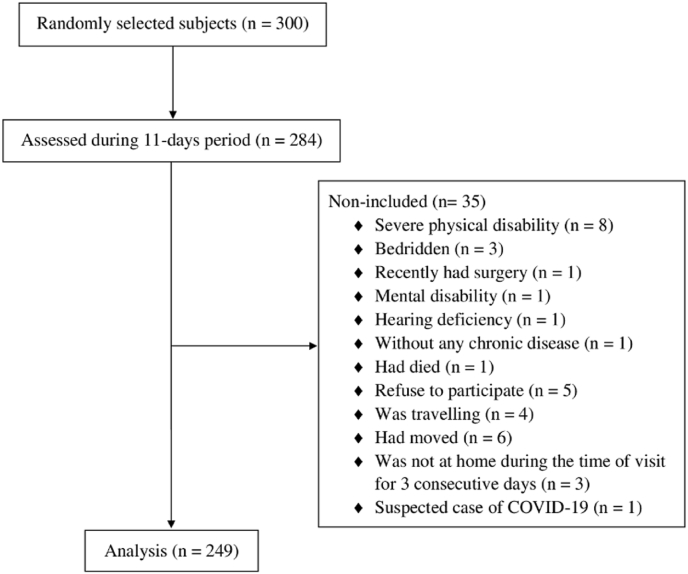
The pandemic of the new coronavirus (COVID-19) may be affecting the physical activity (PA) level in much of the population. This study aimed to investigate the prevalence of physical inactivity and sedentary behavior (SB) among adults with chronic diseases and their associations with sociodemographic factors during the COVID-19 pandemic. This cross-sectional study included 249 participants (age: 18-91 years; 61.4% female) with chronic conditions and attended the Family Health Strategy program in a small town in Brazil. Data were collected between 2020-07-13 and 2020-07-24 by face-to-face interviews. Self-reported PA, sitting time, chronic diseases, medication use, sociodemographic data, and self-isolation adherence were obtained by questionnaire. During this specific time point of the COVID-19 pandemic, 71.5% of participants did not meet the PA recommendations (≥500 METs-min/week), and the prevalence of SB risk (≥4 h sitting) was 62.7%. Adjusted logistic regression indicated that male participants (odds ratio [OR]: 1.89 [95% CI 1.02-3.53]), living alone (OR: 2.92 [95% CI 1.03-8.30]) or in a two-person household (OR: 2.32 [95% CI 1.16-4.63]), and those who reported sometimes performing self-isolation (OR: 3.07 [95% CI 1.47-6.40]) were more likely to meet the minimum PA recommendations. Current smokers had a lower odds (OR: 0.36 [95% CI 0.14-0.95]) of meeting the PA recommendations. Older participants (OR: 2.18 [95% CI 1.06-4.50]) and those who had multimorbidity (OR: 1.92 [95% CI 1.07-3.44]) were more likely to have a higher degree of SB. There is an urgent need to mitigate physical inactivity and SB, and public health interventions must take into account sociodemographic status.
新型冠状病毒(COVID-19)大流行可能正在影响大部分人群的身体活动(PA)水平。本研究旨在调查慢性病成年人中身体活动不足和久坐行为(SB)的患病率及其在COVID-19大流行期间与社会人口学因素的关联。这项横断面研究纳入了249名患有慢性病且参加了巴西一个小镇家庭健康战略项目的参与者(年龄:18 - 91岁;61.4%为女性)。在2020年7月13日至2020年7月24日期间通过面对面访谈收集数据。通过问卷调查获取自我报告的身体活动、久坐时间、慢性病、药物使用、社会人口学数据以及自我隔离依从性。在COVID-19大流行的这个特定时间点,71.5%的参与者未达到身体活动建议(≥500梅脱 - 分钟/周),久坐行为风险(≥4小时久坐)的患病率为62.7%。调整后的逻辑回归表明,男性参与者(比值比[OR]:1.89 [95%置信区间1.02 - 3.53])、独居者(OR:2.92 [95%置信区间1.03 - 8.30])或两人家庭居住者(OR:2.32 [95%置信区间1.16 - 4.63])以及那些报告有时进行自我隔离的人(OR:3.07 [95%置信区间1.47 - 6.40])更有可能达到最低身体活动建议。当前吸烟者达到身体活动建议的几率较低(OR:0.36 [95%置信区间0.14 - 0.95])。年龄较大的参与者(OR:2.18 [95%置信区间1.06 - 4.50])和患有多种疾病的人(OR:1.92 [95%置信区间1.07 - 3.44])更有可能有更高程度的久坐行为。迫切需要减轻身体活动不足和久坐行为,公共卫生干预必须考虑社会人口学状况。