Department of Biomedical Informatics, University of Utah, Salt Lake City, UT, United States.
Department of Biomedical Informatics, University of Utah, Salt Lake City, UT, United States; College of Nursing, University of Utah, Salt Lake City, UT, United States.
J Biomed Inform. 2021 Aug;120:103852. doi: 10.1016/j.jbi.2021.103852. Epub 2021 Jun 28.
Development and dissemination of public health (PH) guidance to healthcare organizations and the general public (e.g., businesses, schools, individuals) during emergencies like the COVID-19 pandemic is vital for policy, clinical, and public decision-making. Yet, the rapidly evolving nature of these events poses significant challenges for guidance development and dissemination strategies predicated on well-understood concepts and clearly defined access and distribution pathways. Taxonomies are an important but underutilized tool for guidance authoring, dissemination and updating in such dynamic scenarios.
To design a rapid, semi-automated method for sampling and developing a PH guidance taxonomy using widely available Web crawling tools and streamlined manual content analysis.
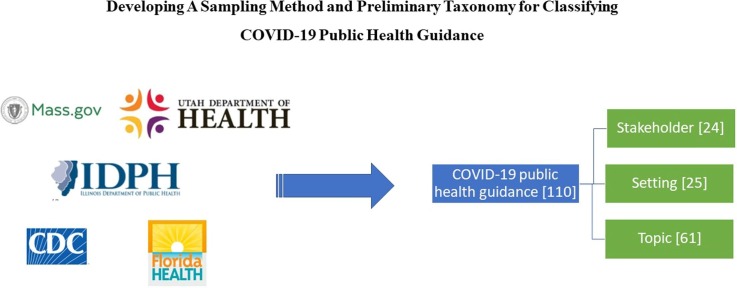
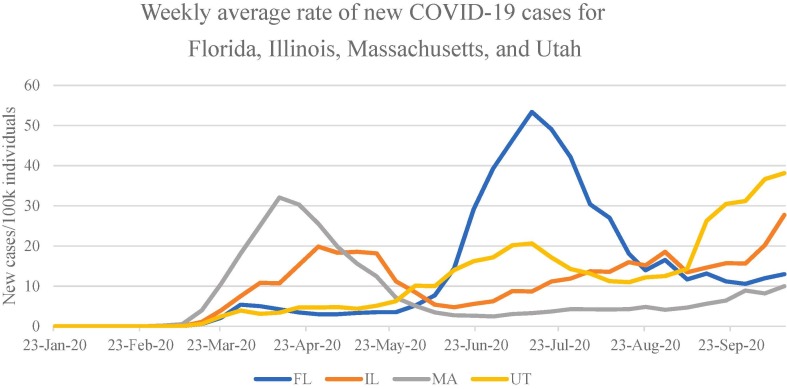
Iterative samples of guidance documents were taken from four state PH agency websites, the US Center for Disease Control and Prevention, and the World Health Organization. Documents were used to derive and refine a preliminary taxonomy of COVID-19 PH guidance via content analysis.
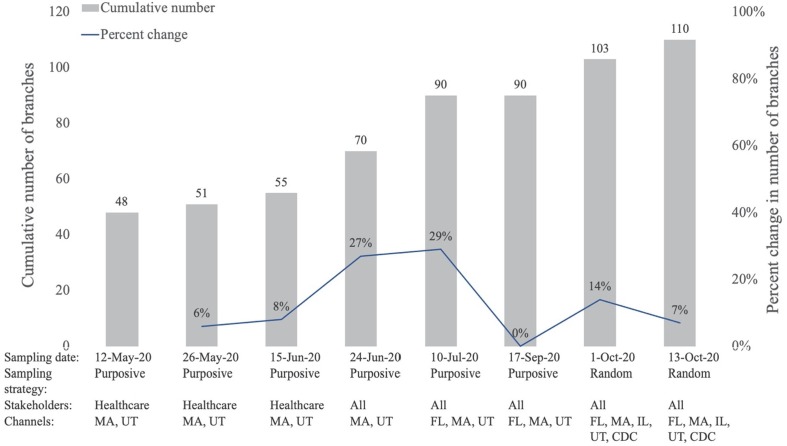
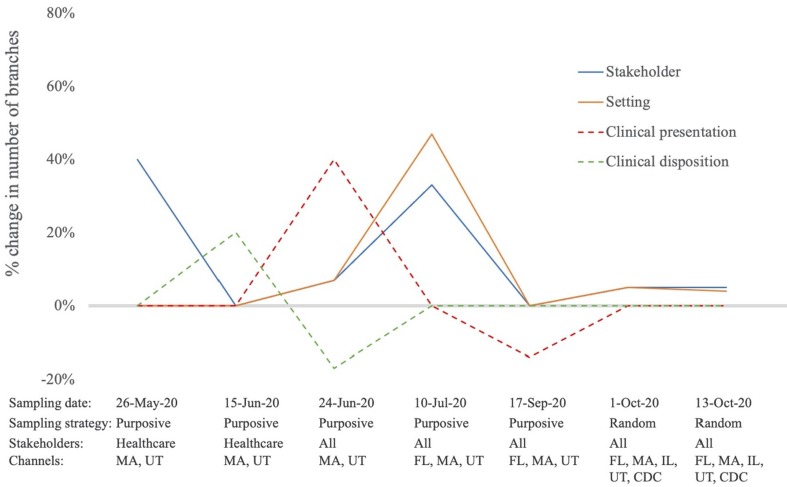
Eight iterations of guidance document sampling and taxonomy revisions were performed, with a final corpus of 226 documents. The preliminary taxonomy contains 110 branches distributed between three major domains: stakeholders (24 branches), settings (25 branches) and topics (61 branches). Thematic saturation measures indicated rapid saturation (≤5% change) for the domains of "stakeholders" and "settings", and "topic"-related branches for clinical decision-making. Branches related to business reopening and economic consequences remained dynamic throughout sampling iterations.
The PH guidance taxonomy can support public health agencies by aligning guidance development with curation and indexing strategies; supporting targeted dissemination; increasing the speed of updates; and enhancing public-facing guidance repositories and information retrieval tools. Taxonomies are essential to support knowledge management activities during rapidly evolving scenarios such as disease outbreaks and natural disasters.
在 COVID-19 等紧急情况下,向医疗机构和公众(例如企业、学校、个人)开发和传播公共卫生(PH)指南对于政策、临床和公众决策至关重要。然而,这些事件的快速演变性质对基于充分理解的概念和明确界定的获取和分配途径的指南开发和传播策略构成了重大挑战。分类法是在这种动态情况下进行指南编写、传播和更新的重要但未充分利用的工具。
设计一种快速、半自动的方法,使用广泛可用的 Web 爬虫工具和简化的手动内容分析来对 PH 指南进行抽样和开发。
从四个州 PH 机构网站、美国疾病控制与预防中心和世界卫生组织中抽取了迭代的指南文件样本。通过内容分析,使用这些文件来得出和完善 COVID-19 PH 指南的初步分类法。
进行了八次指南文件抽样和分类法修订,最终的语料库包含 226 份文件。初步分类法包含 110 个分支,分布在三个主要领域:利益相关者(24 个分支)、环境(25 个分支)和主题(61 个分支)。主题饱和度测量表明,“利益相关者”和“环境”领域以及与临床决策相关的“主题”分支迅速达到饱和(变化≤5%)。与企业重新开放和经济后果相关的分支在整个抽样迭代过程中仍然很活跃。
PH 指南分类法可以通过将指南开发与策展和索引策略对齐、支持有针对性的传播、提高更新速度以及增强面向公众的指南存储库和信息检索工具来支持公共卫生机构。在疾病爆发和自然灾害等快速演变的情况下,分类法对于支持知识管理活动至关重要。