Turinetto Margherita, Scotto Giulia, Tuninetti Valentina, Giannone Gaia, Valabrega Giorgio
Department of Oncology, University of Torino, Torino, Italy.
Candiolo Cancer Institute, FPO-IRCCS, Candiolo, Italy.
Front Oncol. 2021 Jun 14;11:689829. doi: 10.3389/fonc.2021.689829. eCollection 2021.
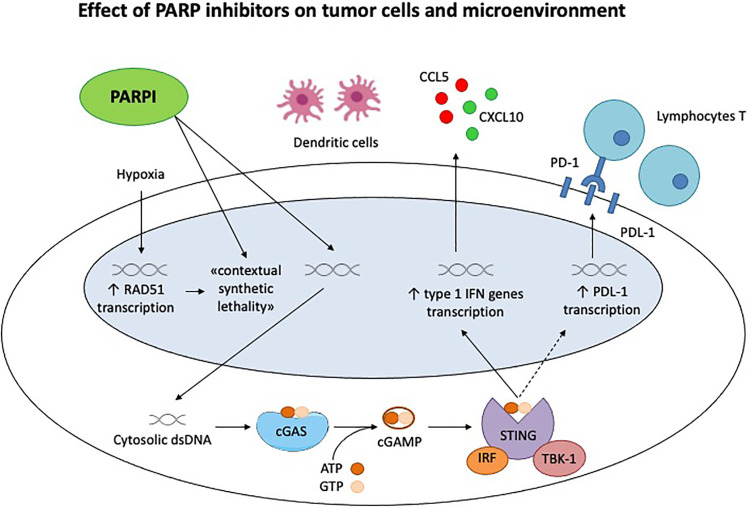
PARP inhibitors (PARPi) have shown promising clinical results and have revolutionized the landscape of ovarian cancer management in the last few years. While the core mechanism of action of these drugs has been largely analyzed, the interaction between PARP inhibitors and the microenvironment has been scarcely researched so far. Recent data shows a variety of mechanism through which PARPi might influence the tumor microenvironment and especially the immune system response, that might even partly be the reason behind PARPi efficacy. One of many pathways that are affected is the cGAS-cGAMP-STING; the upregulation of STING (stimulator of interferon genes), produces more Interferon ϒ and pro inflammatory cytokines, thus increasing intratumoral CD4+ and CD8+ T cells. Upregulation of immune checkpoints such as PD1-PDL1 has also been observed. Another interesting mechanism of interaction between PARPi and microenvironment is the ability of PARPi to kill hypoxic cells, as these cells show an intrinsic reduction in the expression and function of the proteins involved in HR. This process has been defined "contextual synthetic lethality". Despite ovarian cancer having always been considered a poor responder to immune therapy, data is now shedding a new light on the matter. First, OC is much more heterogenous than previously thought, therefore it is fundamental to select predictive biomarkers for target therapies. While single agent therapies have not yielded significant results on the long term, influencing the immune system and the tumor microenvironment the concomitant use of PARPi and other target therapies might be a more successful approach.
聚(ADP - 核糖)聚合酶抑制剂(PARPi)已展现出令人鼓舞的临床效果,并在过去几年彻底改变了卵巢癌的治疗格局。虽然这些药物的核心作用机制已得到大量分析,但迄今为止,PARP抑制剂与微环境之间的相互作用却鲜有研究。最新数据显示,PARPi可能通过多种机制影响肿瘤微环境,尤其是免疫系统反应,这甚至可能部分是PARPi疗效背后的原因。受影响的众多途径之一是cGAS - cGAMP - STING途径;STING(干扰素基因刺激因子)的上调会产生更多的干扰素γ和促炎细胞因子,从而增加肿瘤内的CD4 +和CD8 + T细胞。还观察到免疫检查点如PD1 - PDL1的上调。PARPi与微环境之间另一个有趣的相互作用机制是PARPi杀死缺氧细胞的能力,因为这些细胞显示出参与同源重组(HR)的蛋白质表达和功能的内在降低。这一过程被定义为“背景合成致死”。尽管卵巢癌一直被认为对免疫治疗反应不佳,但现在的数据为这一问题带来了新的曙光。首先卵巢癌比以前认为的更加异质性,因此选择预测性生物标志物用于靶向治疗至关重要。虽然单药治疗长期未取得显著效果,但影响免疫系统和肿瘤微环境,PARPi与其他靶向治疗药物联合使用可能是一种更成功的方法。