Piao Jinlan, Lim Hyun Ji, Lee Maria
Department of Obstetrics and Gynecology, Seoul National University College of Medicine, Seoul, Korea.
Department of Obstetrics and Gynecology, Seoul National University Hospital, Seoul, Korea.
Obstet Gynecol Sci. 2020 May;63(3):346-356. doi: 10.5468/ogs.2020.63.3.346. Epub 2020 Mar 24.
To investigate the prognostic significance of programmed cell death ligand-1 (PD-L1) in ovarian cancer.
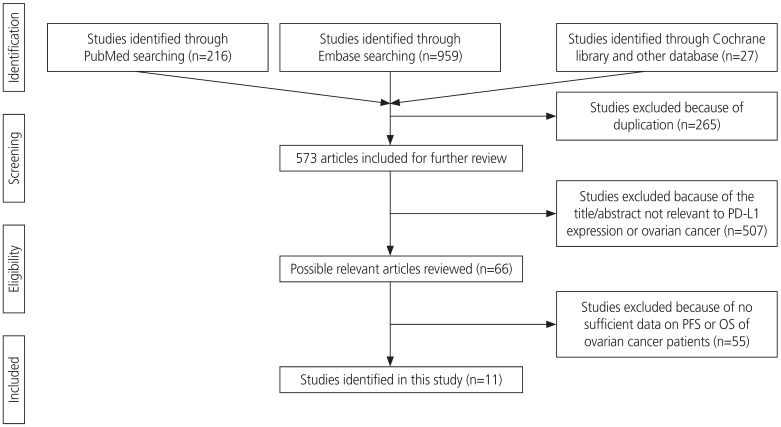
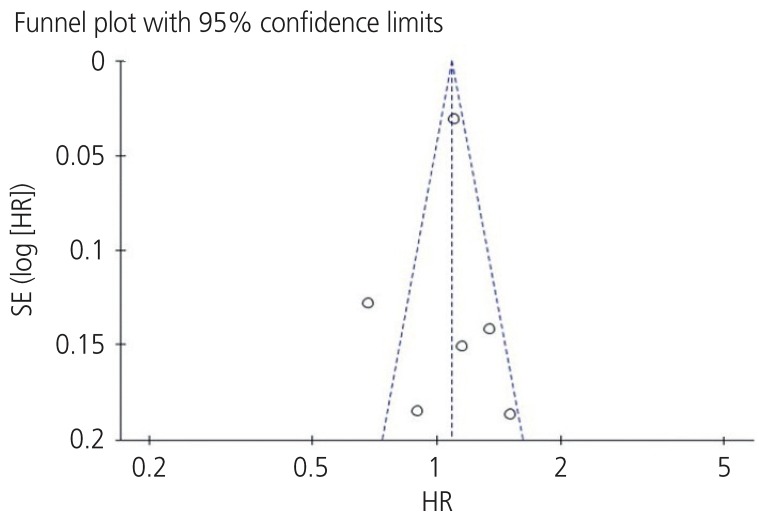
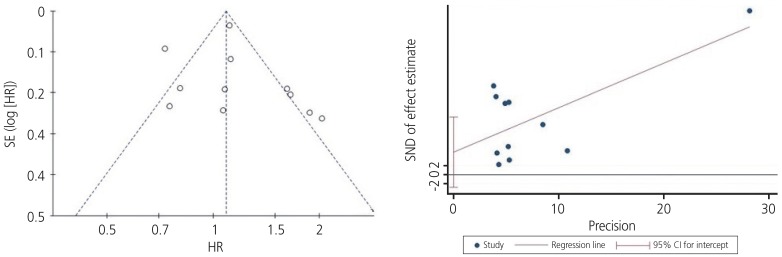
PubMed, Embase, and Cochrane Library databases were searched to identify studies that examined the prognostic significance of immunohistochemically assessed PD-L1 expression in histologically confirmed ovarian cancer. Eleven studies on PD-L1 expression involving 1,296 patients with ovarian cancer were included in this meta-analysis. Pooled hazard ratios (HRs) with corresponding 95% confidence intervals (CIs) were analyzed. Relationship between PD-L1 expression, and overall survival (OS) or progression-free survival (PFS) among patients with ovarian cancer was assessed. Subgroup analysis was performed based on the race, histologic type, and tumor International Federation of Gynecology and Obstetrics stage to evaluate the source of heterogeneity. Begg's Funnel plot and Egger's linear test were used to evaluate publication bias. Random-effects model was implemented when significant between-study heterogeneity (I>50%) was observed.
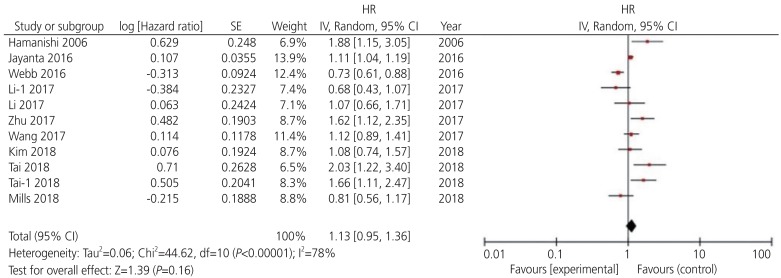
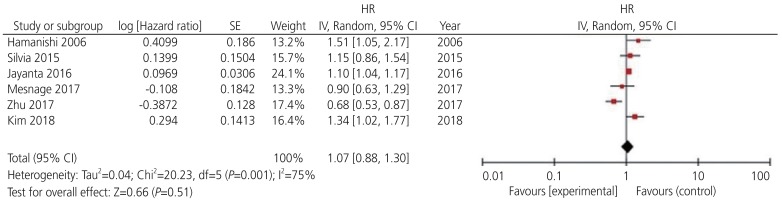
We found no correlation between PD-L1 expression, and OS (HR, 1.13; 95% CI, 0.95-1.36; I=78%) or PFS (HR, 1.07; 95% CI, 0.88-1.30; I=75%) in ovarian cancer. Subgroup analyses showed that higher PD-L1 expression was associated with poor OS in non-Asian patients with ovarian cancer (HR, 1.26; 95% CI, 1.07-1.481; I=59%). We found that upregulated PD-L1 expression to be a positive predictor for OS in serous ovarian cancer (HR, 0.98; 95% CI, 0.76-1.26; I=74%) and a negative predictor for OS in non-serous ovarian cancer (HR, 1.29; 95% CI, 1.03-1.61; I=64%) Furthermore, high PD-L1 expression was found to be a negative predictor for PFS of patients with non-serous ovarian cancer (HR, 1.12; 95% CI, 0.96-1.29; I=37%).
Our meta-analysis suggests that PD-L1 expression is not associated with patient risk for ovarian cancer.
探讨程序性细胞死亡配体1(PD-L1)在卵巢癌中的预后意义。
检索PubMed、Embase和Cochrane图书馆数据库,以确定研究组织学确诊的卵巢癌中免疫组化评估的PD-L1表达的预后意义的研究。本荟萃分析纳入了11项关于PD-L1表达的研究,涉及1296例卵巢癌患者。分析合并风险比(HRs)及相应的95%置信区间(CIs)。评估卵巢癌患者中PD-L1表达与总生存期(OS)或无进展生存期(PFS)之间的关系。根据种族、组织学类型和肿瘤国际妇产科联盟分期进行亚组分析,以评估异质性来源。采用Begg漏斗图和Egger线性检验评估发表偏倚。当观察到显著的研究间异质性(I>50%)时,采用随机效应模型。
我们发现卵巢癌中PD-L1表达与OS(HR,1.13;95%CI,0.95-1.36;I=78%)或PFS(HR,1.07;95%CI,0.88-1.30;I=75%)之间无相关性。亚组分析显示,在非亚洲卵巢癌患者中,较高的PD-L1表达与较差的OS相关(HR,1.26;95%CI,1.07-1.481;I=59%)。我们发现,浆液性卵巢癌中PD-L1表达上调是OS的阳性预测指标(HR,0.98;95%CI,0.76-1.26;I=74%),而非浆液性卵巢癌中是OS的阴性预测指标(HR,1.29;95%CI,1.03-1.61;I=64%)。此外,发现高PD-L1表达是非浆液性卵巢癌患者PFS的阴性预测指标(HR,1.12;95%CI,0.96-1.29;I=37%)。
我们的荟萃分析表明,PD-L1表达与卵巢癌患者风险无关。