
1%葡萄糖酸氯己定沐浴及涂抹润肤剂对住院早产儿细菌病原体定植动态的影响——一项初步临床试验
Impact of 1% chlorhexidine gluconate bathing and emollient application on bacterial pathogen colonization dynamics in hospitalized preterm neonates - A pilot clinical trial.
作者信息
Dramowski Angela, Pillay Sheylyn, Bekker Adrie, Abrahams Ilhaam, Cotton Mark F, Coffin Susan E, Whitelaw Andrew C
机构信息
Department of Paediatrics and Child Health, Faculty of Medicine and Health Sciences, Stellenbosch University, PO Box 241, Cape Town 8000, South Africa.
Division of Medical Microbiology, Department of Pathology, Faculty of Medicine and Health Sciences, Stellenbosch University and National Health Laboratory Service, Tygerberg Hospital, Cape Town, South Africa.
出版信息
EClinicalMedicine. 2021 Jun 18;37:100946. doi: 10.1016/j.eclinm.2021.100946. eCollection 2021 Jul.
BACKGROUND
Chlorhexidine gluconate (CHG) body washes and emollient application may modulate bacterial pathogen colonization and prevent neonatal hospital-acquired infections.
METHODS
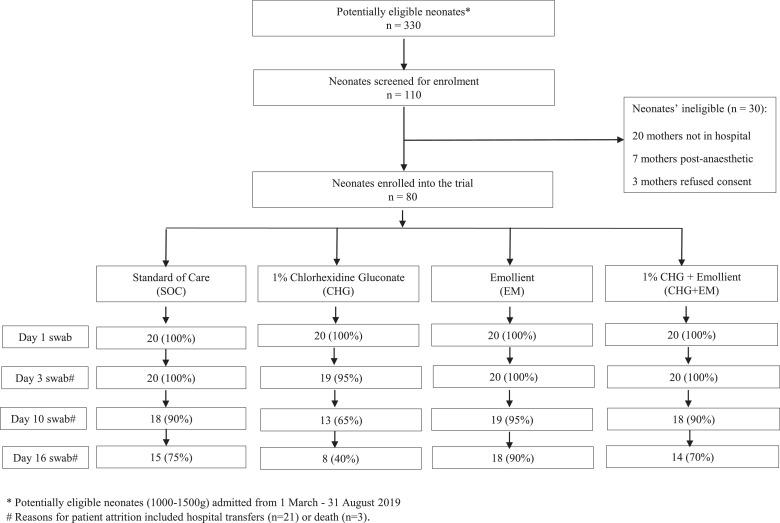
This pilot, non-randomized, open-label trial, enrolled preterm neonates (1000-1500g; day 1-3 of life) at a tertiary hospital in Cape Town, South Africa. Participants were sequentially allocated to 4 trial arms (n=20 each): 1% aqueous CHG (CHG), 1% CHG plus emollient (CHG+EM), emollient only (EM) and standard of care (SOC: no antiseptic/emollient). Trial treatment/s were applied daily for 10 days (d) post-enrolment, documenting neonatal skin condition score. Anterior nose, neck, umbilical and perianal swabs for bacterial culture were collected at d1, d3, d10 and d16 post-enrolment, (±1 day), reporting pathogen acquisition rates and semi-quantitative bacterial colony counts. (ClinicalTrials.gov identifier: NCT03896893; trial status: closed).
FINDINGS
Eighty preterm neonates (mean gestational age 30 weeks [SD 2]) were enrolled between 4 March and 26 August 2019. The bacterial pathogen acquisition rate (comparing d1 and d16 swabs) varied from 33·9% [95%CI 22·9-47·0] at the umbilicus, 39·3% [95%CI 27·6-52·4] at the neck, to 71·4% [95%CI 58·5-81·7] at both the nose and perianal region. At d10, CHG babies had reduced bacterial density detected from neck, umbilicus, and perianal swabs compared to other groups (see Table 3). Following intervention cessation, colonization density was similar across all trial arms, but colonization was more prevalent among EM and CHG+EM babies. Neonatal skin condition score improved in babies receiving emollient application (EM: -0·87 [95%CI 0·69-1·06] and CHG+EM: -0·73 [0·45-0·99]), compared to the SOC and CHG arms (Table 2); no CHG-related skin reactions occurred.
INTERPRETATION
Bacterial colonization density was significantly reduced in babies receiving 1% CHG washes but colonization levels rebounded rapidly post-intervention. Emollient application improved skin condition but was associated with higher rates of colonization.
FUNDING
South African Medical Research Council; National Institutes of Health (TW010682).
背景
葡萄糖酸氯己定(CHG)沐浴露和润肤剂的使用可能会调节细菌病原体的定植,并预防新生儿医院获得性感染。
方法
这项初步的、非随机、开放标签试验在南非开普敦的一家三级医院招募了早产新生儿(体重1000 - 1500克;出生后第1 - 3天)。参与者被依次分配到4个试验组(每组n = 20):1%的CHG水溶液(CHG)、1%的CHG加润肤剂(CHG + EM)、仅使用润肤剂(EM)和标准护理(SOC:不使用防腐剂/润肤剂)。试验治疗在入组后每天应用10天,记录新生儿皮肤状况评分。在入组后的第1天、第3天、第10天和第16天(±1天)采集前鼻孔、颈部、脐部和肛周拭子进行细菌培养,报告病原体获得率和半定量细菌菌落计数。(ClinicalTrials.gov标识符:NCT03896893;试验状态:已结束)。
结果
2019年3月4日至8月26日期间,共招募了80名早产新生儿(平均胎龄30周[标准差2])。细菌病原体获得率(比较第1天和第16天的拭子)在脐部为33.9%[95%置信区间22.9 - 47.0],在颈部为39.3%[95%置信区间27.6 - 52.4],在鼻孔和肛周区域均为71.(95%置信区间58.5 - 81.7)。在第10天,与其他组相比,使用CHG的婴儿从颈部、脐部和肛周拭子中检测到的细菌密度降低(见表3)。干预停止后,所有试验组的定植密度相似,但在使用润肤剂的婴儿(EM)和使用CHG加润肤剂的婴儿(CHG + EM)中定植更为普遍。与标准护理组(SOC)和CHG组相比,使用润肤剂的婴儿(EM:-0.87[95%置信区间0.69 - 1.06]和CHG + EM:-0.73[0.45 - 0.99])的新生儿皮肤状况评分有所改善(表2);未发生与CHG相关的皮肤反应。
解读
接受1% CHG沐浴露的婴儿细菌定植密度显著降低,但干预后定植水平迅速反弹。使用润肤剂可改善皮肤状况,但与较高的定植率相关。
资助
南非医学研究理事会;美国国立卫生研究院(TW010682)。


 Zotero 插件