Department of Anatomy, Physiology and Pharmacology, College of Medicine, University of Saskatchewan, Saskatoon, Saskatchewan, Canada.
Brain Behav. 2021 Aug;11(8):e2262. doi: 10.1002/brb3.2262. Epub 2021 Jul 1.
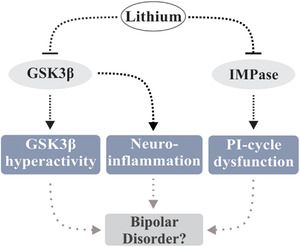
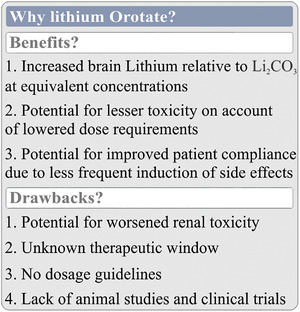
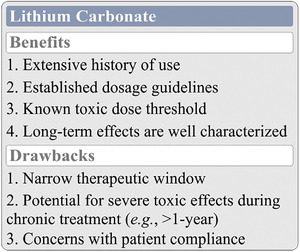
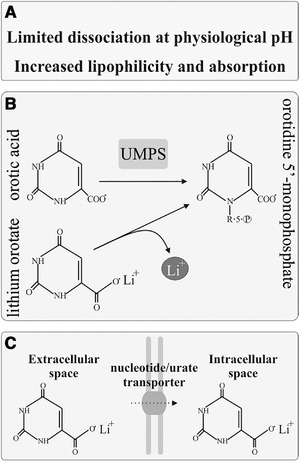
Bipolar disorder (BD) poses a significant public health concern, with roughly one-quarter of sufferers attempting suicide. BD is characterized by manic and depressive mood cycles, the recurrence of which can be effectively curtailed through lithium therapy. Unfortunately, the most frequently employed lithium salt, lithium carbonate (Li CO ), is associated with a host of adverse health outcomes following chronic use: these unwanted effects range from relatively minor inconveniences (e.g., polydipsia and polyuria) to potentially major complications (e.g., hypothyroidism and/or renal impairment). As these undesirable effects can limit patient compliance, an alternative lithium compound with a lesser toxicity profile would dramatically improve treatment efficacy and outcomes. Lithium orotate (LiC H N O ; henceforth referred to as LiOr), a compound largely abandoned since the late 1970s, may represent such an alternative. LiOr is proposed to cross the blood-brain barrier and enter cells more readily than Li CO , which will theoretically allow for reduced dosage requirements and ameliorated toxicity concerns. This review addresses the controversial history of LiOr, complete with discussions of experimental and clinical efficacy, putative mechanisms of action, adverse effects, and its potential future in therapy.
双相情感障碍 (BD) 是一个重大的公共卫生问题,大约四分之一的患者试图自杀。BD 的特征是躁狂和抑郁情绪周期,通过锂治疗可以有效地抑制其复发。不幸的是,最常使用的锂盐碳酸锂 (LiCO) 在长期使用后会引起一系列不良健康后果:这些副作用从相对较小的不便(例如多饮和多尿)到潜在的严重并发症(例如甲状腺功能减退和/或肾功能损害)不等。由于这些不良影响会限制患者的依从性,因此具有较低毒性特征的替代锂化合物将显著提高治疗效果和结果。自 20 世纪 70 年代末以来基本被放弃的锂代琥珀酸 (LiC H N O; 以下简称 LiOr) 可能是这样的一种替代物。LiOr 被提议能够比 LiCO 更容易地穿过血脑屏障并进入细胞,这在理论上可以减少剂量需求并减轻毒性问题。这篇综述讨论了 LiOr 的争议历史,包括对实验和临床疗效、潜在作用机制、不良反应以及它在治疗中的潜在未来的讨论。