Department of Renal Medicine, Lancashire Teaching Hospitals NHS Foundation Trust, Preston, United Kingdom.
Division of Cardiovascular Sciences, University of Manchester, Manchester, United Kingdom.
PLoS One. 2021 Jul 1;16(7):e0251652. doi: 10.1371/journal.pone.0251652. eCollection 2021.
Frailty is associated with adverse health outcomes in people with chronic kidney disease (CKD). Evidence supporting targeted interventions is needed. This pilot randomised controlled trial (RCT) aimed to inform the design of a definitive RCT evaluating the effectiveness of a home-based exercise intervention for pre-frail and frail older adults with CKD.
Participants were recruited from nephrology outpatient clinics to this two-arm parallel group mixed-methods pilot RCT. Inclusion criteria were: ≥65 years old; CKD G3b-5; and Clinical Frailty Scale score ≥4. Participants categorised as pre-frail or frail using the Frailty Phenotype were randomised to a 12-week progressive multi-component home-based exercise programme or usual care. Primary outcome measures included eligibility, recruitment, adherence, outcome measure completion and participant attrition rate. Semi-structured interviews were conducted with participants to explore trial and intervention acceptability.
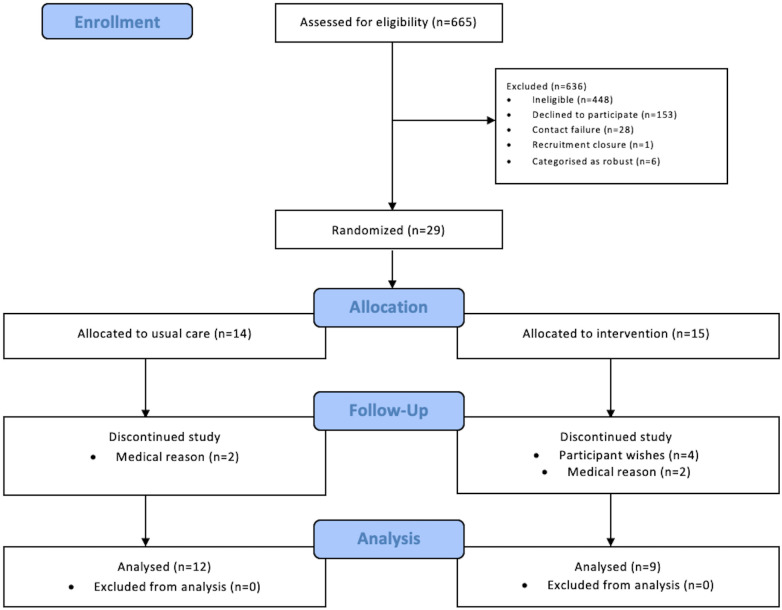
Six hundred and sixty-five patients had an eligibility assessment with 217 (33%; 95% CI 29, 36) eligible. Thirty-five (16%; 95% CI 12, 22) participants were recruited. Six were categorised as robust and withdrawn prior to randomisation. Fifteen participants were randomised to exercise and 14 to usual care. Eleven (73%; 95% CI 45, 91) participants completed ≥2 exercise sessions/week. Retained participants completed all outcome measures (n = 21; 100%; 95% CI 81, 100). Eight (28%; 95% CI 13, 47) participants were withdrawn. Fifteen participated in interviews. Decision to participate/withdraw was influenced by perceived risk of exercise worsening symptoms. Participant perceived benefits included improved fitness, balance, strength, well-being, energy levels and confidence.
This pilot RCT demonstrates that progression to definitive RCT is possible provided recruitment and retention challenges are addressed. It has also provided preliminary evidence that home-based exercise may be beneficial for people living with frailty and CKD.
ISRCTN87708989; https://clinicaltrials.gov/.
虚弱与慢性肾脏病(CKD)患者的不良健康结局相关。需要有针对性干预措施的证据。这项先导随机对照试验(RCT)旨在为一项评估针对 CKD 衰弱前期和衰弱期老年人的家庭为基础的运动干预有效性的确定性 RCT 设计提供信息。
该两臂平行组混合方法先导 RCT 招募了肾病科门诊的参与者。纳入标准为:年龄≥65 岁;CKD G3b-5;临床虚弱量表评分为≥4。使用虚弱表型对衰弱前期或衰弱期的参与者进行分类,并随机分配到为期 12 周的渐进式多组分家庭为基础的运动方案或常规护理。主要结局测量指标包括合格性、招募、依从性、完成结果测量和参与者失访率。对参与者进行半结构化访谈,以探讨试验和干预的可接受性。
665 名患者进行了资格评估,其中 217 名(33%;95%CI,29%,36%)合格。35 名(16%;95%CI,12%,22%)参与者被招募。6 名参与者被归类为强壮且在随机分组前退出。15 名参与者被随机分配到运动组,14 名参与者被分配到常规护理组。11 名(73%;95%CI,45%,91%)参与者每周完成≥2 次运动。保留的参与者完成了所有结局测量(n=21;100%;95%CI,81%,100%)。8 名(28%;95%CI,13%,47%)参与者退出。15 名参与者接受了访谈。参与/退出的决定受到对运动加重症状风险的认知影响。参与者认为的益处包括改善健康、平衡、力量、幸福感、能量水平和信心。
这项先导 RCT 表明,如果解决了招募和保留方面的挑战,向确定性 RCT 推进是可行的。它还提供了初步证据,表明家庭为基础的运动可能对患有衰弱和 CKD 的人有益。
ISRCTN87708989;https://clinicaltrials.gov/。