Gevity Consulting Inc., Ottawa, ON, Canada.
Center for Biologics Evaluation and Research, US Food and Drug Administration, Silver Spring, MD, United States of America.
PLoS One. 2021 Jul 1;16(7):e0253580. doi: 10.1371/journal.pone.0253580. eCollection 2021.
Healthcare administrative claims data hold value for monitoring drug safety and assessing drug effectiveness. The U.S. Food and Drug Administration Biologics Effectiveness and Safety Initiative (BEST) is expanding its analytical capacity by developing claims-based definitions-referred to as algorithms-for populations and outcomes of interest. Acute myocardial infarction (AMI) was of interest due to its potential association with select biologics and the lack of an externally validated International Classification of Diseases, 10th Revision, Clinical Modification (ICD-10-CM) algorithm.
Develop and apply an ICD-10-CM-based algorithm in a U.S. administrative claims database to identify and characterize AMI populations.
A comprehensive literature review was conducted to identify validated AMI algorithms. Building on prior published methodology and consistent application of ICD-9-CM codes, an ICD-10-CM algorithm was developed via forward-backward mapping using General Equivalence Mappings and refined with clinical input. An AMI population was then identified in the IBM® MarketScan® Research Databases and characterized using descriptive statistics.
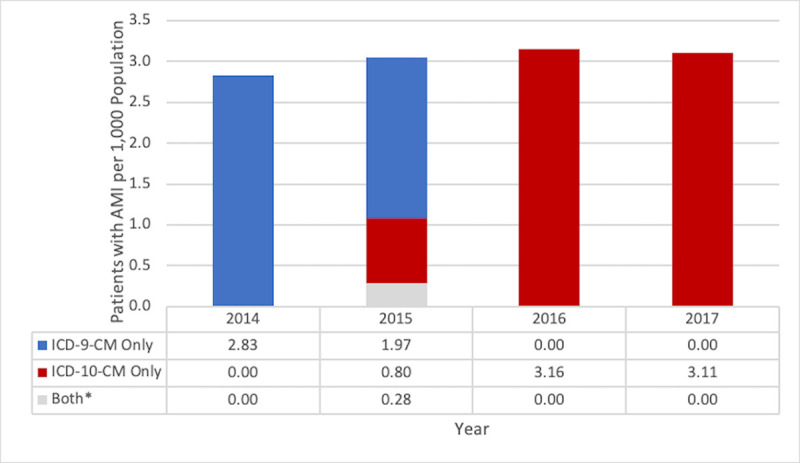
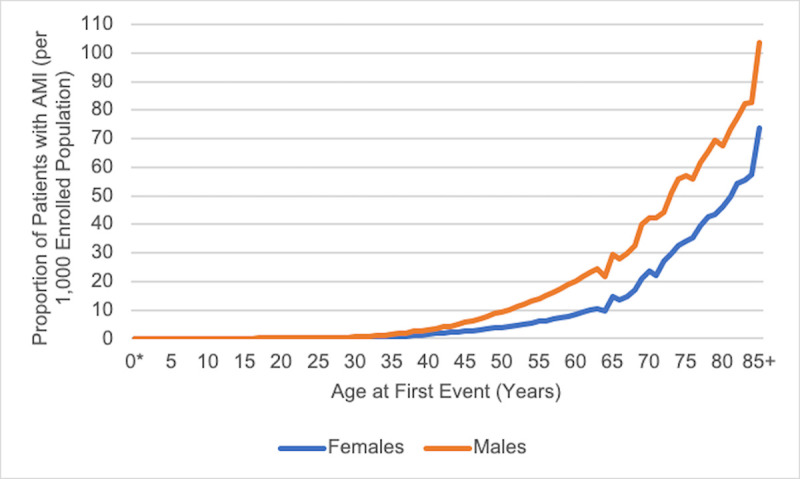
Between 2014-2017, 2.83-3.16 individuals/1,000 enrollees/year received ≥1 AMI diagnosis in any healthcare setting. The 2015 transition to ICD-10-CM did not result in a substantial change in the proportion of patients identified. Average patient age at first AMI diagnosis was 64.9 years, and 61.4% of individuals were male. Unspecified chest pain, hypertension, and coronary atherosclerosis of native coronary vessel/artery were most commonly reported within one day of AMI diagnosis. Electrocardiograms were the most common medical procedure and beta-blockers were the most commonly ordered cardiac medication in the one day before to 14 days following AMI diagnosis. The mean length of inpatient stay was 5.6 days (median 3 days; standard deviation 7.9 days). Findings from this ICD-10-CM-based AMI study were internally consistent with ICD-9-CM-based findings and externally consistent with ICD-9-CM-based studies, suggesting that this algorithm is ready for validation in future studies.
医疗保健行政索赔数据对于监测药物安全性和评估药物有效性具有重要价值。美国食品和药物管理局生物制品的有效性和安全性倡议(BEST)正在通过开发基于索赔的定义(称为算法)来扩大其分析能力,这些定义针对感兴趣的人群和结果。由于急性心肌梗死(AMI)与某些生物制剂的潜在关联以及缺乏外部验证的国际疾病分类,第 10 次修订版,临床修正(ICD-10-CM)算法,因此对此进行了研究。
在一个美国行政索赔数据库中开发和应用基于 ICD-10-CM 的算法,以识别和描述 AMI 人群。
进行了全面的文献回顾,以确定经过验证的 AMI 算法。在前人发表的方法的基础上,并一致应用 ICD-9-CM 代码,通过正向-反向映射使用通用等价映射(General Equivalence Mappings)开发了 ICD-10-CM 算法,并通过临床输入进行了改进。然后,在 IBM® MarketScan®Research Databases 中确定了 AMI 人群,并使用描述性统计数据进行了描述。
在 2014-2017 年期间,每 1000 名参保人中每年有 2.83-3.16 人在任何医疗保健环境中接受过≥1 次 AMI 诊断。2015 年向 ICD-10-CM 的过渡并没有导致所识别患者比例的实质性变化。首次 AMI 诊断时患者的平均年龄为 64.9 岁,61.4%的人为男性。在 AMI 诊断后一天内,最常报告的是未指定的胸痛,高血压和原生冠状动脉/动脉的冠状动脉粥样硬化。在 AMI 诊断前一天至 14 天内,心电图是最常见的医疗程序,β受体阻滞剂是最常用的心脏药物。住院患者的平均住院时间为 5.6 天(中位数为 3 天;标准差为 7.9 天)。基于 ICD-10-CM 的 AMI 研究的结果与基于 ICD-9-CM 的研究结果内部一致,与基于 ICD-9-CM 的研究结果外部一致,表明该算法已准备好在未来的研究中进行验证。