Department of Biology, University of Rome 'Tor Vergata', 00133 Rome, Italy.
Institute of Cytology, 194064 Saint-Petersburg, Russia.
Int J Mol Sci. 2021 Jun 14;22(12):6366. doi: 10.3390/ijms22126366.
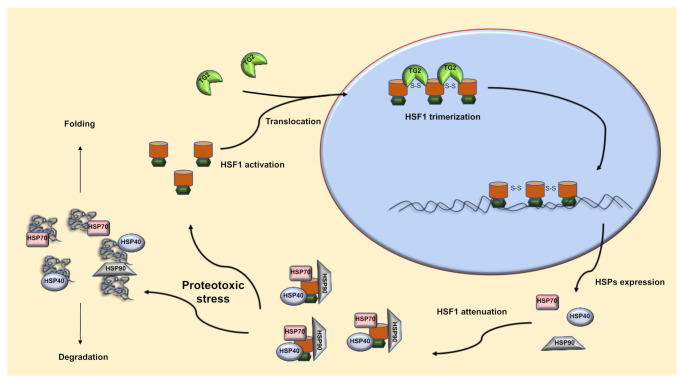
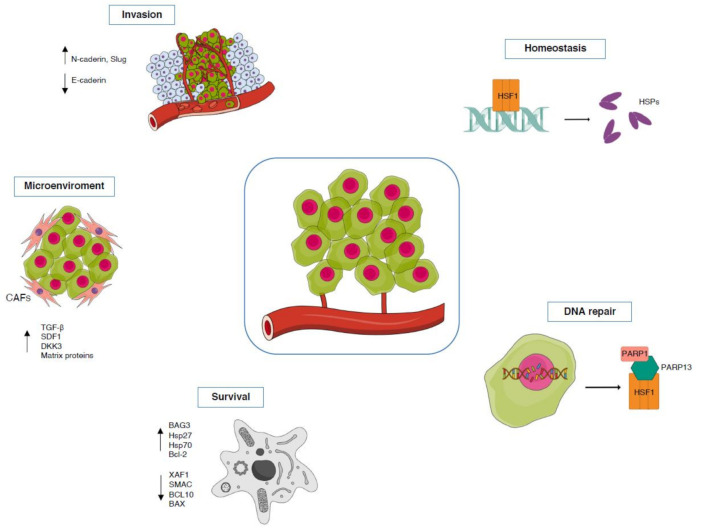
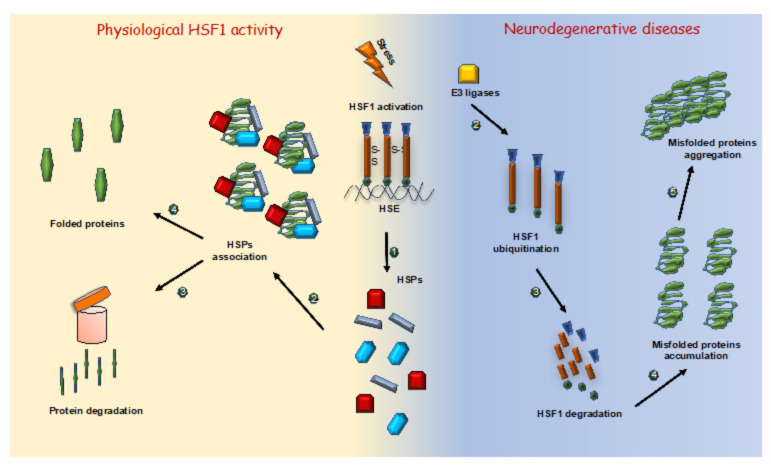
The cellular environment needs to be strongly regulated and the maintenance of protein homeostasis is crucial for cell function and survival. HSF1 is the main regulator of the heat shock response (HSR), the master pathway required to maintain proteostasis, as involved in the expression of the heat shock proteins (HSPs). HSF1 plays numerous physiological functions; however, the main role concerns the modulation of HSPs synthesis in response to stress. Alterations in HSF1 function impact protein homeostasis and are strongly linked to diseases, such as neurodegenerative disorders, metabolic diseases, and different types of cancers. In this context, type 2 Transglutaminase (TG2), a ubiquitous enzyme activated during stress condition has been shown to promote HSF1 activation. HSF1-TG2 axis regulates the HSR and its function is evolutionary conserved and implicated in pathological conditions. In this review, we discuss the role of HSF1 in the maintenance of proteostasis with regard to the HSF1-TG2 axis and we dissect the stress response pathways implicated in physiological and pathological conditions.
细胞环境需要受到严格的调控,而蛋白质稳态的维持对于细胞功能和生存至关重要。HSF1 是热休克反应 (HSR) 的主要调节剂,是维持蛋白质稳态的主要途径,参与热休克蛋白 (HSPs) 的表达。HSF1 发挥着许多生理功能;然而,其主要作用涉及到 HSPs 的合成对压力的响应的调节。HSF1 功能的改变会影响蛋白质稳态,并与神经退行性疾病、代谢疾病和不同类型的癌症等疾病密切相关。在这种情况下,在应激条件下被激活的普遍存在的酶 2 型转谷氨酰胺酶 (TG2) 已被证明可促进 HSF1 的激活。HSF1-TG2 轴调节 HSR,其功能在进化上是保守的,并与病理状况有关。在这篇综述中,我们讨论了 HSF1 在维持蛋白质稳态方面的作用,以及 HSF1-TG2 轴,并剖析了涉及生理和病理状况的应激反应途径。