Heo Nam Ju, Park Hyo Eun, Yoon Ji Won, Kwak Min-Sun, Yang Jong In, Chung Su Jin, Yim Jeong Yoon, Chung Goh Eun
Department of Nephrology, Internal Medicine, Seoul National University Hospital Healthcare System Gangnam Center, Seoul 06236, Korea.
Department of Cardiology, Internal Medicine, Seoul National University Hospital Healthcare System Gangnam Center, Seoul 06236, Korea.
J Clin Med. 2021 Jun 13;10(12):2611. doi: 10.3390/jcm10122611.
An association between nonalcoholic fatty liver disease (NAFLD) and low vitamin D levels has been suggested. We investigated the relationship between vitamin D and NAFLD assessed by controlled attenuation parameter (CAP).
We conducted a retrospective cohort study of apparently healthy subjects who underwent Fibroscan during health screening tests. NAFLD was diagnosed using CAP values.
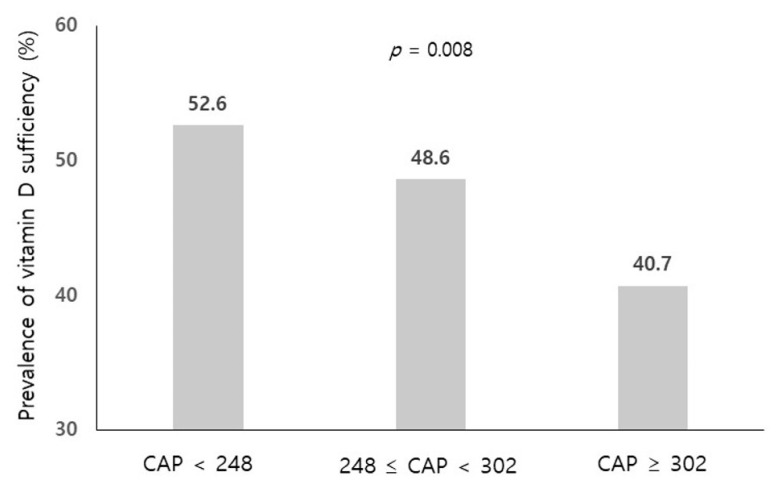
Among the 1202 subjects (mean age 57.2 years, 60.6% male), 630 (52.4%) subjects had NAFLD with CAP ≥ 248 dB/m. Multivariable analysis was conducted after adjusting for metabolic risk factors including diabetes, hypertension, hypercholesterolemia, body mass index, high-density lipoprotein cholesterol, triglyceride and smoking. Higher vitamin D levels showed a lower risk of NAFLD compared to the lowest quartile of vitamin D in a dose-dependent manner (OR 0.68, 95% CI 0.47-1.00 in Q2 vs. Q1; OR 0.65, 95% CI 0.44-0.94 in Q3 vs. Q1; and OR 0.64, 95% CI 0.44-0.94 in Q4 vs. Q1). The highest quartile of vitamin D showed a decreased risk of a severe grade of steatosis (CAP ≥ 302 dB/m) compared to the lowest quartile (OR 0.52, 95% CI 0.31-0.87 in Q4 vs. Q1).
Higher levels of serum vitamin D were associated with a decreased risk of CAP-defined NAFLD, compared to low levels of serum vitamin D. The association between NAFLD and vitamin D suggests that vitamin D may exert a protective role against NAFLD.
非酒精性脂肪性肝病(NAFLD)与低维生素D水平之间的关联已被提出。我们研究了通过受控衰减参数(CAP)评估的维生素D与NAFLD之间的关系。
我们对在健康筛查测试中接受Fibroscan检查的明显健康受试者进行了一项回顾性队列研究。使用CAP值诊断NAFLD。
在1202名受试者(平均年龄57.2岁,60.6%为男性)中,630名(52.4%)受试者的CAP≥248 dB/m,被诊断为NAFLD。在调整了包括糖尿病、高血压、高胆固醇血症、体重指数、高密度脂蛋白胆固醇、甘油三酯和吸烟等代谢危险因素后,进行了多变量分析。与维生素D最低四分位数相比,较高的维生素D水平以剂量依赖的方式显示出较低的NAFLD风险(第二四分位数与第一四分位数相比,OR为0.68,95%CI为0.47-1.00;第三四分位数与第一四分位数相比,OR为0.65,95%CI为0.44-0.94;第四四分位数与第一四分位数相比,OR为0.64,95%CI为0.44-0.94)。与最低四分位数相比,维生素D最高四分位数显示出严重脂肪变性(CAP≥302 dB/m)风险降低(第四四分位数与第一四分位数相比,OR为0.52,95%CI为0.31-0.87)。
与低血清维生素D水平相比,较高的血清维生素D水平与CAP定义的NAFLD风险降低相关。NAFLD与维生素D之间的关联表明,维生素D可能对NAFLD发挥保护作用。