• 文献检索
  • 文档翻译
  • 深度研究
  • 学术资讯
  • Suppr Zotero 插件Zotero 插件
  • 邀请有礼
  • 套餐&价格
  • 历史记录
应用&插件
Suppr Zotero 插件Zotero 插件浏览器插件Mac 客户端Windows 客户端微信小程序
定价
高级版会员购买积分包购买API积分包
服务
文献检索文档翻译深度研究API 文档MCP 服务
关于我们
关于 Suppr公司介绍联系我们用户协议隐私条款
关注我们

Suppr 超能文献

核心技术专利:CN118964589B侵权必究
粤ICP备2023148730 号-1Suppr @ 2026

文献检索

告别复杂PubMed语法,用中文像聊天一样搜索,搜遍4000万医学文献。AI智能推荐,让科研检索更轻松。

立即免费搜索

文件翻译

保留排版,准确专业,支持PDF/Word/PPT等文件格式,支持 12+语言互译。

免费翻译文档

深度研究

AI帮你快速写综述,25分钟生成高质量综述,智能提取关键信息,辅助科研写作。

立即免费体验

用于活动识别和行人识别的足底压力自适应累积

Adaptive Accumulation of Plantar Pressure for Ambulatory Activity Recognition and Pedestrian Identification.

机构信息

Robot Division, Korea Institute of Industrial Technology, Ansan 15588, Korea.

School of Electrical Engineering, Kookmin University, Seoul 02707, Korea.

出版信息

Sensors (Basel). 2021 Jun 2;21(11):3842. doi: 10.3390/s21113842.

DOI:10.3390/s21113842
PMID:34199381
原文链接:https://pmc.ncbi.nlm.nih.gov/articles/PMC8199628/
Abstract

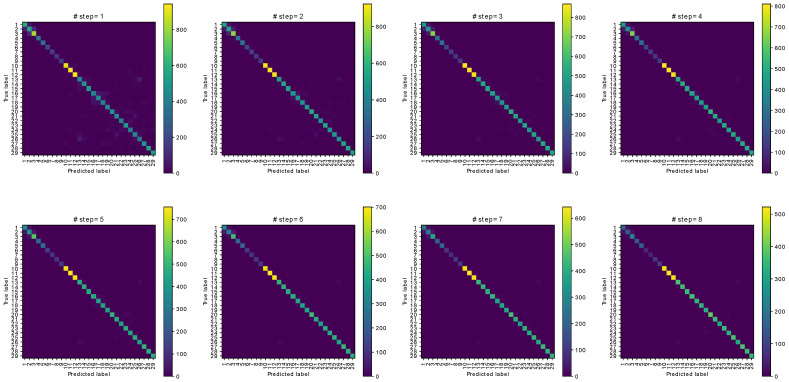
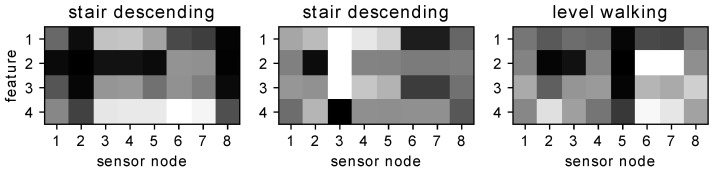
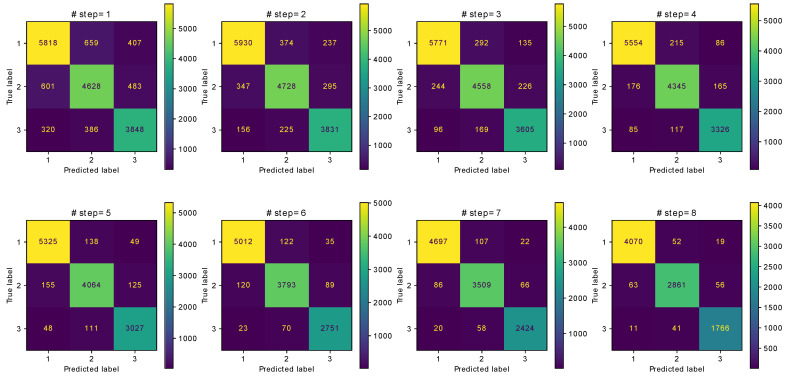
In this paper, we propose a novel method for ambulatory activity recognition and pedestrian identification based on temporally adaptive weighting accumulation-based features extracted from categorical plantar pressure. The method relies on three pressure-related features, which are calculated by accumulating the pressure of the standing foot in each step over three different temporal weighting forms. In addition, we consider a feature reflecting the pressure variation. These four features characterize the standing posture in a step by differently weighting step pressure data over time. We use these features to analyze the standing foot during walking and then recognize ambulatory activities and identify pedestrians based on multilayer multiclass support vector machine classifiers. Experimental results show that the proposed method achieves 97% accuracy for the two tasks when analyzing eight consecutive steps. For faster processing, the method reaches 89.9% and 91.3% accuracy for ambulatory activity recognition and pedestrian identification considering two consecutive steps, respectively, whereas the accuracy drops to 83.3% and 82.3% when considering one step for the respective tasks. Comparative results demonstrated the high performance of the proposed method regarding accuracy and temporal sensitivity.

摘要

在本文中,我们提出了一种新的基于时间自适应加权累积特征的可穿戴活动识别和行人识别方法,该方法基于从类别足底压力中提取的特征。该方法依赖于三个与压力相关的特征,这些特征是通过在三个不同的时间加权形式下累积站立脚在每一步中的压力来计算的。此外,我们还考虑了一个反映压力变化的特征。这四个特征通过随时间对步压数据进行不同的加权来描述一步中的站立姿势。我们使用这些特征来分析行走过程中的站立脚,然后基于多层多类支持向量机分类器识别可穿戴活动和行人。实验结果表明,该方法在分析连续八步时,在这两个任务上的准确率达到 97%。为了更快的处理速度,该方法在考虑连续两步时,对可穿戴活动识别和行人识别的准确率分别达到 89.9%和 91.3%,而在考虑一步时,准确率分别下降到 83.3%和 82.3%。比较结果表明,该方法在准确性和时间敏感性方面具有很高的性能。

https://cdn.ncbi.nlm.nih.gov/pmc/blobs/d6f3/8199628/4a75233c7e30/sensors-21-03842-g006.jpg
https://cdn.ncbi.nlm.nih.gov/pmc/blobs/d6f3/8199628/656fd0b65add/sensors-21-03842-g001.jpg
https://cdn.ncbi.nlm.nih.gov/pmc/blobs/d6f3/8199628/3e895a6fa76c/sensors-21-03842-g002.jpg
https://cdn.ncbi.nlm.nih.gov/pmc/blobs/d6f3/8199628/615b65887822/sensors-21-03842-g003.jpg
https://cdn.ncbi.nlm.nih.gov/pmc/blobs/d6f3/8199628/c690b4565f1c/sensors-21-03842-g004.jpg
https://cdn.ncbi.nlm.nih.gov/pmc/blobs/d6f3/8199628/06a46c1508c7/sensors-21-03842-g005.jpg
https://cdn.ncbi.nlm.nih.gov/pmc/blobs/d6f3/8199628/4a75233c7e30/sensors-21-03842-g006.jpg
https://cdn.ncbi.nlm.nih.gov/pmc/blobs/d6f3/8199628/656fd0b65add/sensors-21-03842-g001.jpg
https://cdn.ncbi.nlm.nih.gov/pmc/blobs/d6f3/8199628/3e895a6fa76c/sensors-21-03842-g002.jpg
https://cdn.ncbi.nlm.nih.gov/pmc/blobs/d6f3/8199628/615b65887822/sensors-21-03842-g003.jpg
https://cdn.ncbi.nlm.nih.gov/pmc/blobs/d6f3/8199628/c690b4565f1c/sensors-21-03842-g004.jpg
https://cdn.ncbi.nlm.nih.gov/pmc/blobs/d6f3/8199628/06a46c1508c7/sensors-21-03842-g005.jpg
https://cdn.ncbi.nlm.nih.gov/pmc/blobs/d6f3/8199628/4a75233c7e30/sensors-21-03842-g006.jpg

相似文献

1
Adaptive Accumulation of Plantar Pressure for Ambulatory Activity Recognition and Pedestrian Identification.用于活动识别和行人识别的足底压力自适应累积
Sensors (Basel). 2021 Jun 2;21(11):3842. doi: 10.3390/s21113842.
2
Pedestrian Navigation Method Based on Machine Learning and Gait Feature Assistance.基于机器学习和步态特征辅助的行人导航方法。
Sensors (Basel). 2020 Mar 10;20(5):1530. doi: 10.3390/s20051530.
3
Gait Recognition Based on the Plantar Pressure Data of Ice and Snow Athletes.基于冰雪运动员足底压力数据的步态识别。
Comput Intell Neurosci. 2022 Jul 30;2022:2982894. doi: 10.1155/2022/2982894. eCollection 2022.
4
Pedestrian Navigation Using Foot-Mounted Inertial Sensor and LIDAR.使用足部惯性传感器和激光雷达的行人导航
Sensors (Basel). 2016 Jan 19;16(1):120. doi: 10.3390/s16010120.
5
Research on the Forward and Reverse Calculation Based on the Adaptive Zero-Velocity Interval Adjustment for the Foot-Mounted Inertial Pedestrian-Positioning System.基于自适应零速区间调整的足部惯性行人定位系统的正反向推算研究。
Sensors (Basel). 2018 May 21;18(5):1642. doi: 10.3390/s18051642.
6
A Novel Pedestrian Navigation Algorithm for a Foot-Mounted Inertial-Sensor-Based System.一种用于基于足部惯性传感器系统的新型行人导航算法。
Sensors (Basel). 2016 Jan 21;16(1):139. doi: 10.3390/s16010139.
7
Robust Stride Detector from Ankle-Mounted Inertial Sensors for Pedestrian Navigation and Activity Recognition with Machine Learning Approaches.基于机器学习的踝关节惯性传感器稳健步长检测在行人导航和活动识别中的应用。
Sensors (Basel). 2019 Oct 16;19(20):4491. doi: 10.3390/s19204491.
8
Research on an Improved Method for Foot-Mounted Inertial/Magnetometer Pedestrian-Positioning Based on the Adaptive Gradient Descent Algorithm.基于自适应梯度下降算法的改进足式惯性/磁强计行人定位方法研究。
Sensors (Basel). 2018 Nov 23;18(12):4105. doi: 10.3390/s18124105.
9
A Method for Autonomous Multi-Motion Modes Recognition and Navigation Optimization for Indoor Pedestrian.室内行人自主多运动模式识别与导航优化方法
Sensors (Basel). 2022 Jul 3;22(13):5022. doi: 10.3390/s22135022.
10
Deep Learning-Based Human Activity Real-Time Recognition for Pedestrian Navigation.基于深度学习的行人导航实时人体活动识别。
Sensors (Basel). 2020 Apr 30;20(9):2574. doi: 10.3390/s20092574.

引用本文的文献

1
Bipedal Static Supination and Dynamic Forefoot Loading Characteristics in Taiwanese College Badminton Players: A Cross-Sectional Study.台湾大学生羽毛球运动员的双足静态旋后和动态前足负荷特征:一项横断面研究。
Bioengineering (Basel). 2023 Apr 21;10(4):498. doi: 10.3390/bioengineering10040498.
2
Elite Tennis Players Experiencing High-Arched Supination and Cuboids Dropped Foot Syndromes in Daily Normal Gait.在日常正常步态中,精英网球运动员会出现高拱形足旋前和骰骨下降足综合征。
Int J Environ Res Public Health. 2022 Jul 22;19(15):8897. doi: 10.3390/ijerph19158897.
3
Traceable Features of Static Plantar Pressure Characteristics and Foot Postures in College Students with Hemiplegic Cerebral Palsy.

本文引用的文献

1
Can Ensemble Deep Learning Identify People by Their Gait Using Data Collected from Multi-Modal Sensors in Their Insole?基于足底多模态传感器采集的数据,集成深度学习能否通过步态识别个体?
Sensors (Basel). 2020 Jul 18;20(14):4001. doi: 10.3390/s20144001.
2
A state-of-the-art review of foot pressure.足部压力的最新综述。
Foot Ankle Surg. 2020 Jan;26(1):25-32. doi: 10.1016/j.fas.2018.12.005. Epub 2018 Dec 24.
3
Examining sensor-based physical activity recognition and monitoring for healthcare using Internet of Things: A systematic review.
偏瘫型脑瘫大学生静态足底压力特征与足部姿势的可追溯特征
J Pers Med. 2022 Mar 4;12(3):394. doi: 10.3390/jpm12030394.
4
Characteristics of Plantar Pressure with Foot Postures and Lower Limb Pain Profiles in Taiwanese College Elite Rugby League Athletes.台湾高校精英触式橄榄球员的足底压力特征与下肢疼痛特征。
Int J Environ Res Public Health. 2022 Jan 20;19(3):1158. doi: 10.3390/ijerph19031158.
使用物联网技术进行医疗保健的基于传感器的身体活动识别和监测的研究:系统评价。
J Biomed Inform. 2018 Nov;87:138-153. doi: 10.1016/j.jbi.2018.09.002. Epub 2018 Sep 26.
4
Deep Recurrent Neural Networks for Human Activity Recognition.深度递归神经网络在人体活动识别中的应用。
Sensors (Basel). 2017 Nov 6;17(11):2556. doi: 10.3390/s17112556.
5
Daily wrist activity classification using a smart band.使用智能手环进行日常手腕活动分类。
Physiol Meas. 2017 Aug 18;38(9):L10-L16. doi: 10.1088/1361-6579/aa7c10.
6
Ambulatory activity classification with dendogram-based support vector machine: Application in lower-limb active exoskeleton.基于树形图的支持向量机的动态活动分类:在下肢主动外骨骼中的应用。
Gait Posture. 2016 Oct;50:53-59. doi: 10.1016/j.gaitpost.2016.08.010. Epub 2016 Aug 21.
7
Stride Counting in Human Walking and Walking Distance Estimation Using Insole Sensors.使用鞋垫传感器进行人类步行步数计数及步行距离估计
Sensors (Basel). 2016 Jun 4;16(6):823. doi: 10.3390/s16060823.
8
Machine learning for activity recognition: hip versus wrist data.用于活动识别的机器学习:髋部数据与腕部数据对比
Physiol Meas. 2014 Nov;35(11):2183-9. doi: 10.1088/0967-3334/35/11/2183. Epub 2014 Oct 23.
9
Activity classification based on inertial and barometric pressure sensors at different anatomical locations.基于不同解剖位置的惯性和气压传感器的活动分类。
Physiol Meas. 2014 Jul;35(7):1245-63. doi: 10.1088/0967-3334/35/7/1245. Epub 2014 May 22.
10
Gait analysis using wearable sensors.使用可穿戴传感器进行步态分析。
Sensors (Basel). 2012;12(2):2255-83. doi: 10.3390/s120202255. Epub 2012 Feb 16.