Ng Jeffrey, Chan Hiang Ping, Kee Adrian, Khoo Kay Leong, See Kay Choong
Division of Respiratory and Critical Care Medicine, University Medicine Cluster, National University Health System, 1E Kent Ridge Road, NUHS Tower Block Level 10, Singapore 119228, Singapore.
Department of Medicine, Yong Loo Lin School of Medicine, National University Singapore, 10 Medical Drive, Singapore 117597, Singapore.
Diagnostics (Basel). 2021 Jun 2;11(6):1021. doi: 10.3390/diagnostics11061021.
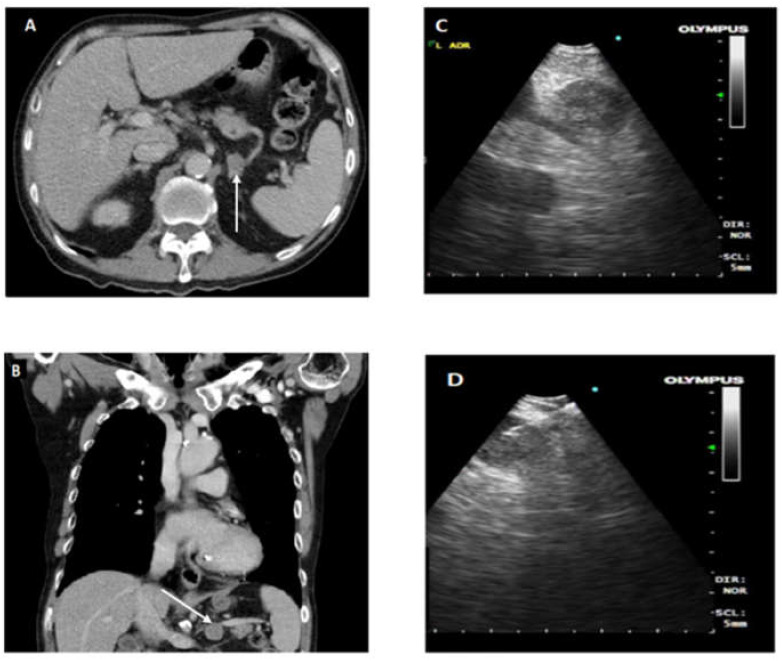
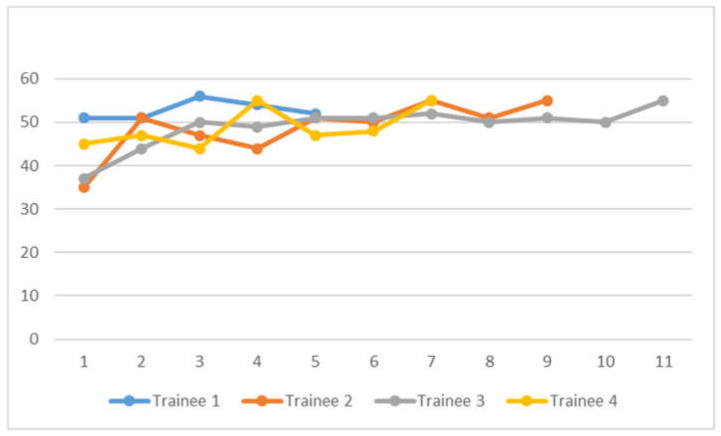
Endobronchial ultrasound (EBUS) combined with trans-esophageal endoscopic ultrasound bronchoscope guided fine need aspirate (EUS-B FNA) of mediastinal lymph nodes is an established procedure for diagnosis. The main barrier to a combined EBUS EUS-B FNA approach is availability of trained and accredited pulmonologist who can perform procedure safely and confidently. To address this gap, we undertook a training program for experienced EBUS bronchoscopists to train, learn, and incorporate combined EBUS EUS-B FNA into their procedural practice. Thirty-two patients were selected based on CT and or PET findings. Four experienced bronchoscopists participated by reading through learning material, observing 5 cases before performing EUS-B FNA under direct supervision. Forty-one lymph nodes and 6 non-nodal lesions were sampled. EUSAT assessment was performed by supervisor. Learning curves were derived from assessment scores. We observed that learning curve tends to plateau when participant can perform 3 or more consecutive cases with EUSAT score above 50. There were no complications. Our experience suggests that there is relative ease in transition to combined EBUS EUS-B TBNA procedures for mediastinal lymphadenopathy and lung cancer diagnosis and staging for experienced bronchoscopist using a program which incorporates direct supervision, EUSAT assessment, and extension of EUS B FNA training into daily real-world practice.
支气管内超声(EBUS)联合经食管内镜超声支气管镜引导下纵隔淋巴结细针抽吸术(EUS-B FNA)是一种成熟的诊断方法。联合EBUS EUS-B FNA方法的主要障碍是缺乏能够安全、自信地实施该操作的经过培训且获得认可的肺科医生。为了填补这一空白,我们为有经验的EBUS支气管镜检查医生开展了一项培训计划,以培训、学习并将联合EBUS EUS-B FNA纳入他们的操作实践中。根据CT和/或PET检查结果选择了32例患者。四名有经验的支气管镜检查医生参与其中,他们阅读学习材料,在直接监督下进行EUS-B FNA操作前观察5例病例。共采集了41个淋巴结和6个非淋巴结病变样本。由主管进行EUSAT评估。学习曲线由评估分数得出。我们观察到,当参与者能够连续进行3例或更多例EUSAT评分高于50分的病例时,学习曲线趋于平稳。未发生并发症。我们的经验表明,对于有经验的支气管镜检查医生而言,通过一个将直接监督、EUSAT评估以及将EUS B FNA培训扩展到日常实际操作中的计划,向联合EBUS EUS-B TBNA程序过渡以用于纵隔淋巴结病和肺癌的诊断及分期相对容易。