Cerbu Bianca, Pantea Stelian, Bratosin Felix, Vidican Iulia, Turaiche Mirela, Frent Stefan, Borsi Ema, Marincu Iosif
Department of Infectious Diseases, Victor Babes University of Medicine and Pharmacy, 300041 Timisoara, Romania.
Surgical Clinic 2 Department, Victor Babes University of Medicine and Pharmacy, 300041 Timisoara, Romania.
Medicina (Kaunas). 2021 Jun 10;57(6):597. doi: 10.3390/medicina57060597.
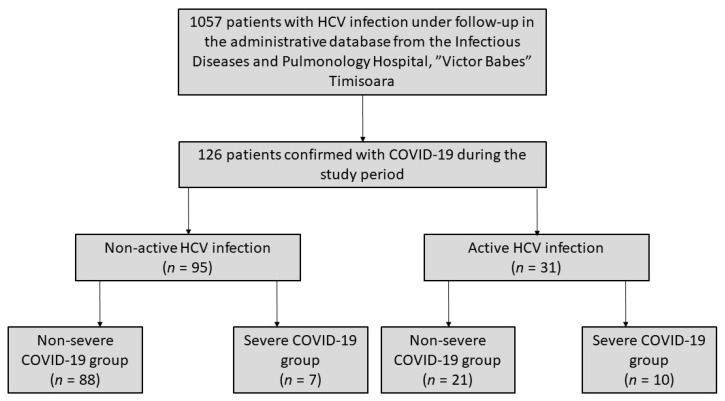
: The COVID-19 pandemic is an ongoing public health emergency. Patients with chronic diseases are at greater risk for complications and poor outcomes. The objective of this study was to investigate the liver function abnormalities and clinical outcomes in patients with COVID-19 and chronic hepatitis C. : This retrospective, single-center study was conducted on a cohort of 126 patients with a history of hepatitis C, confirmed with COVID-19 between 01 April 2020 and 30 December 2020. Several clinical outcomes were compared between patients with active and non-active HCV infection, and the risks of liver impairment and all-cause mortality in active HCV patients were analyzed using a multivariate logistic regression model. : Among 1057 patients under follow-up for chronic HCV infection, 126 (11.9%) were confirmed with COVID-19; of these, 95 (75.4%) were under treatment or achieved SVR, while in the other 31 (24.6%), we found active HCV replication. There was a significantly higher proportion of severe COVID-19 cases in the active HCV group as compared to the non-active HCV group (32.2 vs. 7.3%, < 0.001). Multivariate analysis showed that age, sex, alanine aminotransferase, C-reactive protein, procalcitonin, and HCV viral load were significant independent risk factors for liver impairment and all-cause mortality. The length of stay in hospital and intensive care unit for COVID-19 was significantly higher in patients with active HCV infection (-value < 0.001), and a higher proportion of these patients required mechanical ventilation. : Active HCV infection is an independent risk factor for all-cause mortality in COVID-19 patients.
:新型冠状病毒肺炎大流行是一场持续的突发公共卫生事件。慢性病患者出现并发症和不良结局的风险更高。本研究的目的是调查新型冠状病毒肺炎患者合并慢性丙型肝炎时的肝功能异常情况及临床结局。:本项回顾性单中心研究纳入了126例有丙型肝炎病史且于2020年4月1日至2020年12月30日期间确诊新型冠状病毒肺炎的患者。比较了活动性和非活动性丙型肝炎病毒感染患者的几种临床结局,并使用多因素逻辑回归模型分析了活动性丙型肝炎患者肝功能损害和全因死亡率的风险。:在1057例接受慢性丙型肝炎感染随访的患者中,126例(11.9%)确诊新型冠状病毒肺炎;其中,95例(75.4%)正在接受治疗或已实现持续病毒学应答,而在另外31例(24.6%)中,发现有丙型肝炎病毒活动性复制。与非活动性丙型肝炎病毒组相比,活动性丙型肝炎病毒组中重症新型冠状病毒肺炎病例的比例显著更高(32.2%对7.3%,<0.001)。多因素分析显示,年龄、性别、丙氨酸氨基转移酶、C反应蛋白、降钙素原和丙型肝炎病毒载量是肝功能损害和全因死亡率的显著独立危险因素。活动性丙型肝炎感染患者因新型冠状病毒肺炎住院和入住重症监护病房的时间显著更长(-值<0.001),且这些患者中需要机械通气的比例更高。:活动性丙型肝炎感染是新型冠状病毒肺炎患者全因死亡率的独立危险因素。