Gonçalves Ana Cristina, Alves Raquel, Baldeiras Inês, Marques Bárbara, Oliveiros Bárbara, Pereira Amélia, Nascimento Costa José Manuel, Cortesão Emília, Mota Vieira Luisa, Sarmento Ribeiro Ana Bela
Laboratory of Oncobiology and Hematology and University Clinic of Hematology, Faculty of Medicine (FMUC), University of Coimbra, 3000-370 Coimbra, Portugal.
Institute for Clinical and Biomedical Research (iCBR)-Group of Environment, Genetics and Oncobiology (CIMAGO), FMUC, University of Coimbra, 3000-370 Coimbra, Portugal.
Cancers (Basel). 2021 Jun 23;13(13):3138. doi: 10.3390/cancers13133138.
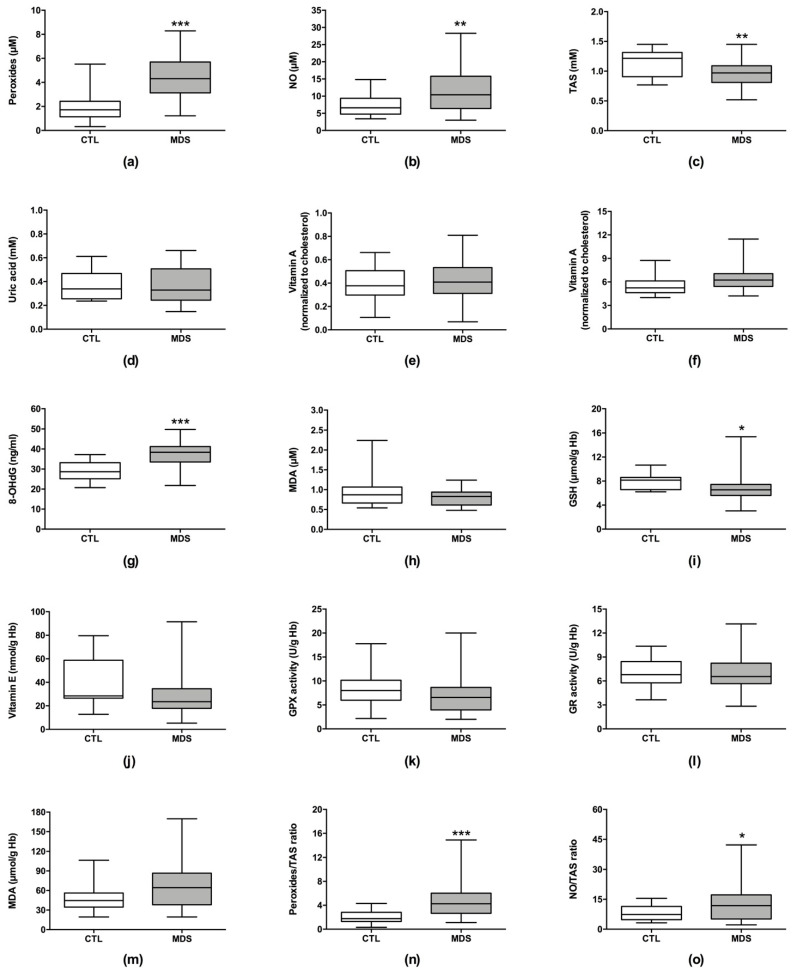
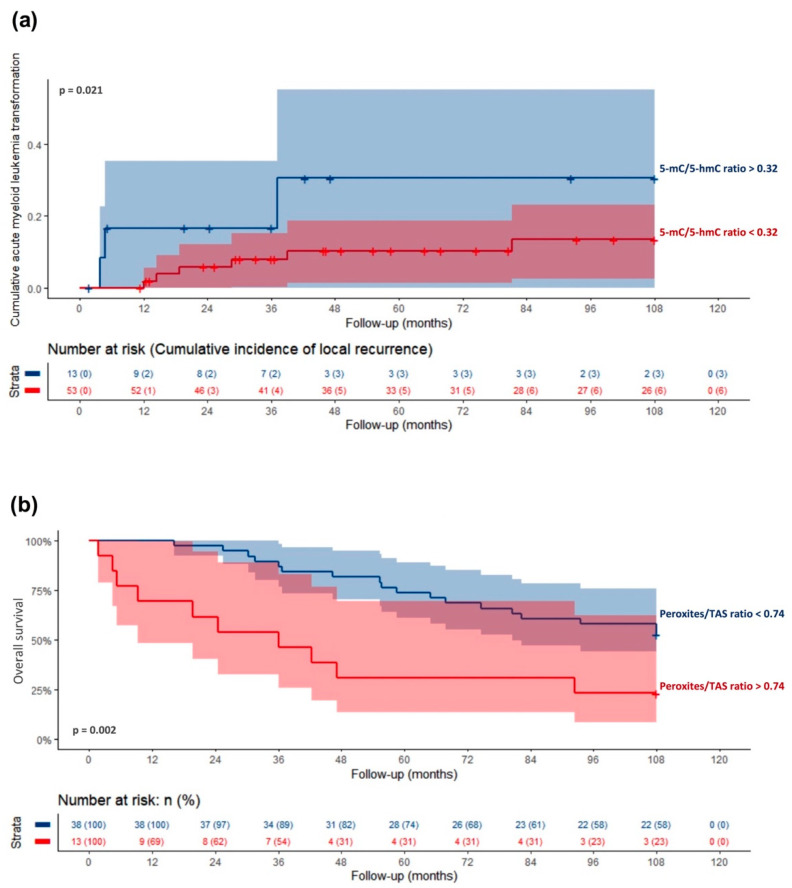
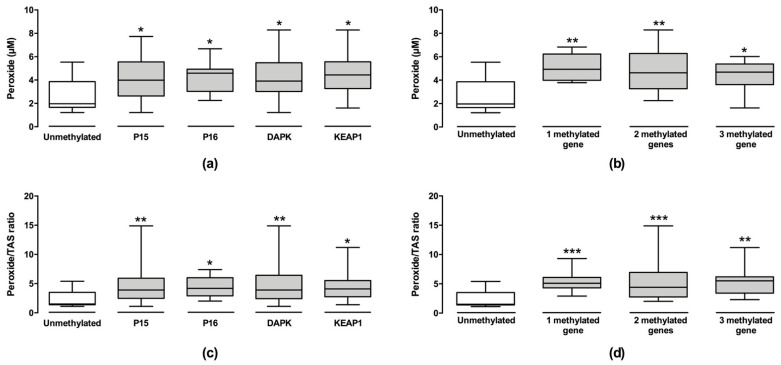
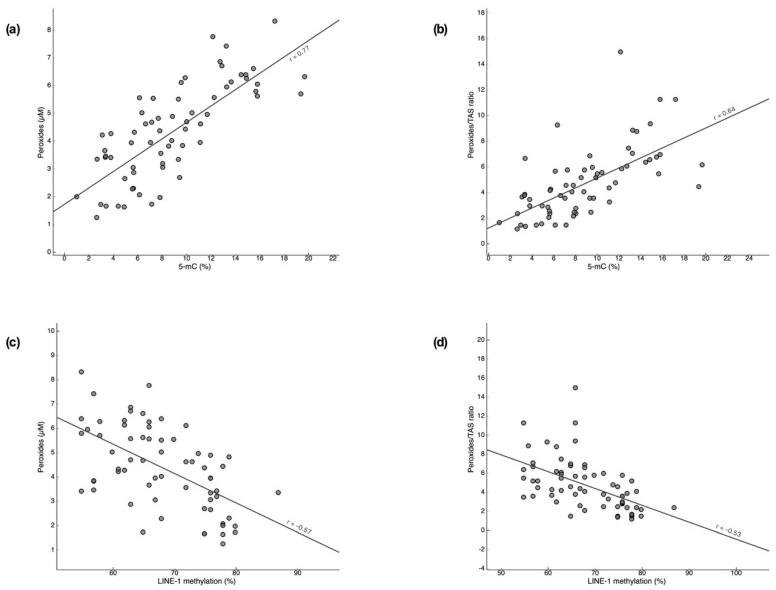
Oxidative stress and abnormal DNA methylation have been implicated in cancer, including myelodysplastic syndromes (MDSs). This fact leads us to investigate whether oxidative stress is correlated with localized and global DNA methylations in the peripheral blood of MDS patients. Sixty-six MDS patients and 26 healthy individuals were analyzed. Several oxidative stress and macromolecule damage parameters were analyzed. Localized (gene promotor) and global DNA methylations (5-mC and 5-hmC levels; LINE-1 methylation) were assessed. MDS patients had lower levels of reduced glutathione and total antioxidant status (TAS) and higher levels of peroxides, nitric oxide, peroxides/TAS, and 8-hydroxy-2-deoxyguanosine compared with controls. These patients had higher 5-mC levels and lower 5-hmC/5-mC ratio and LINE-1 methylation and increased methylation frequency of at least one methylated gene. Peroxide levels and peroxide/TAS ratio were higher in patients with methylated genes than those without methylation and negatively correlated with LINE-1 methylation and positively with 5-mC levels. The 5-hmC/5-mC ratio was significantly associated with progression to acute leukemia and peroxide/TAS ratio with overall survival. This study points to a relationship between oxidative stress and DNA methylation, two common pathogenic mechanisms involved in MDS, and suggests the relevance of 5-hmC/5-mC and peroxide/TAS ratios as complementary prognostic biomarkers.
氧化应激和异常DNA甲基化与包括骨髓增生异常综合征(MDS)在内的癌症有关。这一事实促使我们研究氧化应激是否与MDS患者外周血中的局部和整体DNA甲基化相关。我们分析了66例MDS患者和26名健康个体。分析了几个氧化应激和大分子损伤参数。评估了局部(基因启动子)和整体DNA甲基化(5-甲基胞嘧啶和5-羟甲基胞嘧啶水平;LINE-1甲基化)。与对照组相比,MDS患者的还原型谷胱甘肽水平和总抗氧化状态(TAS)较低,而过氧化物、一氧化氮、过氧化物/TAS和8-羟基-2'-脱氧鸟苷水平较高。这些患者的5-甲基胞嘧啶水平较高,5-羟甲基胞嘧啶/5-甲基胞嘧啶比值和LINE-1甲基化较低,且至少一个甲基化基因的甲基化频率增加。甲基化基因患者的过氧化物水平和过氧化物/TAS比值高于未甲基化患者,与LINE-1甲基化呈负相关,与5-甲基胞嘧啶水平呈正相关。5-羟甲基胞嘧啶/5-甲基胞嘧啶比值与进展为急性白血病显著相关,过氧化物/TAS比值与总生存期相关。本研究指出了氧化应激与DNA甲基化之间的关系,这是MDS中涉及的两种常见致病机制,并表明5-羟甲基胞嘧啶/5-甲基胞嘧啶和过氧化物/TAS比值作为补充性预后生物标志物的相关性。