Laboratorio de Genética Bioquímica (LAGENBIO), Instituto Agroalimentario de Aragón (IA2), Instituto de Investigación Sanitaria de Aragón (IISAragón), Universidad de Zaragoza, Miguel Servet 177, 50013 Zaragoza, Spain.
Centro de Investigación en Encefalopatías y Enfermedades Transmisibles Emergentes, Instituto Agroa-Limentario de Aragón (IA2), Instituto de Investigación Sanitaria de Aragón (IISAragón), Universidad de Zaragoza, Miguel Servet 177, 50013 Zaragoza, Spain.
Int J Mol Sci. 2021 Jun 25;22(13):6822. doi: 10.3390/ijms22136822.
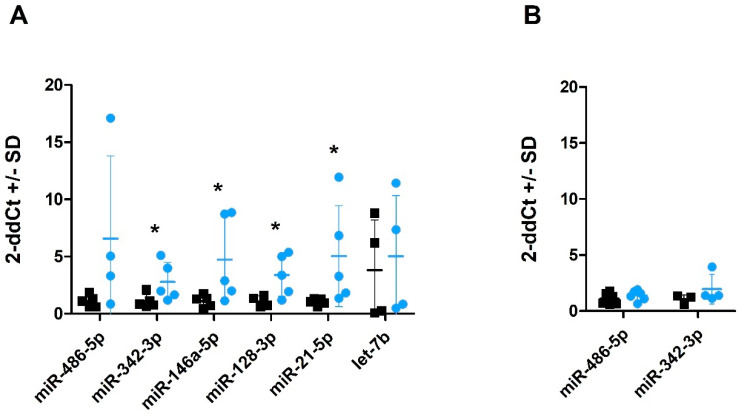
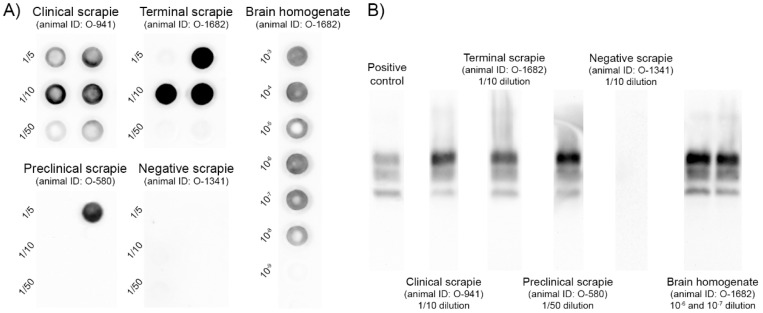
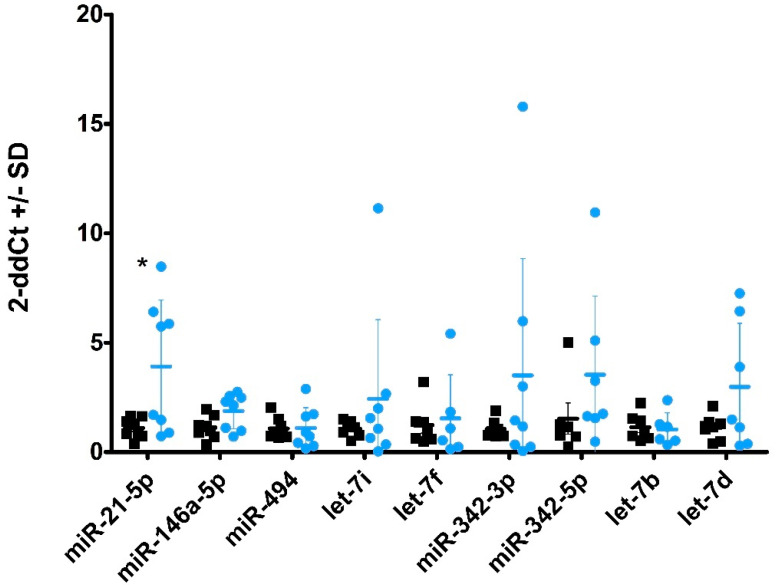
Diagnosis of transmissible spongiform encephalopathies (TSEs), or prion diseases, is based on the detection of proteinase K (PK)-resistant PrP in post-mortem tissues as indication of infection and disease. Since PrP detection is not considered a reliable method for in vivo diagnosis in most TSEs, it is of crucial importance to identify an alternative source of biomarkers to provide useful alternatives for current diagnostic methodology. Ovine scrapie is the prototype of TSEs and has been known for a long time. Using this natural model of TSE, we investigated the presence of PrP in exosomes derived from plasma and cerebrospinal fluid (CSF) by protein misfolding cyclic amplification (PMCA) and the levels of candidate microRNAs (miRNAs) by quantitative PCR (qPCR). Significant scrapie-associated increase was found for miR-21-5p in plasma-derived but not in CSF-derived exosomes. However, miR-342-3p, miR-146a-5p, miR-128-3p and miR-21-5p displayed higher levels in total CSF from scrapie-infected sheep. The analysis of overexpressed miRNAs in this biofluid, together with plasma exosomal miR-21-5p, could help in scrapie diagnosis once the presence of the disease is suspected. In addition, we found the presence of PrP in most CSF-derived exosomes from clinically affected sheep, which may facilitate in vivo diagnosis of prion diseases, at least during the clinical stage.
传染性海绵状脑病(TSEs)或朊病毒病的诊断基于在死后组织中检测到蛋白水解酶(PK)抗性 PrP,作为感染和疾病的指示。由于 PrP 检测不被认为是大多数 TSEs 中体内诊断的可靠方法,因此确定替代生物标志物来源以提供当前诊断方法的有用替代方法至关重要。绵羊瘙痒病是 TSE 的原型,并且已经为人所知很长时间了。使用这种 TSE 的天然模型,我们通过蛋白质错误折叠循环扩增(PMCA)研究了源自血浆和脑脊液(CSF)的外泌体中 PrP 的存在,并用定量 PCR(qPCR)研究了候选 microRNAs(miRNAs)的水平。在源自血浆的外泌体中,但不在源自 CSF 的外泌体中,发现了与瘙痒病相关的 miR-21-5p 的显著增加。然而,miR-342-3p、miR-146a-5p、miR-128-3p 和 miR-21-5p 在感染瘙痒病的绵羊的总 CSF 中显示出更高的水平。在这种生物流体中分析过表达的 miRNA,以及源自血浆的外泌体 miR-21-5p,一旦怀疑疾病存在,可能有助于瘙痒病的诊断。此外,我们发现大多数源自临床受影响绵羊的 CSF 衍生外泌体中存在 PrP,这可能有助于朊病毒病的体内诊断,至少在临床阶段。