Abdelhamid Gomaa Said Mohamed, Bassiouni Marwa Gomaa Abdelghani, Gómez-Benito Juana
Quantitative Psychology Unit, Faculty of Psychology, University of Barcelona, 08035 Barcelona, Spain.
Group on Measurement Invariance and Analysis of Change (GEIMAC), Institute of Neurosciences, University of Barcelona, 08035 Barcelona, Spain.
Int J Environ Res Public Health. 2021 Jun 25;18(13):6835. doi: 10.3390/ijerph18136835.
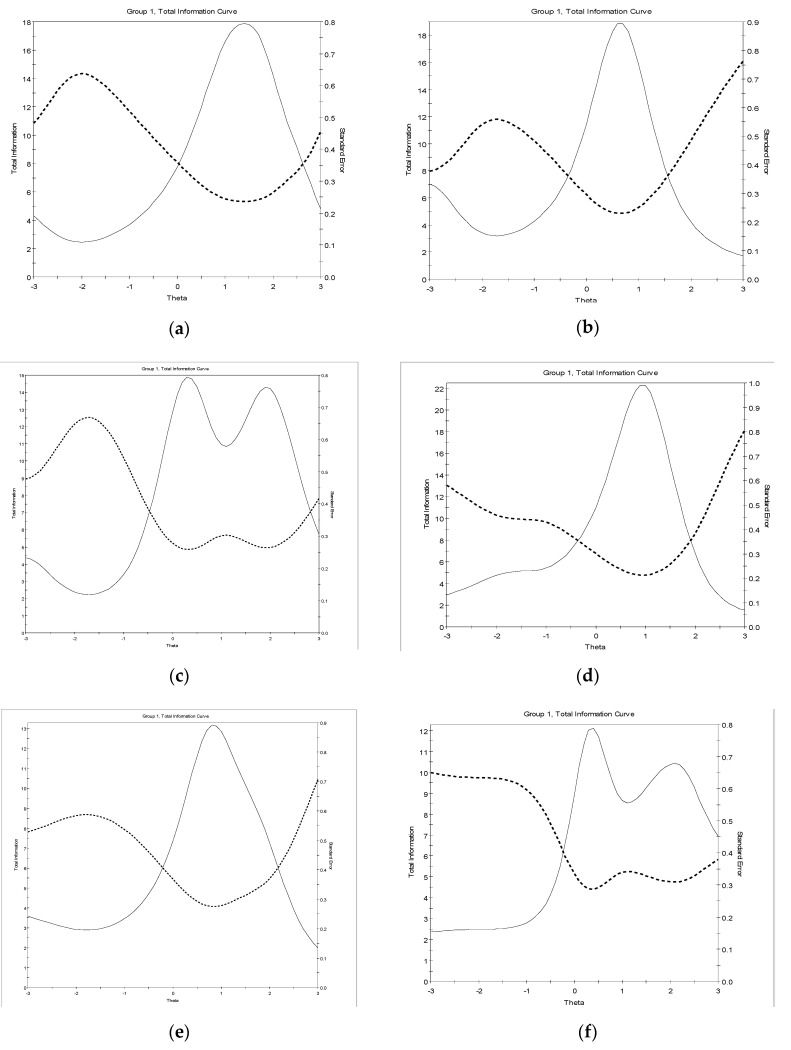
: The Wechsler Adult Intelligence Scale-Fourth Edition (WAIS-IV) has been adapted to 28 different cultures and there has been considerable interest in examining its structure through exploratory and confirmatory factor analysis. This study investigates item and scale properties of the Egyptian WAIS-IV using item response theory (IRT) models. : The sample consisted of 250 adults from Egypt. The item-level and subtest statistical properties of the Egyptian WAIS-IV were established using a combination of four dichotomous IRT models and four polytomous IRT models. In addition, factor analysis was performed to investigate the dimensionality of each subtest. : Factor analysis indicated the unidimensionality of each subtest. Among IRT models, the two-parameter logistic model provided a good fit for dichotomous subtests, while the graded response model fitted the polytomous data. Most items of the Egyptian WAIS-IV showed high discrimination, and the scale was adequately informative across the levels of latent traits (i.e., cognitive variables). However, each subtest included at least some items with limited ability to distinguish between individuals with differing levels of the cognitive variable being measured. Furthermore, most subtests have items that do not follow the difficulty rank they are ascribed in the WAIS-IV manual. : Overall, the results suggest that the Egyptian WAIS-IV offers a highly valid assessment of intellectual abilities, despite the need for some improvements.
韦氏成人智力量表第四版(WAIS-IV)已被改编以适用于28种不同文化,并且人们对通过探索性和验证性因素分析来研究其结构有着浓厚兴趣。本研究使用项目反应理论(IRT)模型调查埃及版WAIS-IV的项目和量表属性。
样本由250名来自埃及的成年人组成。通过结合四种二分IRT模型和四种多分IRT模型,确定了埃及版WAIS-IV的项目水平和子测验统计属性。此外,进行了因素分析以研究每个子测验的维度。
因素分析表明每个子测验具有单维度性。在IRT模型中,两参数逻辑斯蒂模型对二分性子测验拟合良好,而等级反应模型对多分类数据拟合良好。埃及版WAIS-IV的大多数项目显示出高区分度,并且该量表在潜在特质(即认知变量)水平上具有足够的信息量。然而,每个子测验至少包含一些在区分被测量认知变量水平不同的个体方面能力有限的项目。此外,大多数子测验中的项目并不遵循WAIS-IV手册中赋予它们的难度等级。
总体而言,结果表明埃及版WAIS-IV尽管需要一些改进,但对智力能力提供了高度有效的评估。