Department of Innovative Medicine, Graduate School of Medicine, Chiba University, Chiba 260-8670, Japan.
Department of Mucosal Immunology, The University of Tokyo Distinguished Professor Unit, The Institute of Medical Science, The University of Tokyo, Tokyo 108-8639, Japan.
Cells. 2021 Jun 28;10(7):1615. doi: 10.3390/cells10071615.
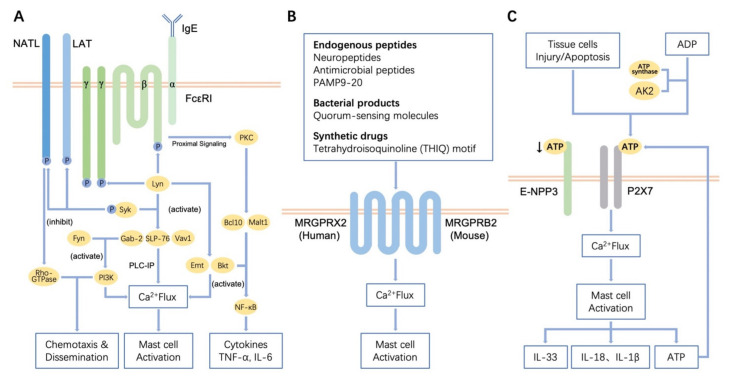
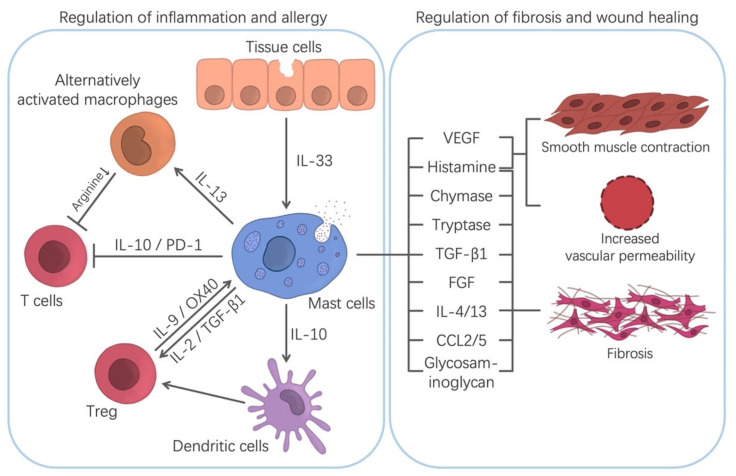
It is well known that mast cells (MCs) initiate type I allergic reactions and inflammation in a quick response to the various stimulants, including-but not limited to-allergens, pathogen-associated molecular patterns (PAMPs), and damage-associated molecular patterns (DAMPs). MCs highly express receptors of these ligands and proteases (e.g., tryptase, chymase) and cytokines (TNF), and other granular components (e.g., histamine and serotonin) and aggravate the allergic reaction and inflammation. On the other hand, accumulated evidence has revealed that MCs also possess immune-regulatory functions, suppressing chronic inflammation and allergic reactions on some occasions. IL-2 and IL-10 released from MCs inhibit excessive immune responses. Recently, it has been revealed that allergen immunotherapy modulates the function of MCs from their allergic function to their regulatory function to suppress allergic reactions. This evidence suggests the possibility that manipulation of MCs functions will result in a novel approach to the treatment of various MCs-mediated diseases.
众所周知,肥大细胞 (MCs) 能够快速响应各种刺激物(包括但不限于过敏原、病原体相关分子模式 (PAMPs) 和损伤相关分子模式 (DAMPs)),引发 I 型过敏反应和炎症。MCs 高度表达这些配体和蛋白酶(例如,类胰蛋白酶、糜蛋白酶)以及细胞因子(TNF)和其他颗粒成分(例如,组胺和 5-羟色胺)的受体,从而加重过敏反应和炎症。另一方面,大量证据表明,MCs 还具有免疫调节功能,在某些情况下抑制慢性炎症和过敏反应。MCs 释放的 IL-2 和 IL-10 抑制过度的免疫反应。最近,人们发现变应原免疫疗法可调节 MCs 的功能,使其从过敏功能转变为调节功能,从而抑制过敏反应。这一证据表明,操纵 MCs 功能可能为治疗各种由 MCs 介导的疾病提供一种新方法。