Catoni Cristina, Di Paolo Veronica, Rossi Elisabetta, Quintieri Luigi, Zamarchi Rita
Veneto Institute of Oncology IOV-IRCCS, Padua, Italy.
Laboratory of Drug Metabolism, Department of Pharmaceutical and Pharmacological Sciences, University of Padua, Padua, Italy.
Diagnostics (Basel). 2021 Jun 19;11(6):1118. doi: 10.3390/diagnostics11061118.
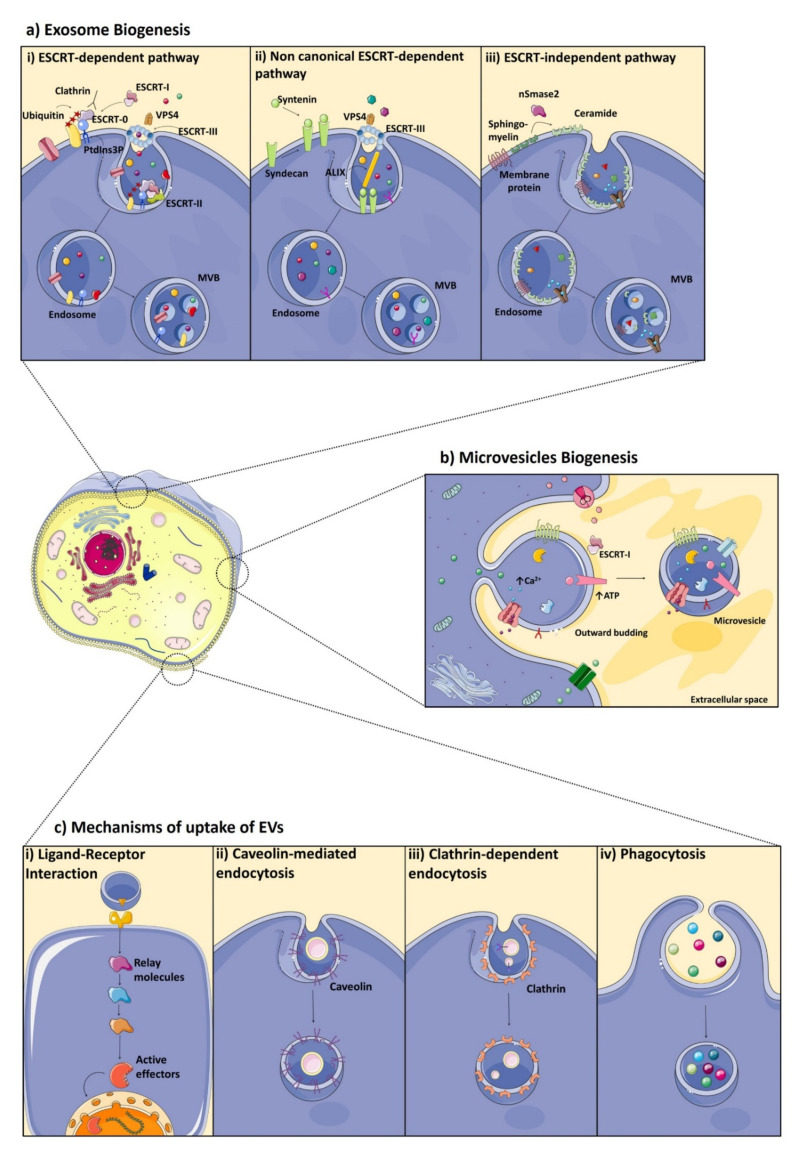
Extracellular vesicles (EVs) are important mediators of intercellular communication playing a pivotal role in the regulation of physiological and pathological processes, including cancer. In particular, there is significant evidence suggesting that tumor-derived EVs exert an immunosuppressive activity during cancer progression, as well as stimulate tumor cell migration, angiogenesis, invasion and metastasis. The use of EVs as a liquid biopsy is currently a fast-growing area of research in medicine, with the potential to provide a step-change in the diagnosis and treatment of cancer, allowing the prediction of both therapy response and prognosis. EVs could be useful not only as biomarkers but also as drug delivery systems, and may represent a target for anticancer therapy. In this review, we attempted to summarize the current knowledge about the techniques used for the isolation of EVs and their roles in cancer biology, as liquid biopsy biomarkers and as therapeutic tools and targets.
细胞外囊泡(EVs)是细胞间通讯的重要介质,在包括癌症在内的生理和病理过程的调节中起着关键作用。特别是,有大量证据表明,肿瘤来源的细胞外囊泡在癌症进展过程中发挥免疫抑制活性,同时刺激肿瘤细胞迁移、血管生成、侵袭和转移。将细胞外囊泡用作液体活检目前是医学研究中一个快速发展的领域,有可能在癌症的诊断和治疗方面带来重大变革,实现对治疗反应和预后的预测。细胞外囊泡不仅可作为生物标志物,还可作为药物递送系统,并且可能成为抗癌治疗的靶点。在这篇综述中,我们试图总结目前关于用于分离细胞外囊泡的技术及其在癌症生物学中的作用的知识,包括作为液体活检生物标志物以及作为治疗工具和靶点的作用。