Vanderbilt Epidemiology Center, Vanderbilt University Medical Center, Department of Medicine, Division of Epidemiology, Nashville, TN 37203, USA.
International Epidemiology Field Station, Vanderbilt University Medical Center, Nashville, TN 37203, USA.
Nutrients. 2021 Jun 19;13(6):2094. doi: 10.3390/nu13062094.
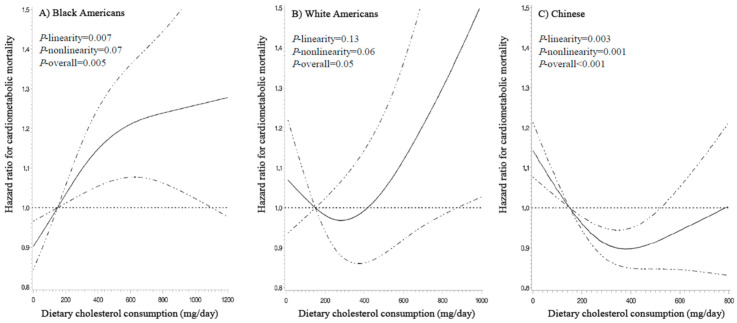
We examined the associations of dietary cholesterol and egg intakes with cardiometabolic and all-cause mortality among Chinese and low-income Black and White Americans. Included were 47,789 Blacks, 20,360 Whites, and 134,280 Chinese aged 40-79 years at enrollment. Multivariable Cox models with restricted cubic splines were applied to estimate hazard ratios (HRs) and 95% confidence intervals (CIs) for mortality outcomes using intakes of 150 mg cholesterol/day and 1 egg/week as the references. Cholesterol intake showed a nonlinear association with increased all-cause mortality and a linear association with increased cardiometabolic mortality among Black Americans: HRs (95% CIs) associated with 300 and 600 mg/day vs. 150 mg/day were 1.07 (1.03-1.11) and 1.13 (1.05-1.21) for all-cause mortality (-linearity = 0.04, -nonlinearity = 0.002, and -overall < 0.001) and 1.10 (1.03-1.16) and 1.21 (1.08-1.36) for cardiometabolic mortality (-linearity = 0.007, -nonlinearity = 0.07, and -overall = 0.005). Null associations with all-cause or cardiometabolic mortality were noted for White Americans (-linearity ≥ 0.13, -nonlinearity ≥ 0.06, and -overall ≥ 0.05 for both). Nonlinear inverse associations were observed among Chinese: HR (95% CI) for 300 vs. 150 mg/day was 0.94 (0.92-0.97) for all-cause mortality and 0.91 (0.87-0.95) for cardiometabolic mortality, but the inverse associations disappeared with cholesterol intake > 500 mg/day (-linearity ≥ 0.12; -nonlinearity ≤ 0.001; -overall < 0.001 for both). Similarly, we observed a positive association of egg intake with all-cause mortality in Black Americans, but a null association in White Americans and a nonlinear inverse association in Chinese. In conclusion, the associations of cholesterol and egg intakes with cardiometabolic and all-cause mortality may differ across ethnicities who have different dietary patterns and cardiometabolic risk profiles. However, residual confounding remains possible.
我们研究了中国人以及低收入的美国黑人和白人的饮食胆固醇和鸡蛋摄入量与心血管代谢和全因死亡率之间的关系。研究对象包括 47789 名黑人、20360 名白人以及 134280 名年龄在 40-79 岁的中国人。使用 150 毫克胆固醇/天和 1 个鸡蛋/周作为参考摄入量,多变量 Cox 模型中的限制立方样条用于估计死亡率结局的风险比(HRs)和 95%置信区间(CIs)。胆固醇摄入量与全因死亡率呈非线性关联,与心血管代谢死亡率呈线性关联:与 150 毫克/天相比,300 毫克/天和 600 毫克/天的 HR(95%CI)分别为 1.07(1.03-1.11)和 1.13(1.05-1.21)(-线性度=0.04,-非线性度=0.002,-整体<0.001),1.10(1.03-1.16)和 1.21(1.08-1.36)(-线性度=0.007,-非线性度=0.07,-整体=0.005)。白人美国人的全因或心血管代谢死亡率与胆固醇摄入量无关(-线性度≥0.13,-非线性度≥0.06,-整体≥0.05)。中国人中观察到非线性反比关系:与 150 毫克/天相比,300 毫克/天的 HR(95%CI)分别为全因死亡率的 0.94(0.92-0.97)和心血管代谢死亡率的 0.91(0.87-0.95),但胆固醇摄入量>500 毫克/天时,这种反比关系消失(-线性度≥0.12;-非线性度≤0.001;-整体<0.001)。同样,我们观察到黑人美国人的鸡蛋摄入量与全因死亡率呈正相关,而白人美国人则无关联,中国人则呈非线性反比关系。总之,胆固醇和鸡蛋摄入量与心血管代谢和全因死亡率的关系可能因具有不同饮食模式和心血管代谢风险特征的种族而有所不同。然而,仍可能存在残余混杂。