Department of Nutrition and Movement Sciences, NUTRIM (School of Nutrition and Translational Research in Metabolism), Maastricht University Medical Center, P.O. Box 5800 Maastricht, The Netherlands.
Institute of Clinical Chemistry and Clinical Pharmacology, University Hospital Bonn, Venusberg-Campus 1, 53127 Bonn, Germany.
Nutrients. 2022 Apr 14;14(8):1643. doi: 10.3390/nu14081643.
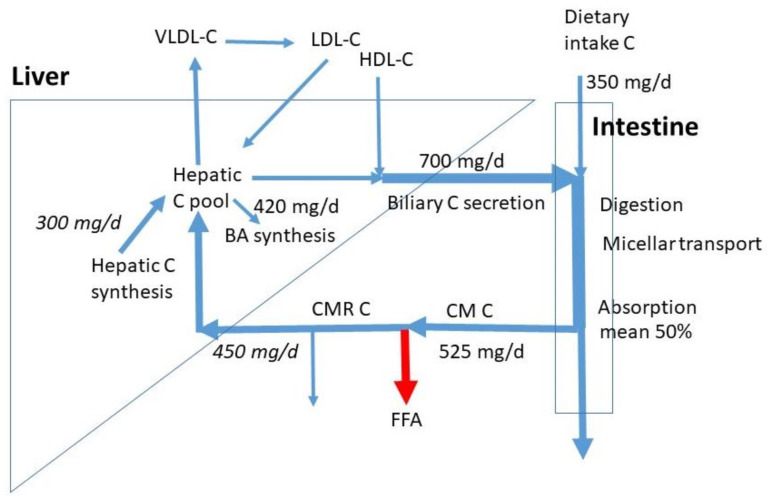
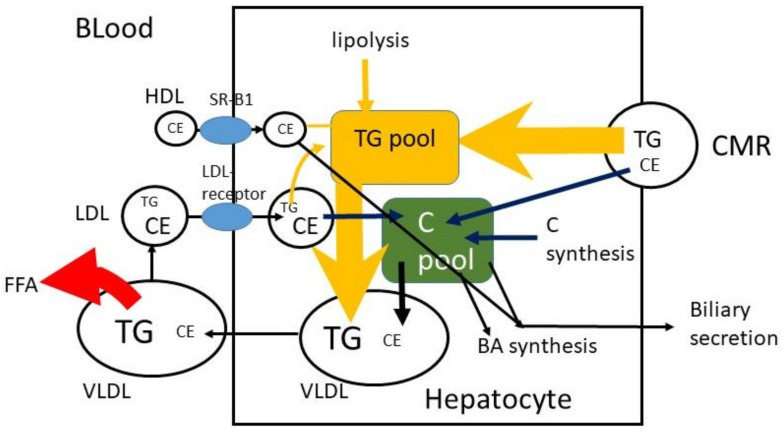
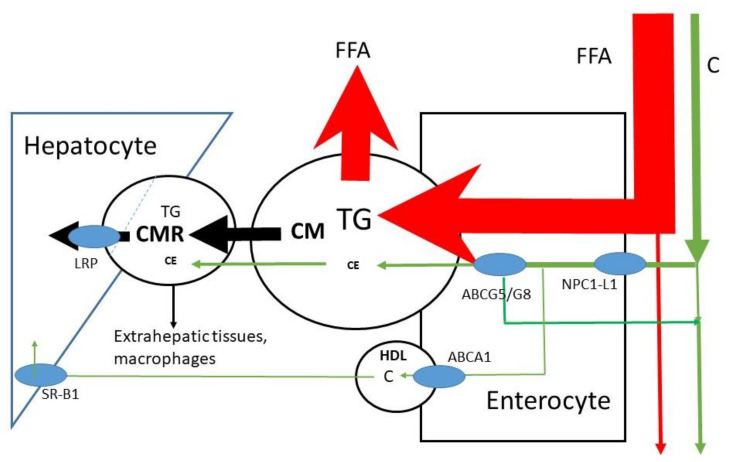
Dietary cholesterol (C) is a major contributor to the endogenous C pool, and it affects the serum concentration of total C, particularly the low-density lipoprotein cholesterol (LDL-C). A high serum concentration of LDL-C is associated with an increased risk for atherosclerosis and cardiovascular diseases. This concentration is dependent on hepatic C metabolism creating a balance between C input (absorption and synthesis) and C elimination (conversion to bile acids and fecal excretion). The daily C absorption rate is determined by dietary C intake, biliary C secretion, direct trans-intestinal C excretion (TICE), and the fractional C absorption rate. Hepatic C metabolism coordinates C fluxes entering the liver via chylomicron remnants (CMR), LDL, high-density lipoproteins (HDL), hepatic C synthesis, and those leaving the liver via very low-density lipoproteins (VLDL), biliary secretion, and bile acid synthesis. The knowns and the unknowns of this C homeostasis are discussed.
膳食胆固醇(C)是内源性 C 池的主要贡献者,它影响总 C 的血清浓度,特别是低密度脂蛋白胆固醇(LDL-C)。高血清 LDL-C 浓度与动脉粥样硬化和心血管疾病的风险增加有关。这种浓度取决于肝脏 C 代谢,在 C 的输入(吸收和合成)和 C 的消除(转化为胆汁酸和粪便排泄)之间创造平衡。C 的每日吸收率由膳食 C 摄入、胆汁 C 分泌、直接肠内 C 排泄(TICE)和 C 吸收分数决定。肝脏 C 代谢通过乳糜微粒残基(CMR)、LDL、高密度脂蛋白(HDL)进入肝脏的 C 流以及通过极低密度脂蛋白(VLDL)、胆汁分泌和胆汁酸合成离开肝脏的 C 流进行协调。讨论了这种 C 动态平衡的已知和未知因素。