Hennig Paulina, Fenini Gabriele, Di Filippo Michela, Karakaya Tugay, Beer Hans-Dietmar
Department of Dermatology, University Hospital Zurich, Wagistrasse 18, CH-8952 Schlieren, Switzerland.
Faculty of Medicine, University of Zurich, CH-8032 Zurich, Switzerland.
Biomedicines. 2021 Jun 22;9(7):707. doi: 10.3390/biomedicines9070707.
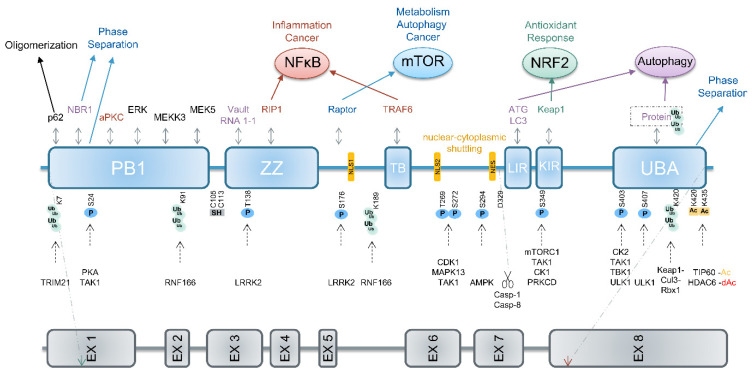
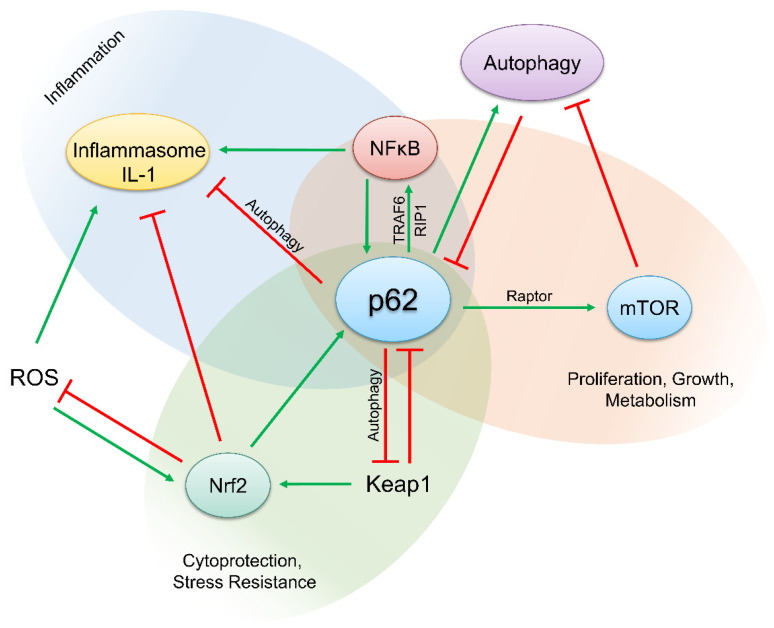
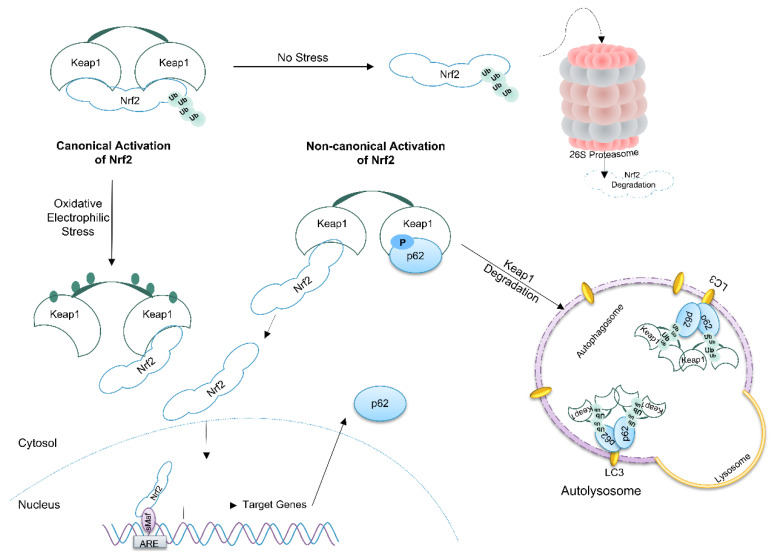
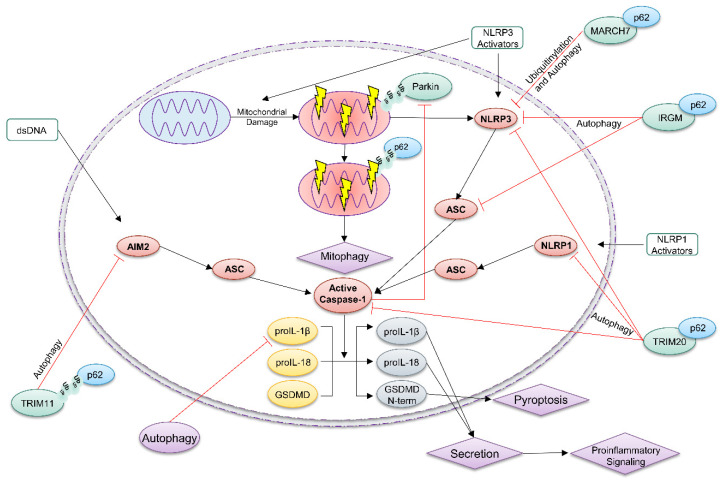
p62 is a highly conserved, multi-domain, and multi-functional adaptor protein critically involved in several important cellular processes. Via its pronounced domain architecture, p62 binds to numerous interaction partners, thereby influencing key pathways that regulate tissue homeostasis, inflammation, and several common diseases including cancer. Via binding of ubiquitin chains, p62 acts in an anti-inflammatory manner as an adaptor for the auto-, xeno-, and mitophagy-dependent degradation of proteins, pathogens, and mitochondria. Furthermore, p62 is a negative regulator of inflammasome complexes. The transcription factor Nrf2 regulates expression of a bundle of ROS detoxifying genes. p62 activates Nrf2 by interaction with and autophagosomal degradation of the Nrf2 inhibitor Keap1. Moreover, p62 activates mTOR, the central kinase of the mTORC1 sensor complex that controls cell proliferation and differentiation. Through different mechanisms, p62 acts as a positive regulator of the transcription factor NF-κB, a central player in inflammation and cancer development. Therefore, p62 represents not only a cargo receptor for autophagy, but also a central signaling hub, linking several important pro- and anti-inflammatory pathways. This review aims to summarize knowledge about the molecular mechanisms underlying the roles of p62 in health and disease. In particular, different types of tumors are characterized by deregulated levels of p62. The elucidation of how p62 contributes to inflammation and cancer progression at the molecular level might promote the development of novel therapeutic strategies.
p62是一种高度保守、具有多个结构域和多种功能的衔接蛋白,在多个重要的细胞过程中发挥关键作用。通过其独特的结构域架构,p62与众多相互作用伙伴结合,从而影响调节组织稳态、炎症以及包括癌症在内的几种常见疾病的关键信号通路。通过结合泛素链,p62作为一种衔接蛋白,以抗炎方式参与蛋白质、病原体和线粒体的自噬、异噬及线粒体自噬依赖性降解。此外,p62是炎性小体复合物的负调节因子。转录因子Nrf2调节一系列ROS解毒基因的表达。p62通过与Nrf2抑制剂Keap1相互作用并使其自噬体降解来激活Nrf2。此外,p62激活mTOR,mTOR是控制细胞增殖和分化的mTORC1传感复合物的中心激酶。通过不同机制,p62作为转录因子NF-κB的正调节因子,而NF-κB是炎症和癌症发展中的核心因子。因此,p62不仅是自噬的货物受体,也是一个中心信号枢纽,连接着几个重要的促炎和抗炎途径。本综述旨在总结关于p62在健康和疾病中作用的分子机制的知识。特别是,不同类型的肿瘤具有p62水平失调的特征。阐明p62在分子水平上如何促进炎症和癌症进展可能会推动新型治疗策略的发展。