Foundation of Research and Science Development, 01-793 Warsaw, Poland.
Polbionica Ltd., 01-793 Warsaw, Poland.
Cells. 2021 Jun 18;10(6):1544. doi: 10.3390/cells10061544.
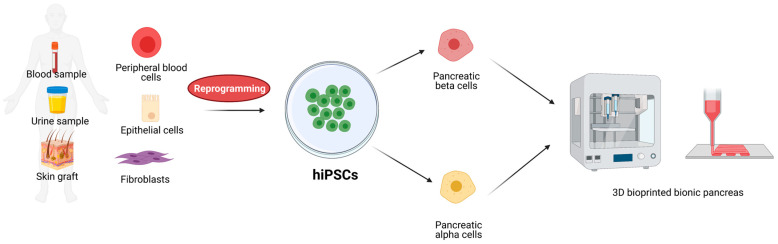
Type 1 diabetes (T1D) is the third most common autoimmune disease which develops due to genetic and environmental risk factors. Often, intensive insulin therapy is insufficient, and patients require a pancreas or pancreatic islets transplant. However, both solutions are associated with many possible complications, including graft rejection. The best approach seems to be a donor-independent T1D treatment strategy based on human stem cells cultured in vitro and differentiated into insulin and glucagon-producing cells (β and α cells, respectively). Both types of cells can then be incorporated into the bio-ink used for 3D printing of the bionic pancreas, which can be transplanted into T1D patients to restore glucose homeostasis. The aim of this review is to summarize current knowledge about stem cells sources and their transformation into key pancreatic cells. Last, but not least, we comment on possible solutions of post-transplant immune response triggered stem cell-derived pancreatic cells and their potential control mechanisms.
1 型糖尿病(T1D)是第三大常见的自身免疫性疾病,由遗传和环境风险因素引起。通常,强化胰岛素治疗是不够的,患者需要胰腺或胰岛移植。然而,这两种解决方案都可能伴随着许多并发症,包括移植物排斥。最好的方法似乎是一种不依赖供体的 T1D 治疗策略,该策略基于体外培养的人类干细胞,并分化为产生胰岛素和胰高血糖素的细胞(分别为β和α细胞)。然后,可以将这两种类型的细胞合并到用于 3D 打印仿生胰腺的生物墨水中,将其移植到 T1D 患者体内以恢复葡萄糖稳态。本综述的目的是总结目前关于干细胞来源及其转化为关键胰腺细胞的知识。最后但同样重要的是,我们还评论了移植后免疫反应引发的干细胞源性胰腺细胞的可能解决方案及其潜在的控制机制。