Department of Medicine, Queen Mary Hospital, The University of Hong Kong, Pokfulam Road 102, Hong Kong, China.
State Key Laboratory of Liver Research, The University of Hong Kong, Hong Kong, China.
Viruses. 2021 Jun 18;13(6):1169. doi: 10.3390/v13061169.
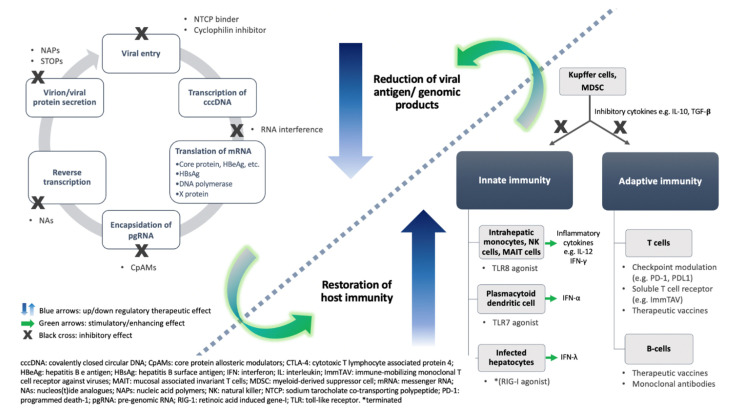
Globally, chronic hepatitis B (CHB) infection is one of the leading causes of liver failure, decompensated cirrhosis, and hepatocellular carcinoma. Existing antiviral therapy can suppress viral replication but not fully eradicate the virus nor the risk of liver-related complications. Novel treatments targeting alternative steps of the viral cycle or to intensify/restore the host's immunity are being developed. We discuss novel drugs that have already entered clinical phases of development. Agents that interfere with specific steps of HBV replication include RNA interference, core protein allosteric modulation, and inhibition of viral entry or viral protein excretion (NAPs and STOPS). Agents that target the host's immunity include toll-like receptor agonists, therapeutic vaccines, immune checkpoint modulators, soluble T-cell receptors, and monoclonal antibodies. Most have demonstrated favorable results in suppression of viral proteins and genomic materials (i.e., HBV DNA and/or pre-genomic RNA), and/or evidence on host-immunity restoration including cytokine responses and T-cell activation. Given the abundant clinical experience and real-world safety data with the currently existing therapy, any novel agent for CHB should be accompanied by convincing safety data. Combination therapy of nucleos(t)ide analogue, a novel virus-directing agent, and/or an immunomodulatory agent will be the likely approach to optimize the chance of a functional cure in CHB.
全球范围内,慢性乙型肝炎(CHB)感染是导致肝衰竭、失代偿性肝硬化和肝细胞癌的主要原因之一。现有的抗病毒疗法可以抑制病毒复制,但不能完全清除病毒及其引发的肝脏相关并发症的风险。目前正在开发针对病毒周期替代步骤或增强/恢复宿主免疫的新型治疗方法。我们讨论了已经进入临床开发阶段的新型药物。针对 HBV 复制特定步骤的药物包括 RNA 干扰、核心蛋白变构调节、病毒进入或病毒蛋白分泌抑制剂(NAPs 和 STOPS)。针对宿主免疫的药物包括 Toll 样受体激动剂、治疗性疫苗、免疫检查点调节剂、可溶性 T 细胞受体和单克隆抗体。大多数药物在抑制病毒蛋白和基因组物质(即 HBV DNA 和/或前基因组 RNA)方面显示出良好的效果,并且/或者在宿主免疫恢复方面有证据支持,包括细胞因子反应和 T 细胞激活。鉴于现有治疗方法在临床经验和真实世界安全性数据方面非常丰富,任何用于 CHB 的新型药物都应伴随令人信服的安全性数据。核苷(酸)类似物、新型病毒靶向药物和/或免疫调节剂的联合治疗可能是优化 CHB 功能性治愈机会的一种方法。