Department of Geography, Geomatics and Environment, University of Toronto Mississauga, Mississauga, ON L5L 1C6, Canada.
Department of Geography and Planning, University of Toronto, Toronto, ON M5S 1A1, Canada.
Sensors (Basel). 2021 Jun 11;21(12):4039. doi: 10.3390/s21124039.
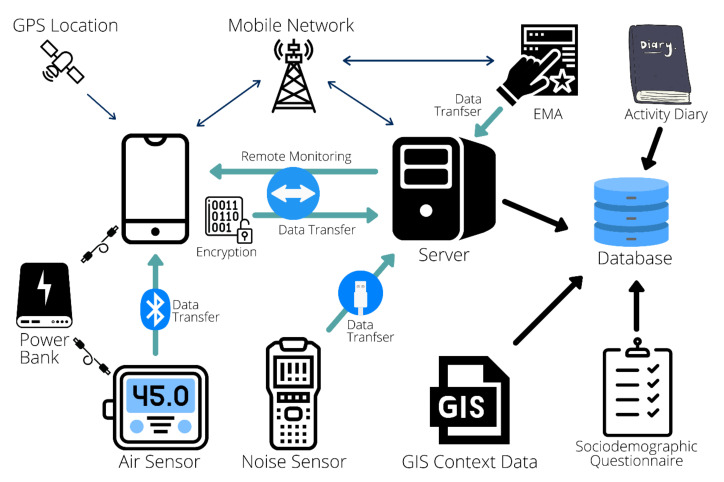
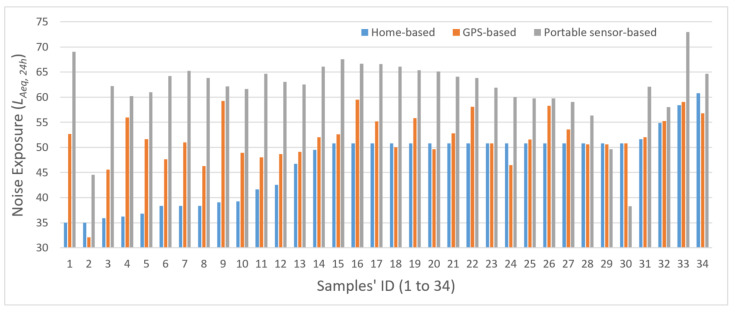
The effects of environmental exposure on human health have been widely explored by scholars in health geography for decades. However, recent advances in geospatial technologies, especially the development of mobile approaches to collecting real-time and high-resolution individual data, have enabled sophisticated methods for assessing people's environmental exposure. This study proposes an individual environmental exposure assessment system (IEEAS) that integrates objective real-time monitoring devices and subjective sensing tools to provide a composite way for individual-based environmental exposure data collection. With field test data collected in Chicago and Beijing, we illustrate and discuss the advantages of the proposed IEEAS and the composite analysis that could be applied. Data collected with the proposed IEEAS yield relatively accurate measurements of individual exposure in a composite way, and offer new opportunities for developing more sophisticated ways to measure individual environmental exposure. With the capability to consider both the variations in environmental risks and human mobility in high spatial and temporal resolutions, the IEEAS also helps mitigate some uncertainties in environmental exposure assessment and thus enables a better understanding of the relationship between individual environmental exposure and health outcomes.
几十年来,健康地理学领域的学者们广泛探讨了环境暴露对人类健康的影响。然而,近年来地理空间技术的进步,特别是实时、高分辨率个体数据采集移动方法的发展,为评估人们的环境暴露提供了复杂的方法。本研究提出了一个个体环境暴露评估系统(IEEAS),该系统集成了客观的实时监测设备和主观的传感工具,为基于个体的环境暴露数据采集提供了一种综合方式。通过在芝加哥和北京收集的现场测试数据,我们说明了并讨论了所提出的 IEEAS 的优点以及可以应用的综合分析。通过所提出的 IEEAS 收集的数据以综合方式得出了个体暴露的相对准确的测量值,并为开发更复杂的个体环境暴露测量方法提供了新的机会。由于能够考虑到环境风险和人类流动性在高时空分辨率上的变化,IEEAS 还有助于减轻环境暴露评估中的一些不确定性,从而更好地理解个体环境暴露与健康结果之间的关系。