Department of Biochemistry and Genetics, University of Navarra, 31008 Pamplona, Spain.
The John van Geest Cancer Research Centre, School of Science and Technology, Nottingham Trent University, Nottingham NG11 8NS, UK.
Int J Mol Sci. 2021 Jun 29;22(13):6978. doi: 10.3390/ijms22136978.
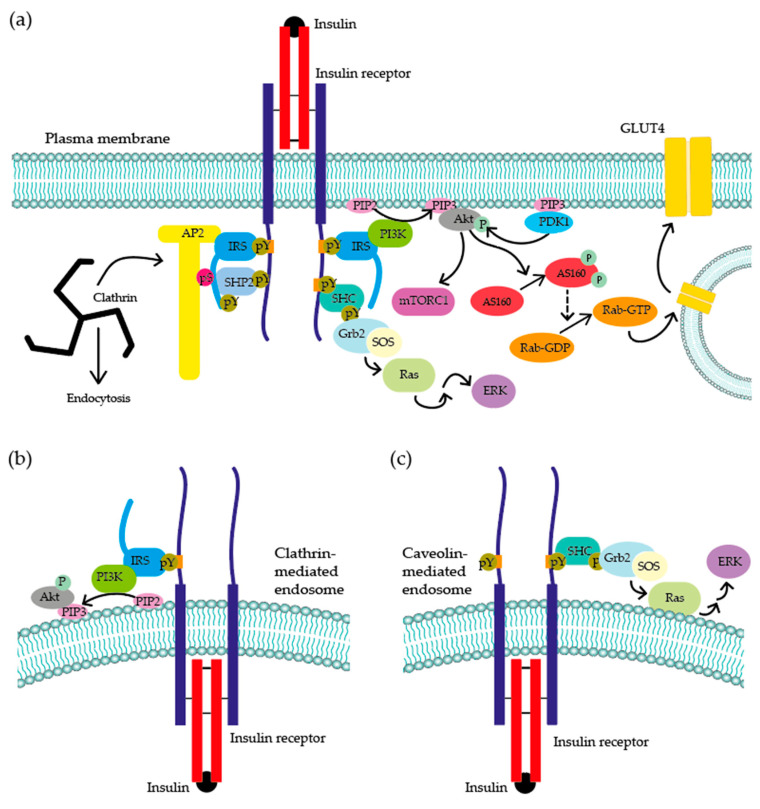
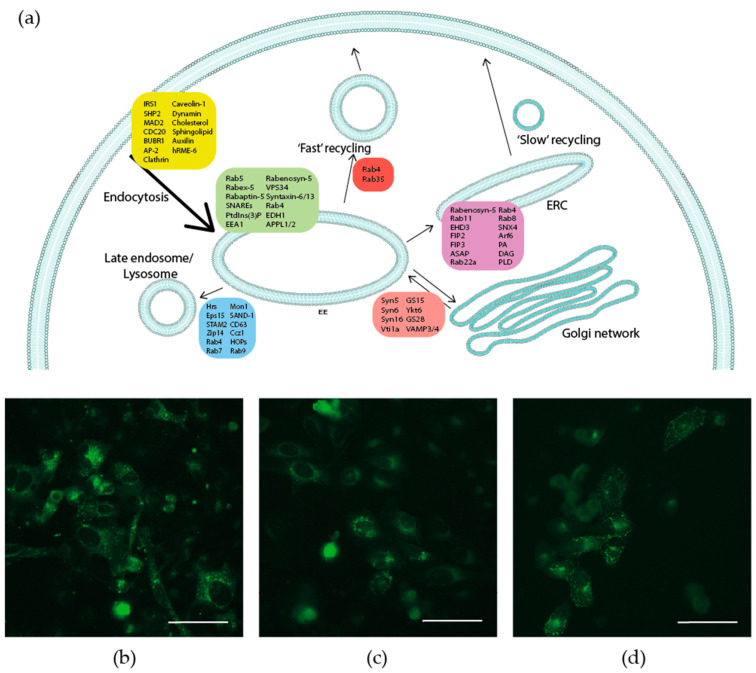
The endocytosis of ligand-bound receptors and their eventual recycling to the plasma membrane (PM) are processes that have an influence on signalling activity and therefore on many cell functions, including migration and proliferation. Like other tyrosine kinase receptors (TKR), the insulin receptor (INSR) has been shown to be endocytosed by clathrin-dependent and -independent mechanisms. Once at the early endosome (EE), the sorting of the receptor, either to the late endosome (LE) for degradation or back to the PM through slow or fast recycling pathways, will determine the intensity and duration of insulin effects. Both the endocytic and the endosomic pathways are regulated by many proteins, the Arf and Rab families of small GTPases being some of the most relevant. Here, we argue for a specific role for the slow recycling route, whilst we review the main molecular mechanisms involved in INSR endocytosis, sorting and recycling, as well as their possible role in cell functions.
配体结合的受体的内吞作用及其最终的循环回到质膜(PM)是影响信号活性的过程,因此也影响许多细胞功能,包括迁移和增殖。与其他酪氨酸激酶受体(TKR)一样,胰岛素受体(INSR)已被证明可通过网格蛋白依赖和非依赖机制内吞。一旦到达早期内体(EE),受体的分拣,无论是到晚期内体(LE)进行降解,还是通过慢速或快速再循环途径回到 PM,将决定胰岛素作用的强度和持续时间。内吞作用和内体途径都受到许多蛋白质的调节,小 GTPase 的 Arf 和 Rab 家族就是其中一些最相关的。在这里,我们主张缓慢再循环途径的特定作用,同时我们回顾了 INSR 内吞作用、分拣和再循环涉及的主要分子机制,以及它们在细胞功能中的可能作用。