Kim Irene, Park Hyomin, Hwang Injoo, Moon Dodam, Yun Hyunji, Lee Eun Ju, Kim Hyo-Soo
Molecular Medicine & Biopharmaceutical Sciences, Graduate School of Convergence Science and Technology, and College of Medicine, Seoul National University, Seoul National University Hospital, 101 DeaHak-ro, JongRo-gu, Seoul, 03080, Republic of Korea.
Program in Stem Cell Biology, Seoul National University College of Medicine, Seoul, Republic of Korea.
Cell Biosci. 2021 Jul 1;11(1):120. doi: 10.1186/s13578-021-00631-3.
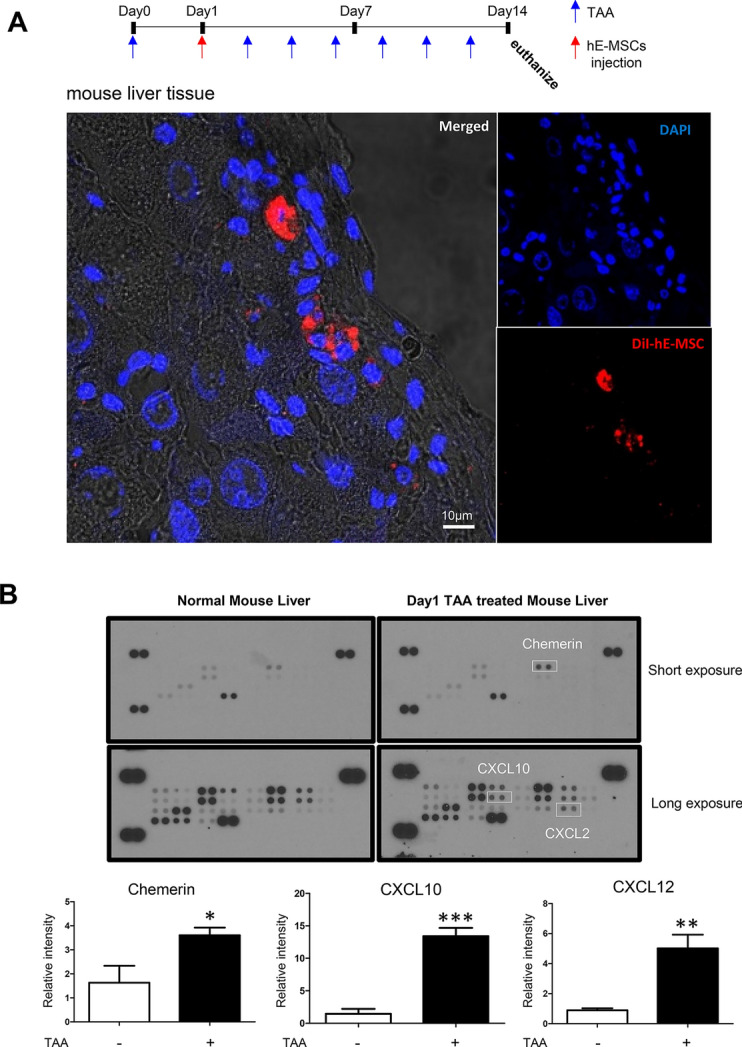
The homing capacity of human mesenchymal stem cells (hMSCs) to the injured sites enables systemic administration of hMSCs in clinical practice. In reality, only a small proportion of MSCs are detected in the target tissue, which is a major bottleneck for MSC-based therapies. We still don't know the mechanism how MSCs are chemo-attracted to certain target organ and engrafted through trans-endothelial migration. In this study, we aimed to determine the mechanism how the circulating hMSCs home to the injured liver.
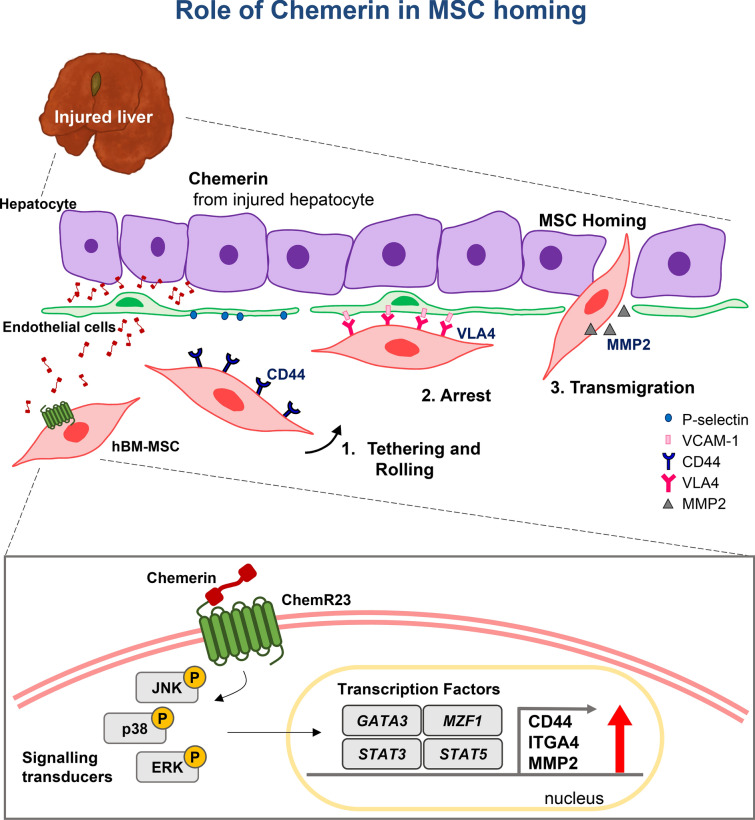
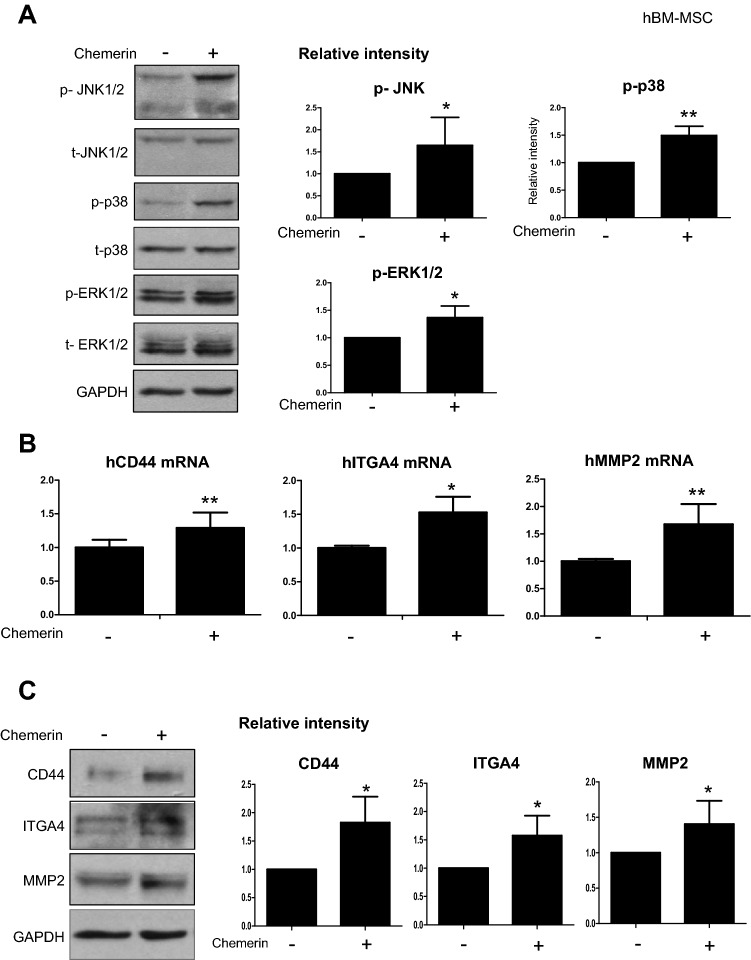
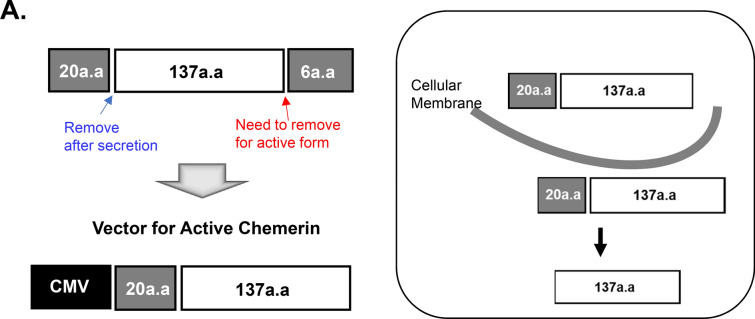
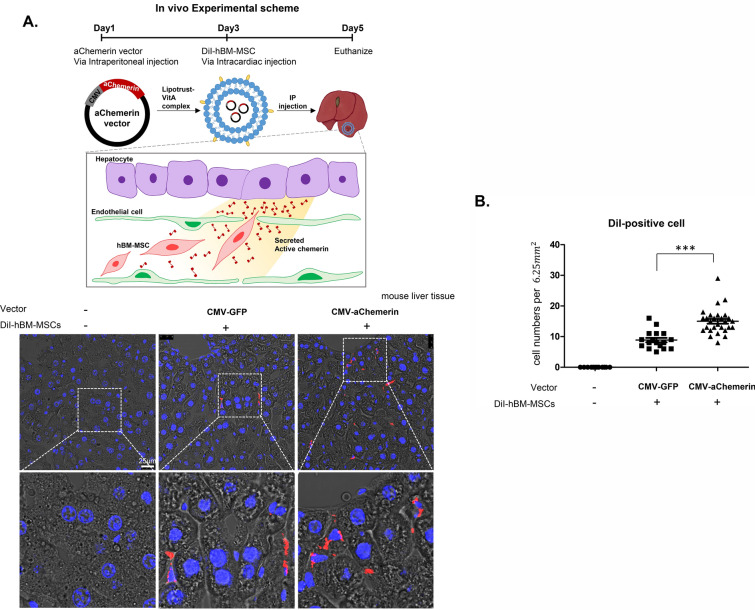
When we compare the cytokine array between normal and injured mouse liver at 1-day thioacetamide (TAA)-treatment, we found that chemerin, CXCL2, and CXCL10 were higher in the injured liver than normal one. Among three, only chemerin was the chemoattractant of hMSCs in 2D- and 3D-migration assay. Analysis of the signal transduction pathways in hMSCs showed that chemerin activated the phosphorylation of JNK1/2, ERK1/2 and p38, and finally upregulated CD44, ITGA4, and MMP-2 that are involved in the transendothelial migration and extravasation of MSCs. Upstream transcription regulators of CD44, ITGA4, and MMP-2 after chemerin treatment were MZF1, GATA3, STAT3, and STAT5A. To develop chemerin as a chemoattractant tool, we cloned gene encoding the active chemerin under the CMV promoter (CMV-aChemerin). We analyzed the migration of hMSCs in the 3D model for space of the Disse, which mimics transmigration of hMSCs in the liver. CMV-aChemerin-transfected hepatocytes were more effective to attract hMSC than control hepatocytes, leading to the enhanced transendothelial migration and homing of hMSCs to liver. The homing efficiency of the intravascularly-delivered hMSCs to liver was evaluated after systemic introduction of the CMV-aChemerin plasmid packed in liposome-vitamin A conjugates which target liver. CMV-aChemerin plasmid targeting liver significantly enhanced homing efficiency of hMSCs to liver compared with control plasmid vector.
Chemerin is the newly found chemoattractant of hMSCs and may be a useful tool to manipulate the homing of the intravascularly-administered hMSC to the specific target organ.
人间充质干细胞(hMSCs)归巢至损伤部位的能力使得hMSCs在临床实践中能够进行全身给药。实际上,在靶组织中仅检测到一小部分间充质干细胞,这是基于间充质干细胞治疗的主要瓶颈。我们仍然不清楚间充质干细胞如何被趋化至特定靶器官并通过跨内皮迁移实现植入的机制。在本研究中,我们旨在确定循环中的hMSCs归巢至损伤肝脏的机制。
当我们比较硫代乙酰胺(TAA)处理1天时正常小鼠肝脏与损伤小鼠肝脏之间的细胞因子阵列时,我们发现趋化素、CXCL2和CXCL10在损伤肝脏中高于正常肝脏。在这三者中,只有趋化素在二维和三维迁移试验中是hMSCs的趋化因子。对hMSCs中信号转导通路的分析表明,趋化素激活了JNK1/2、ERK1/2和p38的磷酸化,最终上调了参与间充质干细胞跨内皮迁移和外渗的CD44、ITGA4和MMP-2。趋化素处理后,CD44、ITGA4和MMP-2的上游转录调节因子为MZF1、GATA3、STAT3和STAT5A。为了将趋化素开发为一种趋化工具,我们在CMV启动子(CMV-a趋化素)下克隆了编码活性趋化素的基因。我们在模拟hMSCs在肝脏中跨膜迁移的狄氏间隙空间三维模型中分析了hMSCs的迁移。与对照肝细胞相比,转染CMV-a趋化素的肝细胞对hMSCs的趋化作用更强,导致hMSCs跨内皮迁移和归巢至肝脏的能力增强。在全身引入包裹在靶向肝脏的脂质体-维生素A缀合物中的CMV-a趋化素质粒后,评估血管内递送的hMSCs归巢至肝脏的效率。与对照质粒载体相比,靶向肝脏的CMV-a趋化素质粒显著提高了hMSCs归巢至肝脏的效率。
趋化素是新发现的hMSCs趋化因子,可能是一种用于调控血管内给药的hMSCs归巢至特定靶器官的有用工具。