Zheng Xiao-Bin, He Xiao-Wen, Zhang Long-Juan, Qin Hua-Bo, Lin Xu-Tao, Liu Xuan-Hui, Zhou Chi, Liu Hua-Shan, Hu Tuo, Cheng Hai-Chun, He Xiao-Sheng, Wu Xian-Rui, Chen Yu-Feng, Ke Jia, Wu Xiao-Jian, Lan Ping
Department of Colorectal Surgery, The Sixth Affiliated Hospital of Sun Yat-sen University, Guangzhou, Guangdong, P.R. China.
Guangdong Provincial Key Laboratory of Colorectal and Pelvic Floor Diseases, The Sixth Affiliated Hospital of Sun Yat-sen University, Guangzhou, Guangdong, P.R. China.
Gastroenterol Rep (Oxf). 2019 Apr;7(2):127-138. doi: 10.1093/gastro/goy017. Epub 2018 Jun 8.
Increasing interest has developed in the therapeutic potential of bone marrow-derived mesenchymal stem cells (MSCs) for the treatment of inflammatory bowel disease (IBD) and IBD-induced cancer. However, whether MSCs have the ability to suppress or promote tumor development remains controversial. The stromal cell-derived factor 1 (SDF-1)/C-X-C chemokine receptor type 4 (CXCR4) axis is well known to play a critical role in the homing of MSCs. In this study, we aimed to evaluate the role of CXCR4-overexpressing MSCs on the tumorigenesis of IBD.
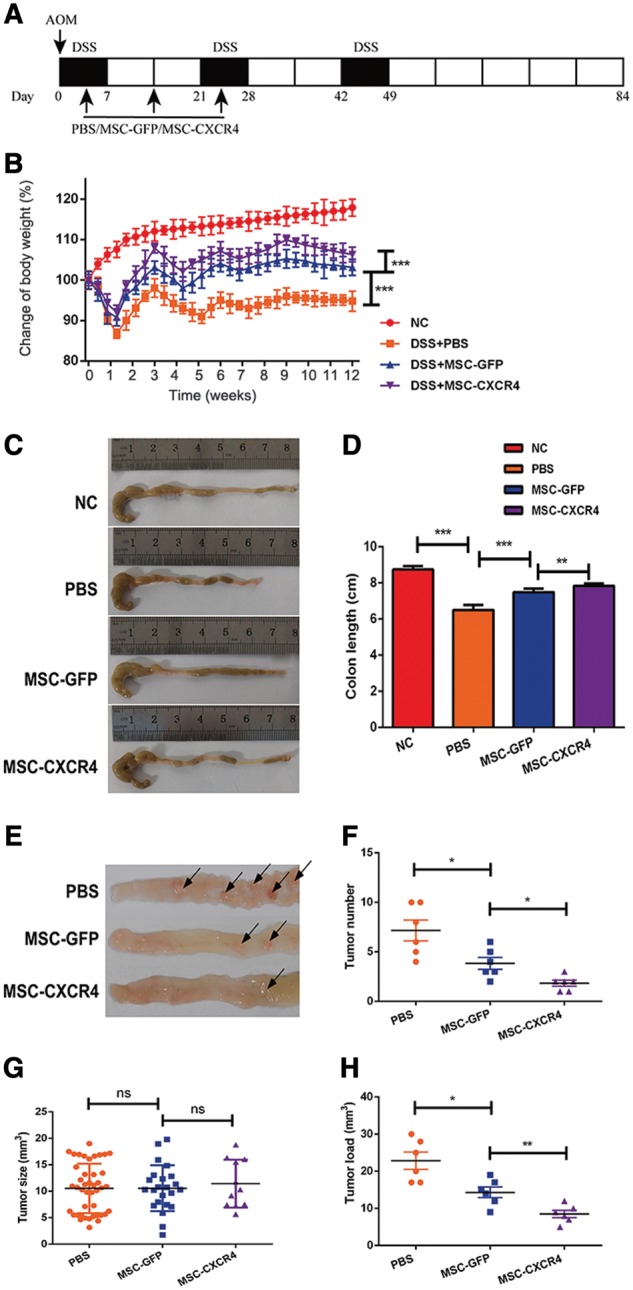
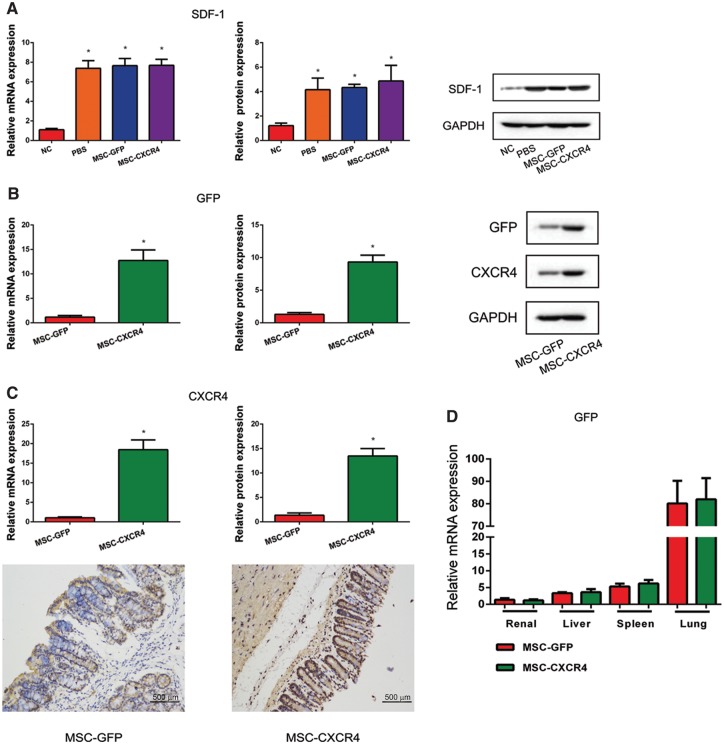
MSCs were transduced with lentiviral vector carrying either CXCR4 or green fluorescent protein (GFP). Chemotaxis and invasion assays were used to detect CXCR4 expression. A mouse model of colitis-associated tumorigenesis was established using azoxymethane and dextran sulfate sodium (DSS). The mice were divided into three groups and then injected with phosphate buffer saline (PBS), MSC-GFP or MSC-CXCR4.
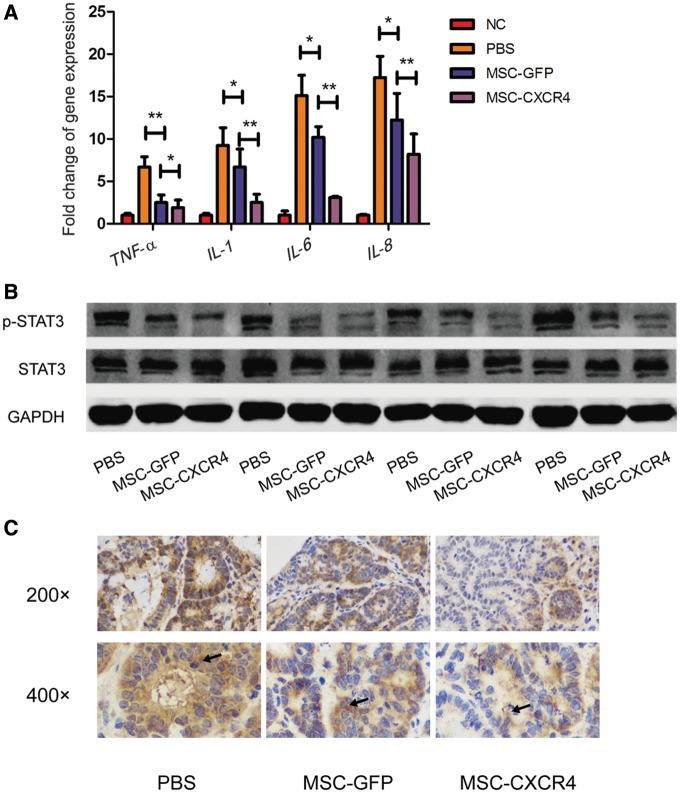
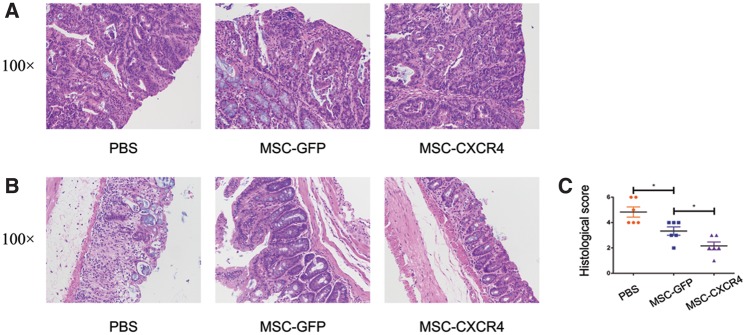
Compared with the mice injected with MSC-GFP, the mice injected with MSC-CXCR4 showed relieved weight loss, longer colons, lower tumor numbers and decreased tumor load; expression of pro-inflammatory cytokines decreased, and signal transducer and activator of transcription 3 (STAT3) phosphorylation level in colon tissue was down-regulated.
CXCR4-overexpressing MSCs exhibited effective anti-tumor function, which may be associated with enhanced homing to inflamed intestinal tissues.
骨髓间充质干细胞(MSCs)在治疗炎症性肠病(IBD)及IBD相关癌症方面的治疗潜力受到越来越多的关注。然而,MSCs究竟具有抑制还是促进肿瘤发展的能力仍存在争议。众所周知,基质细胞衍生因子1(SDF-1)/C-X-C趋化因子受体4(CXCR4)轴在MSCs归巢过程中起关键作用。在本研究中,我们旨在评估过表达CXCR4的MSCs在IBD肿瘤发生中的作用。
用携带CXCR4或绿色荧光蛋白(GFP)的慢病毒载体转导MSCs。采用趋化性和侵袭试验检测CXCR4表达。使用氧化偶氮甲烷和葡聚糖硫酸钠(DSS)建立结肠炎相关肿瘤发生的小鼠模型。将小鼠分为三组,然后分别注射磷酸盐缓冲盐水(PBS)、MSC-GFP或MSC-CXCR4。
与注射MSC-GFP的小鼠相比,注射MSC-CXCR4的小鼠体重减轻缓解、结肠更长、肿瘤数量减少且肿瘤负荷降低;促炎细胞因子表达降低,结肠组织中信号转导子和转录激活子3(STAT3)磷酸化水平下调。
过表达CXCR4的MSCs表现出有效的抗肿瘤功能,这可能与增强向炎症肠组织的归巢有关。