Animal Production and Health Laboratory, Joint FAO/IAEA Agricultural and Biotechnology Laboratory, Division of Nuclear Techniques in Food and Agriculture, Department of Nuclear Sciences and Applications, International Atomic Energy Agency, Vienna, Austria.
Institute of Biotechnology, University of Natural Resources and Life Sciences (BOKU), Vienna, Austria.
Front Immunol. 2021 Jun 15;12:666543. doi: 10.3389/fimmu.2021.666543. eCollection 2021.
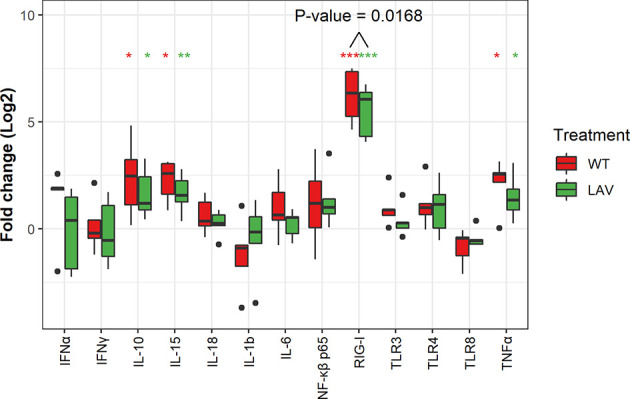
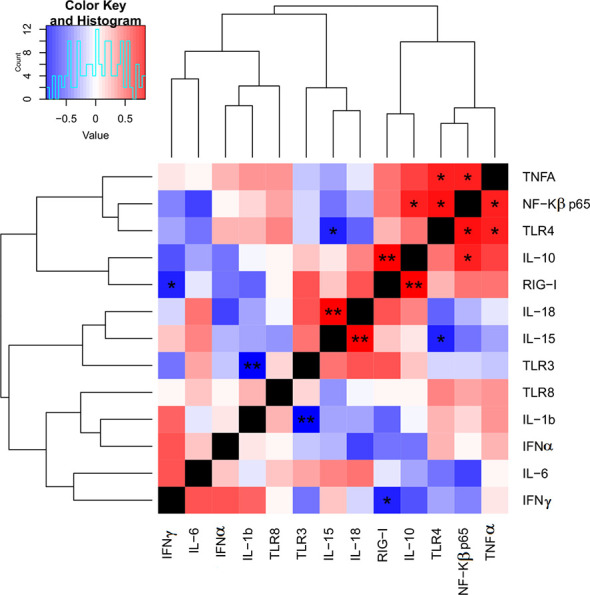
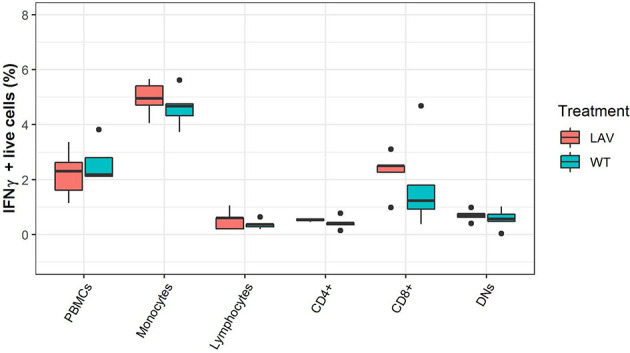
Sheeppox (SPP) is a highly contagious disease of small ruminants caused by sheeppox virus (SPPV) and predominantly occurs in Asia and Africa with significant economic losses. SPPV is genetically and immunologically closely related to goatpox virus (GTPV) and lumpy skin disease virus (LSDV), which infect goats and cattle respectively. SPPV live attenuated vaccines (LAVs) are used for vaccination against SPP and goatpox (GTP). Mechanisms related to innate immunity elicited by SPPV are unknown. Although adaptive immunity is responsible for long-term immunity, it is the innate responses that prevent viral invasion and replication before LAVs generate specific long-term protection. We analyzed the relative expression of thirteen selected genes that included pattern recognition receptors (PRRs), Nuclear factor-κβ p65 (NF-κβ), and cytokines to understand better the interaction between SPPV and its host. The transcripts of targeted genes in sheep PBMC incubated with either wild type (WT) or LAV SPPV were analyzed using quantitative PCR. Among PRRs, we observed a significantly higher expression of RIG-1 in PBMC incubated with both WT and LAV, with the former producing the highest expression level. However, there was high inter-individual variability in cytokine transcripts levels among different donors, with the expression of TNFα, IL-15, and IL-10 all significantly higher in both PBMC infected with either WT or LAV compared to control PBMC. Correlation studies revealed a strong significant correlation between RIG-1 and IL-10, between TLR4, TNFα, and NF-κβ, between IL-18 and IL-15, and between NF-κβ and IL-10. There was also a significant negative correlation between RIG-1 and IFNγ, between TLR3 and IL-1 β, and between TLR4 and IL-15 (P< 0.05). This study identified RIG-1 as an important PRR in the signaling pathway of innate immune activation during SPPV infection, possibly through intermediate viral dsRNA. The role of immunomodulatory molecules produced by SPPV capable of inhibiting downstream signaling activation following RIG-1 upregulation is discussed. These findings advance our knowledge of the induction of immune responses by SPPV and will help develop safer and more potent vaccines against SPP and GTP.
绵羊痘(SPP)是一种由绵羊痘病毒(SPPV)引起的小反刍动物的高度传染性疾病,主要发生在亚洲和非洲,造成重大经济损失。SPPV 在遗传和免疫上与山羊痘病毒(GTPV)和牛结节疹病毒(LSDV)密切相关,后两者分别感染山羊和牛。用于预防 SPP 和山羊痘(GTP)的绵羊痘活弱毒疫苗(LAV)已被使用。与 SPPV 诱导的先天免疫相关的机制尚不清楚。尽管适应性免疫负责长期免疫,但正是先天反应在 LAV 产生特定的长期保护之前阻止了病毒的入侵和复制。我们分析了 13 个选定基因的相对表达,包括模式识别受体(PRRs)、核因子-κβ p65(NF-κβ)和细胞因子,以更好地了解 SPPV 与其宿主之间的相互作用。用定量 PCR 分析了与野生型(WT)或 LAV SPPV 孵育的绵羊 PBMC 中靶向基因的转录物。在 PRRs 中,我们观察到 RIG-1 在与 WT 和 LAV 孵育的 PBMC 中的表达显著升高,前者产生的表达水平最高。然而,不同供体之间细胞因子转录物水平的个体间差异很大,与对照 PBMC 相比,WT 或 LAV 感染的 PBMC 中 TNFα、IL-15 和 IL-10 的表达均显著升高。相关性研究表明,RIG-1 与 IL-10 之间存在很强的显著相关性,TLR4、TNFα 和 NF-κβ 之间、IL-18 和 IL-15 之间、NF-κβ 和 IL-10 之间也存在很强的显著相关性。RIG-1 与 IFNγ 之间、TLR3 与 IL-1β 之间、TLR4 与 IL-15 之间也存在显著负相关(P<0.05)。本研究确定 RIG-1 是 SPPV 感染期间先天免疫激活信号通路中的重要 PRR,可能通过中间病毒 dsRNA。讨论了 SPPV 产生的免疫调节分子的作用,这些分子能够抑制 RIG-1 上调后的下游信号激活。这些发现提高了我们对 SPPV 诱导免疫反应的认识,并将有助于开发更安全、更有效的 SPP 和 GTP 疫苗。